
![Report of the Special Mission to Egypt under Lord Milner, and related papers [‎37v] (74/473)](https://iiif.qdl.qa/iiif/images/81055/vdc_100000001491.0x000295/Mss Eur F112_260_0074.jp2/full/!1200,1200/0/default.jpg "Report of the Special Mission to Egypt under Lord Milner, and related papers [‎37v] (74/473)")
Report of the Special Mission to Egypt under Lord Milner, and related papers [37v] (74/473)
The record is made up of 1 file (237 folios). It was created in 15 May 1920-14 Oct 1921. It was written in English. The original is part of the British Library: India Office The department of the British Government to which the Government of India reported between 1858 and 1947. The successor to the Court of Directors. Records and Private Papers Documents collected in a private capacity. .
Transcription
This transcription is created automatically. It may contain errors.
\ •
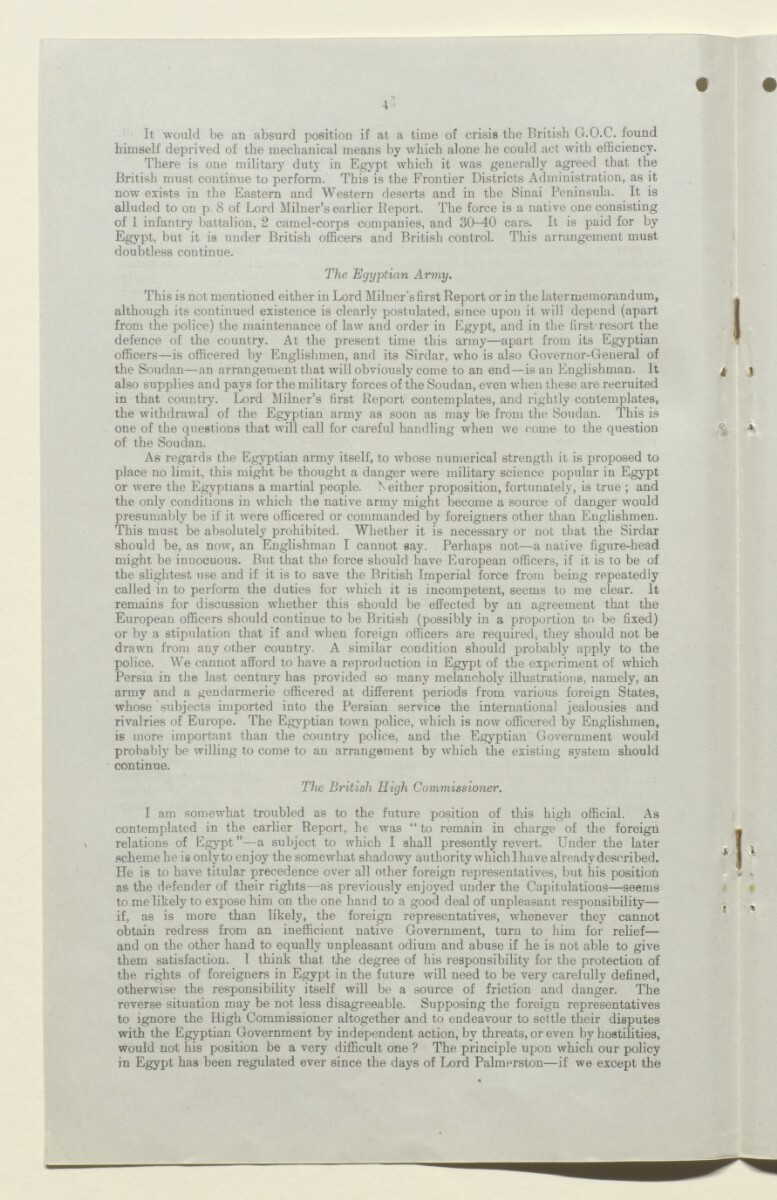
It would be an absurd position if at a time of crisis the British G.O.C. found
himself deprived of the mechanical means by which alone he could act with efficiency.
There is one military duty in Egypt which it was generally agreed that the
British must continue to perform. This is the Frontier Districts Administration, as it
now exists in the Eastern and Western deserts and in the Sinai Peninsula. It is
alluded to on p. 8 of Lord Milner’s earlier Deport. The force is a native one consisting
of 1 infantry battalion, 2 camel-corps companies, and 30-40 cars. It is paid for by
Egypt, but it is under British officers and British control. This arrangement must
doubtless continue.
The Egyptian Army.
This is not mentioned either in Lord Milners first Report or in the later memorandum,
although its continued existence is clearly postulated, since upon it will depend (apart
from the police) the maintenance of law and order in Egypt, and in the first-resort the
defence of the country. At the present time this army—apart from its Egyptian
officers—is officered by Englishmen, and its
Sirdar
Leader of a tribe or a polity; also refers to a military rank or title given to a commander of an army or division.
, who is also Governor-General of
the Soudan—an arrangement that will obviously come to an end—is an Englishman. It 4
also supplies and pays for the military forces of the Soudan, even when these are recruited
in that country. Lord Milner’s first Report contemplates, and rightly contemplates,
the withdrawal of the Egyptian army as soon as may be from the Soudan. This is
one of the questions that will call for careful handling when we come to the question
of the Soudan.
As regards the Egyptian army itself, to whose numerical strength it is proposed to
place no limit, this might be thought a danger were military science popular in Egypt
or were the Egyptians a martial people. Neither proposition, fortunately, is true ; and
the only conditions in which the native army might become a source of danger would
presumably be if it were officered or commanded by foreigners other than Englishmen.
This must be absolutely prohibited. Whether it is necessary or not that the
Sirdar
Leader of a tribe or a polity; also refers to a military rank or title given to a commander of an army or division.
should be, as now, an Englishman I cannot say. Perhaps not—a native figure-head
might be innocuous. But that the force should have European officers, if it is to be of
the slightest use and if it is to save the British Imperial force from being repeatedly
called in to perform the duties for which it is incompetent, seems to me clear. It
remains for discussion whether this should be effected by an agreement that the
European officers should continue to be British (possibly in a proportion to be fixed)
or by a stipulation that if and when foreign officers are required, they should not be
drawn from any other country. A similar condition should probably apply to the
police. We cannot afford to have a reproduction in Egypt of the experiment of which
Persia in the last century has provided so many melancholy illustrations, namely, an
army and a gendarmerie officered at different periods from various foreign States,
whose subjects imported into the Persian service the international jealousies and
rivalries of Europe. The Egyptian town police, which is now officered by Englishmen,
is more important than the country police, and the Egyptian Government would
probably be willing to come to an arrangement by which the existing system should
continue.
The British High Commissioner.
I am somewhat troubled as to the future position of this high official. As
contemplated in the earlier Report, he was “ to remain in charge of the foreign
relations of Egypt ”—a subject to which I shall presently revert. Under the later
scheme he is only to enjoy the somewhat shadowy authority whichlhave already described.
He is to have titular precedence over all other foreign representatives, but his position
as the defender of their rights—as previously enjoyed under the Capitulations—seems
to me likely to expose him on the one hand to a good deal of unpleasant responsibility— ?
if, as is more than likely, the foreign representatives, whenever they cannot
obtain redress from an inefficient native Government, turn to him for relief—
and on the other hand to equally unpleasant odium and abuse if he is not able to give
them satisfaction. I think that the degree of his responsibility for the protection of
the rights of foreigners in Egypt in the future will need to be very carefully defined,
otherwise the responsibility itself will be a source of friction and danger. The
reverse situation may be not less disagreeable. Supposing the foreign representatives
to ignore the High Commissioner altogether and to endeavour to settle their disputes
with the Egyptian Government by independent action, by threats, or even by hostilities,
would not his position be a very difficult one ? The principle upon which our policy
in Egypt has been regulated ever since the days of Lord Palmerston—if we except the
About this item
- Content
The file contains official correspondence, memoranda, and reports relating to political affairs in Egypt. The correspondents and authors are officials at the Foreign Office (Lord Curzon was Secretary of State for Foreign Affairs at the time), War Office, Air Ministry, Admiralty, Colonial Office, Board of Trade, Board of Education, as well as those within the Egyptian civil service.
The file contains copies of reports of the Special Mission to Egypt (folios 1-7, 75-93, and 175-194), led by Lord Alfred Milner, whose purpose was to investigate and advise following the Egyptian Revolution of 1919. Much of the content of the file is in response to the findings and recommendations of the Mission and discusses the possibilities of a political settlement with Egypt.
- Extent and format
- 1 file (237 folios)
- Arrangement
The file is arranged in chronological order, from the front to the rear.
- Physical characteristics
Foliation: the foliation sequence (used for referencing) commences at the front cover with 1, and terminates at the inside back cover with 235; these numbers are written in pencil, are circled, and are located in the top right corner of the recto The front of a sheet of paper or leaf, often abbreviated to 'r'. side of each folio. The file has one foliation anomaly, f 76a.
- Written in
- English in Latin script View the complete information for this record
Use and share this item
- Share this item
Report of the Special Mission to Egypt under Lord Milner, and related papers [37v] (74/473), British Library: India Office Records and Private Papers, Mss Eur F112/260, in Qatar Digital Library <https://www.qdl.qa/archive/81055/vdc_100080131819.0x00004b> [accessed 9 August 2026]
https://www.qdl.qa/en/archive/81055/vdc_100080131819.0x00004b
Copy and paste the code below into your web page where you would like to embed the image.
<meta charset="utf-8"><a href="https://www.qdl.qa/en/archive/81055/vdc_100080131819.0x00004b">Report of the Special Mission to Egypt under Lord Milner, and related papers [‎37v] (74/473)</a> <a href="https://www.qdl.qa/en/archive/81055/vdc_100080131819.0x00004b"> <img src="https://iiif.qdl.qa/iiif/images/81055/vdc_100000001491.0x000295/Mss Eur F112_260_0074.jp2/full/!280,240/0/default.jpg" alt="" /> </a>
This record has a IIIF manifest available as follows. If you have a compatible viewer you can drag the icon to load it.https://www.qdl.qa/en/iiif/81055/vdc_100000001491.0x000295/manifestOpen in Universal viewerOpen in Mirador viewerMore options for embedding images
Copyright: How to use this content
- Reference
- Mss Eur F112/260
- Title
- Report of the Special Mission to Egypt under Lord Milner, and related papers
- Pages
- front, front-i, 2r:39v, 42r:50v, 53r:76v, 76ar:76av, 77r:140v, 143r:143v, 144ar, 144r:235v
- Author
- East India Company, the Board of Control, the India Office, or other British Government Department
- Usage terms
- Open Government Licence