
![Report of the Special Mission to Egypt under Lord Milner, and related papers [‎235r] (472/473)](https://iiif.qdl.qa/iiif/images/81055/vdc_100000001491.0x000295/Mss Eur F112_260_0472.jp2/full/!1200,1200/0/default.jpg "Report of the Special Mission to Egypt under Lord Milner, and related papers [‎235r] (472/473)")
Report of the Special Mission to Egypt under Lord Milner, and related papers [235r] (472/473)
The record is made up of 1 file (237 folios). It was created in 15 May 1920-14 Oct 1921. It was written in English. The original is part of the British Library: India Office The department of the British Government to which the Government of India reported between 1858 and 1947. The successor to the Court of Directors. Records and Private Papers Documents collected in a private capacity. .
Transcription
This transcription is created automatically. It may contain errors.
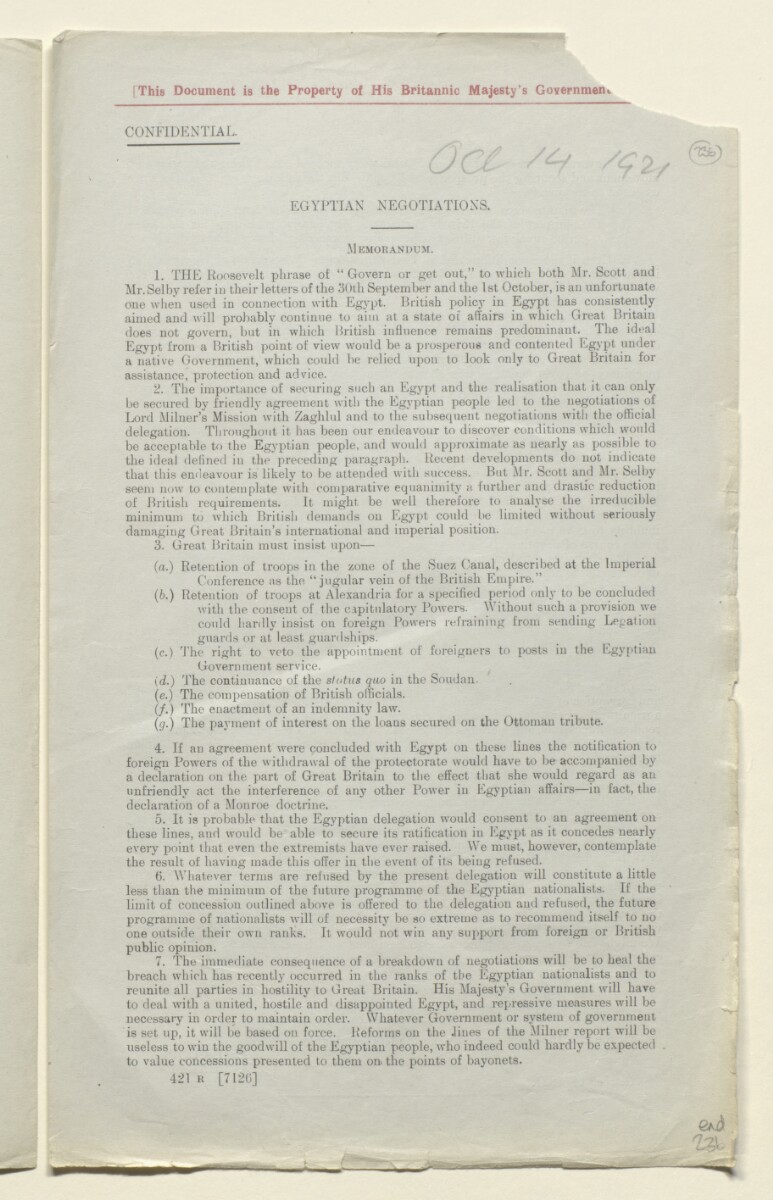
[This Document is the Property of His Britannic Majesty’s Governmen
CONFIDENTIAL.
EGYPTIAN NEGOTIATIONS.
Memorandum.
1. THE Roosevelt phrase of “ Govern or get out,” to which both Mr. Scott and
Mr. Selby refer in their letters of the 30th September and the 1st October, is an unfortunate
one when used in connection with Egypt. British policj’ in Egypt lias consistently
aimed and will probably continue to aim at a state ot affairs in which Great Britain
does not govern, but in which British influence remains predominant. The ideal
Egypt from a British point of view would be a prosperous and contented Egypt under
a native Government, which could be relied upon to look only to Great Britain lor
assistance, protection and advice.
2. The importance of securing such an Egypt and the realisation that it can only
be secured by friendly agreement with the Egyptian people led to the negotiations of
Lord Milner’s Mission with Zaghlul and to the subsequent negotiations with the official
delegation. Throughout it has been our endeavour to discover conditions which would
be acceptable to the Egyptian people, and would approximate as nearly as possible to
the ideal defined in the preceding paragraph. Recent developments do not indicate
that this endeavour is likely to be attended with success. But Mr. Scott and Mr. Selby
seem now to contemplate with comparative equanimity a further and drastic reduction
of British requirements. It might be well therefore to analyse the irreducible
minimum to which British demands on Egypt could be limited without seriously
damaging Great Britain’s international and imperial position.
3. Great Britain must insist upon—
(a.) Retention of troops in the zone of the Suez ('anal, described at the Imperial
Conference as the “jugular vein of the British Empire.”
(b.) Retention of troops at Alexandria for a specified period only to be concluded
with the consent of the capitulatory Powers. M ithout such a provision we
could hardly insist on foreign Powers refraining from sending Lepation
guards or at least guardships.
(c.) The right to veto the appointment of foreigners to posts in the Egyptian
Government service.
(d.) The continuance of the status quo in the Soudan.
(e.) The compensation of British officials.
(/.) The enactment of an indemnity law.
(g.) The payment of interest on the loans secured on the Ottoman tribute.
4. If an agreement were concluded with Egypt on these lines the notification to
foreign Powers of the withdrawal of the protectorate would have to be accompanied by
a declaration on the part of Great Britain to the effect that she would regard as an
unfriendly act the interference of any other Power in Egyptian affairs—in fact, the
declaration of a Monroe doctrine.
5. It is probable that the Egyptian delegation would consent to an agreement on
these lines, and would be able to secure its ratification in Egypt as it concedes nearly
every point that even the extremists have ever raised. We must, however, contemplate
the result of having made this offer in the event of its being refused.
6. Whatever terms are refused by the present delegation will constitute a little
less than the minimum of the future programme of the Egyptian nationalists. If the
limit of concession outlined above is offered to the delegation and refused, the future
programme of nationalists will of necessity be so extreme as to recommend itself to no
one outside their own ranks. It would not win any support from foreign or British
public opinion.
7. The immediate consequence of a breakdown of negotiations will be to heal the
breach which has recently occurred in the ranks of the Egyptian nationalists and to
reunite all parties in hostility to Great Britain. His Majesty’s Government will have
to deal with a united, hostile and disappointed Egypt, and repressive measures will be
necessary in order to maintain order. Whatever Government or system of government
is set up, it will be based on force. Reforms on the Jines of the Milner report will be
useless to win the goodwill of the Egyptian people, who indeed could hardly be expected
to value concessions presented to them on the points of bayonets.
421 R [ 7120 ]
About this item
- Content
The file contains official correspondence, memoranda, and reports relating to political affairs in Egypt. The correspondents and authors are officials at the Foreign Office (Lord Curzon was Secretary of State for Foreign Affairs at the time), War Office, Air Ministry, Admiralty, Colonial Office, Board of Trade, Board of Education, as well as those within the Egyptian civil service.
The file contains copies of reports of the Special Mission to Egypt (folios 1-7, 75-93, and 175-194), led by Lord Alfred Milner, whose purpose was to investigate and advise following the Egyptian Revolution of 1919. Much of the content of the file is in response to the findings and recommendations of the Mission and discusses the possibilities of a political settlement with Egypt.
- Extent and format
- 1 file (237 folios)
- Arrangement
The file is arranged in chronological order, from the front to the rear.
- Physical characteristics
Foliation: the foliation sequence (used for referencing) commences at the front cover with 1, and terminates at the inside back cover with 235; these numbers are written in pencil, are circled, and are located in the top right corner of the recto The front of a sheet of paper or leaf, often abbreviated to 'r'. side of each folio. The file has one foliation anomaly, f 76a.
- Written in
- English in Latin script View the complete information for this record
Use and share this item
- Share this item
Report of the Special Mission to Egypt under Lord Milner, and related papers [235r] (472/473), British Library: India Office Records and Private Papers, Mss Eur F112/260, in Qatar Digital Library <https://www.qdl.qa/archive/81055/vdc_100080131821.0x000049> [accessed 4 June 2026]
https://www.qdl.qa/en/archive/81055/vdc_100080131821.0x000049
Copy and paste the code below into your web page where you would like to embed the image.
<meta charset="utf-8"><a href="https://www.qdl.qa/en/archive/81055/vdc_100080131821.0x000049">Report of the Special Mission to Egypt under Lord Milner, and related papers [‎235r] (472/473)</a> <a href="https://www.qdl.qa/en/archive/81055/vdc_100080131821.0x000049"> <img src="https://iiif.qdl.qa/iiif/images/81055/vdc_100000001491.0x000295/Mss Eur F112_260_0472.jp2/full/!280,240/0/default.jpg" alt="" /> </a>
This record has a IIIF manifest available as follows. If you have a compatible viewer you can drag the icon to load it.https://www.qdl.qa/en/iiif/81055/vdc_100000001491.0x000295/manifestOpen in Universal viewerOpen in Mirador viewerMore options for embedding images
Copyright: How to use this content
- Reference
- Mss Eur F112/260
- Title
- Report of the Special Mission to Egypt under Lord Milner, and related papers
- Pages
- front, front-i, 2r:39v, 42r:50v, 53r:76v, 76ar:76av, 77r:140v, 143r:143v, 144ar, 144r:235v
- Author
- East India Company, the Board of Control, the India Office, or other British Government Department
- Usage terms
- Open Government Licence