
!['Mosul Question, Lausanne 1922-1923 and after - Papers, despatches, speeches - Hotel de la Mer at Lausanne - Correspondence about oil' [‎199v] (396/501)](https://iiif.qdl.qa/iiif/images/81055/vdc_100000001491.0x0002c2/Mss Eur F112_294_0400.jp2/full/!1200,1200/0/default.jpg "'Mosul Question, Lausanne 1922-1923 and after - Papers, despatches, speeches - Hotel de la Mer at Lausanne - Correspondence about oil' [‎199v] (396/501)")
'Mosul Question, Lausanne 1922-1923 and after - Papers, despatches, speeches - Hotel de la Mer at Lausanne - Correspondence about oil' [199v] (396/501)
The record is made up of 251 folios (1 file). It was created in 15 Nov 1922-3 Nov 1923. It was written in English. The original is part of the British Library: India Office The department of the British Government to which the Government of India reported between 1858 and 1947. The successor to the Court of Directors. Records and Private Papers Documents collected in a private capacity. .
Transcription
This transcription is created automatically. It may contain errors.
1
4
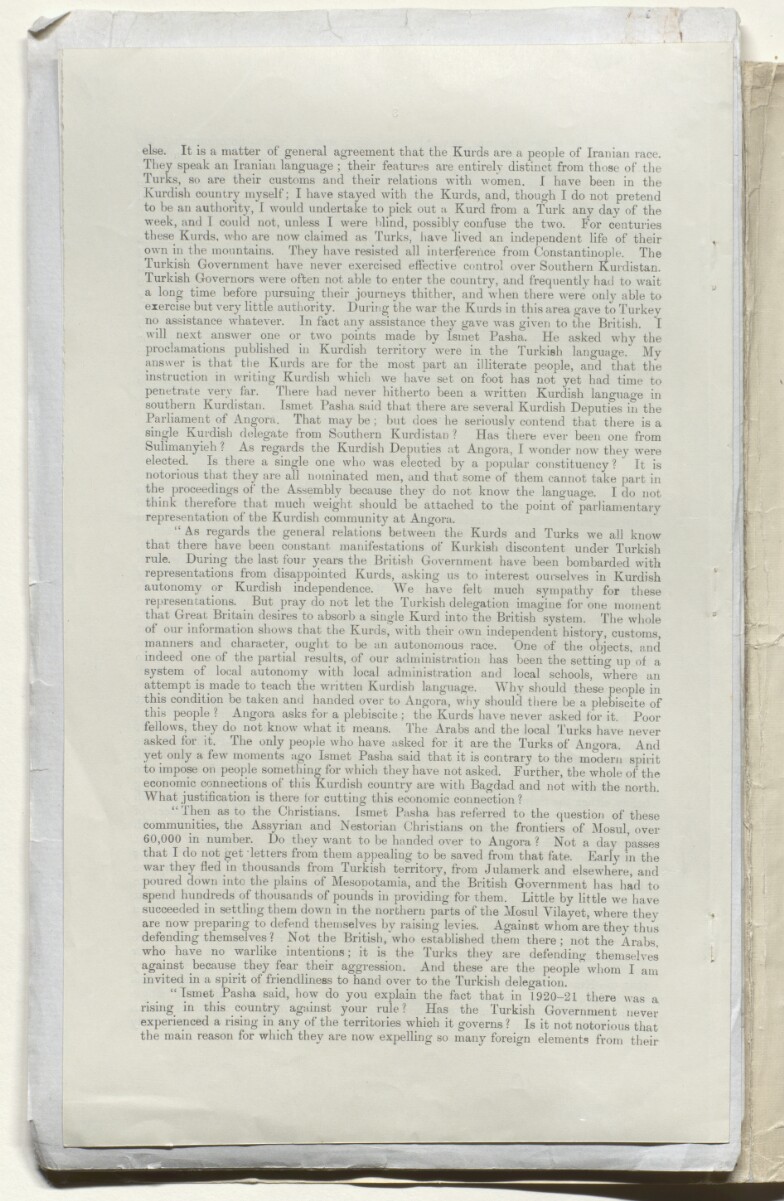
else. It is a matter of general agreement that the Kurds are a people of Iranian race.
They speak an Iranian language ; their features are entirely distinct from those of the
Turks, so are their customs and their relations with women. I have been in the
Kurdish country myself; I have stayed with the Kurds, and, though I do not pretend
to he an authority, I would undertake to pick out a Kurd from a Turk any day of the
week, and 1 could not, unless I were blind, possibly confuse the two. For centuries
these Kurds, who are now claimed as Turks, have lived an independent life of their
own in the mountains. They have resisted all interference from Constantinople. The
Turkish Government have never exercised effective control over Southern Kurdistan.
Turkish Governors were often not able to enter the country, and frequently had to wait
a long time before pursuing their journeys thither, and when there were only able to
exercise but very little authority. During the war the Kurds in this area gave to Turkey
no assistance whatever. In fact any assistance they gave was given to the British. I
will next, answer one or two points made by Ismet
Pasha
An Ottoman title used after the names of certain provincial governors, high-ranking officials and military commanders.
. He asked why the
proclamations published in Kurdish territory were in the Turkish language. My
answer is that the Kurds are for the most part an illiterate people, and that the
instruction in writing Kurdish which we have set on foot has not yet had time to
penetrate very far. There had never hitherto been a written Kurdish language in
southern Kurdistan. Ismet
Pasha
An Ottoman title used after the names of certain provincial governors, high-ranking officials and military commanders.
said that there are several Kurdish Deputies in the
Parliament of Angora. That may be ; but does he seriously contend that there is a
single Kurdish delegate from Southern Kurdistan ? Has there ever been one from
Sulimanyieh ? As regards the Kurdish Deputies at Angora, I wonder now they were
elected. Is there a single one who was elected by a popular constituency ? It is
notorious that they are all nominated men, and that some of them cannot take part in
the proceedings of the Assembly because they do not know the language. I do not
think therefore that much weight should be attached to the point of parliamentary
representation of the Kurdish community at Angora.
“ As regards the general relations between the Kurds and Turks we all know
that there have been constant manifestations of Kurkish discontent under Turkish
rule. During the last four years the British Government have been bombarded with
representations from disappointed Kurds, asking us to interest ourselves in Kurdish
autonomy or Kurdish independence. We have felt much sympathy for these
representations. But pray do not let the Turkish delegation imagine for one moment
that Great Britain desires to absorb a single Kurd into the British system. The whole
of our information shows that the Kurds, with their own independent history, customs,
manners and character, ought to be an autonomous race. One of the objects, and
indeed one of the partial results, of our administration has been the setting up of a
system of local autonomy with local administration and local schools, where an
attempt is made to teach the written Kurdish language. Why should these people in
this condition be taken and handed over to Angora, why should there be a plebiscite of
this people ? Angora asks for a plebiscite; the Kurds have never asked for it. Poor
fellows, they do not know what it means. The Arabs and the local Turks have never
asked for it. The only people who have asked for it are the Turks of Angora. And
yet only a few moments ago Ismet
Pasha
An Ottoman title used after the names of certain provincial governors, high-ranking officials and military commanders.
said that it is contrary to the modern spirit
to impose on people something for which they have not asked. Further, the whole of the
economic connections of this Kurdish country are with Bagdad and not with the north.
W hat justification is there for cutting this economic connection ?
<l I hen as to the Christians, ismet
Pasha
An Ottoman title used after the names of certain provincial governors, high-ranking officials and military commanders.
has referred to the question of these
communities, the Assyrian and Nestorian Christians on the frontiers of Mosul, over
60,000 in number. Do they want to be handed over to Angora ? Not a day passes
that I do not get letters from them appealing to be saved from that fate. Early in the
war they fled in thousands from Turkish territory, from Julamerk and elsewhere, and
poured down into the plains of Mesopotamia, and"the British Government has had to
spend hundreds of thousands of pounds in providing for them. Little by little we have
succeeded in settling them down in the northern parts of the Mosul Vilayet, where thev
are now preparing to defend themselves by raising levies. Against whom are thev thus
defending themselves ? Not the British, who established them there; not the Arabs,
who have no warlike intentions; it is the Turks they are defending themselves
against because they fear their aggression. And these are the people whom I am
invited in a spirit of friendliness to hand over to the Turkish delegation.
“ Ismet
Pasha
An Ottoman title used after the names of certain provincial governors, high-ranking officials and military commanders.
said, how do you explain the fact that in 1920-21 there was a
rising in this country against your rule? Has the Turkish Government never
experienced a rising in any of the territories which it governs ? Is it not notorious that
the main reason for which they are now expelling so many foreign elements from their
About this item
- Content
Letters and papers on the frontier between Iraq (also written as Irak in the file) and Turkey, with particular reference to Mosul and questions concerning oil. The file consists mainly of correspondence between Secretary of State for Foreign Affairs George Curzon, and officials in the Foreign Office, Air Ministry, Colonial Office and Ismet Pasha An Ottoman title used after the names of certain provincial governors, high-ranking officials and military commanders. [Mustafa İsmet İnönü]. The contents of the file are as follows:
- Sir John Evelyn Shuckburgh to Curzon (15 November 1922). Letter enclosing paper setting out main arguments against evacuating Iraq
- Eric Graham Forbes Adam for Curzon (3 December 1922). Interview with Mukhtar Bey [Mukhtār Beg]; submission of draft telegrams to Foreign Office
- Sir William Tyrrell to Foreign Office (Memo, 3 December 1922, circulated to the Cabinet); interview with Ismet Pasha An Ottoman title used after the names of certain provincial governors, high-ranking officials and military commanders. , 28 November 1922
- Air Staff for Cabinet (5 December 1922). Note: on Sir John Salmond’s proposal for a Forward Policy in the event of Turkish invasion of Iraq or a Resumption of Hostilities with Turkey, 4 December 1922
- Curzon to Foreign Office (6 December 1922). Telegram, 5 December 1922
- Middle East Department (7 December 1922). Note: Mosul – on above telegram
- Foreign Office to Curzon (8 December 1922). Telegram: Mosul
- Curzon to Ismet Pasha An Ottoman title used after the names of certain provincial governors, high-ranking officials and military commanders. (14 December 1922). Letter: enclosing Memo on Mosul Vilayet: reasons for refusing Turkish claim
- Curzon for Cabinet (26 December 1922). Curzon for Cabinet. Memo presented to Ismet Pasha An Ottoman title used after the names of certain provincial governors, high-ranking officials and military commanders. on Mosul, 14 December 1922
- Curzon to Cabinet (27 December 1922). Letter: Ismet Pasha An Ottoman title used after the names of certain provincial governors, high-ranking officials and military commanders. to Curzon enclosing reply to British memo, 23 December 1922
- Curzon for Cabinet (28 December 1922). Letter: Ismet Pasha An Ottoman title used after the names of certain provincial governors, high-ranking officials and military commanders. enclosing counter reply, 26 December 1922
- Ismet Pasha An Ottoman title used after the names of certain provincial governors, high-ranking officials and military commanders. (29 December 1922). Letter with annexed Memo
- Curzon for Cabinet (1 January 1923). Letter Ismet Pasha An Ottoman title used after the names of certain provincial governors, high-ranking officials and military commanders. to Curzon
- Sir Percy Cox to Colonial Office (30 December 1922)
- Sir Philip Lloyd-Greame to Sir Sydney Chapman (1 January 1923). Letter: possibility of settlement on basis of oil concessions to Turks and Italians
- Eric Graham Forbes Adam for Curzon (4 January 1923). Memo: conversation with Reader William Bullard and three Turkish experts
- Sir E Crowe to Curzon (3 January 1923). Telegram: from Colonial Office: oil
- Mr Lyndsay to Curzon (4 January 1923). Telegram: paraphrase of Colonial Office telegram to Bagdad [Baghdad], 2 January
- Curzon to Colonial Office (5 January 1923). Telegram: oil
- Sir Ronald William Graham to Curzon (8 January 1923). Letter: (printed for Cabinet) to Curzon: Italian press
- Reader William Bullard to Curzon (9 January 1923). Note: Mosul
- Sir Auckland Geddes (12 January 1923) Telegram: American attitude
- Notes by Curzon (16 January 1923). Handwritten: visit of Aga Petros to Ismet Pasha An Ottoman title used after the names of certain provincial governors, high-ranking officials and military commanders.
- Shuckburgh to Forbes Adam (18 January 1923). Letter enclosing draft of telegram to Curzon
- Forbes Adam for Curzon (18 January 1923). Note attaching statement of the history and position with regard to the Mandates in Syria and Iraq and the question of frontiers
- British Case for Northern Frontier of Iraq with Map (19 January 1923). Folder containing notes ‘mostly taken from the memoranda which you (i.e. Curzon) exchanged with Ismet Pasha’ – December 1922
- Forbes Adam for Curzon (20 January 1923). Note: Plebiscite and Mosul
- Forbes Adam for Curzon: ‘Note attaching detailed minute as to the oil in Iraq and the history and present position of the claim of the Turkish Petroleum Company’
- Mr Childs's Statement for the American representatives (23 January 1923)
- Daily Telegraph cutting on League of Nations and Mosul Problem (27 January 1923)
- Curzon for Cabinet (26 January 1923). Speech: reply to Ismet Pasha An Ottoman title used after the names of certain provincial governors, high-ranking officials and military commanders. respecting Mosul, 23 January 1923
- Secretary of State for Colonies to Acting High Commissioner for Iraq (26 January 1923). Paraphrase: telegram: British proposal that question of Northern Frontier of Iraq should be referred to the League of Nations
- High Commissioner, Bagdad to Lord Crew (29 January 1923) Telegram: Enclosing telegram from Iraq Government to Lord Balfour for communication to League of Nations
- Lord Crewe to Curzon (31 January 1923). Telegram: Iraq frontier
- Telegram to Ankara signed by Ismet Hassan [‘Iṣmat Ḥasan] and Rozor Nur [Riḍa Nūr]
- Oil engineering and finance (17 February 1923). Article: The Mesopotamian Oilfields
- The Graphic (17 February 1923). Article: The Mystic City of Mosul
- Colonel Francis Richard Maunsell for Cabinet (24 September 1923). Notes on the Mosul frontier question
- Sir James Edward Masterton-Smith to Foreign Office (3 November 1923). Printed for the information of Curzon, copy of a despatch from the High Commissioner for Iraq, on the subject of the delimitation of the Turco-Irak frontier.
Following documents are undated:
- Lord Balfour to League of Nations. Speech: The frontier between Turkish territory and the territory of Iraq
- The President of the League of Nations. Reply: after Speech by Balfour
- Typewritten report: The question of Mosul
- Typewritten report: The Question of Mosul
The file also includes handwritten notes by Curzon on the Mosul vilayet and groups residing there.
- Extent and format
- 251 folios (1 file)
- Arrangement
The papers are arranged in approximate chronological order from the front to the rear of the file.
- Physical characteristics
Foliation: the foliation sequence (used for referencing) commences at the front cover with 1, and terminates at the inside back cover with 251; these numbers are written in pencil, are circled, and are located in the top right corner of the recto The front of a sheet of paper or leaf, often abbreviated to 'r'. side of each folio.
- Written in
- English in Latin script View the complete information for this record
Use and share this item
- Share this item
'Mosul Question, Lausanne 1922-1923 and after - Papers, despatches, speeches - Hotel de la Mer at Lausanne - Correspondence about oil' [199v] (396/501), British Library: India Office Records and Private Papers, Mss Eur F112/294, in Qatar Digital Library <https://www.qdl.qa/archive/81055/vdc_100130546287.0x0000c5> [accessed 5 June 2026]
https://www.qdl.qa/en/archive/81055/vdc_100130546287.0x0000c5
Copy and paste the code below into your web page where you would like to embed the image.
<meta charset="utf-8"><a href="https://www.qdl.qa/en/archive/81055/vdc_100130546287.0x0000c5">'Mosul Question, Lausanne 1922-1923 and after - Papers, despatches, speeches - Hotel de la Mer at Lausanne - Correspondence about oil' [‎199v] (396/501)</a> <a href="https://www.qdl.qa/en/archive/81055/vdc_100130546287.0x0000c5"> <img src="https://iiif.qdl.qa/iiif/images/81055/vdc_100000001491.0x0002c2/Mss Eur F112_294_0400.jp2/full/!280,240/0/default.jpg" alt="" /> </a>
This record has a IIIF manifest available as follows. If you have a compatible viewer you can drag the icon to load it.https://www.qdl.qa/en/iiif/81055/vdc_100000001491.0x0002c2/manifestOpen in Universal viewerOpen in Mirador viewerMore options for embedding images
Copyright: How to use this content
- Reference
- Mss Eur F112/294
- Title
- 'Mosul Question, Lausanne 1922-1923 and after - Papers, despatches, speeches - Hotel de la Mer at Lausanne - Correspondence about oil'
- Pages
- 1r:28v, 28ar:28av, 29r:72v, 91r:167v, 170r:218r, 218r:251v
- Author
- East India Company, the Board of Control, the India Office, or other British Government Department
- Usage terms
- Open Government Licence