
!['Mosul Question, Lausanne 1922-1923 and after - Papers, despatches, speeches - Hotel de la Mer at Lausanne - Correspondence about oil' [‎220r] (438/501)](https://iiif.qdl.qa/iiif/images/81055/vdc_100000001491.0x0002c2/Mss Eur F112_294_0446.jp2/full/!1200,1200/0/default.jpg "'Mosul Question, Lausanne 1922-1923 and after - Papers, despatches, speeches - Hotel de la Mer at Lausanne - Correspondence about oil' [‎220r] (438/501)")
'Mosul Question, Lausanne 1922-1923 and after - Papers, despatches, speeches - Hotel de la Mer at Lausanne - Correspondence about oil' [220r] (438/501)
The record is made up of 251 folios (1 file). It was created in 15 Nov 1922-3 Nov 1923. It was written in English. The original is part of the British Library: India Office The department of the British Government to which the Government of India reported between 1858 and 1947. The successor to the Court of Directors. Records and Private Papers Documents collected in a private capacity. .
Transcription
This transcription is created automatically. It may contain errors.
a
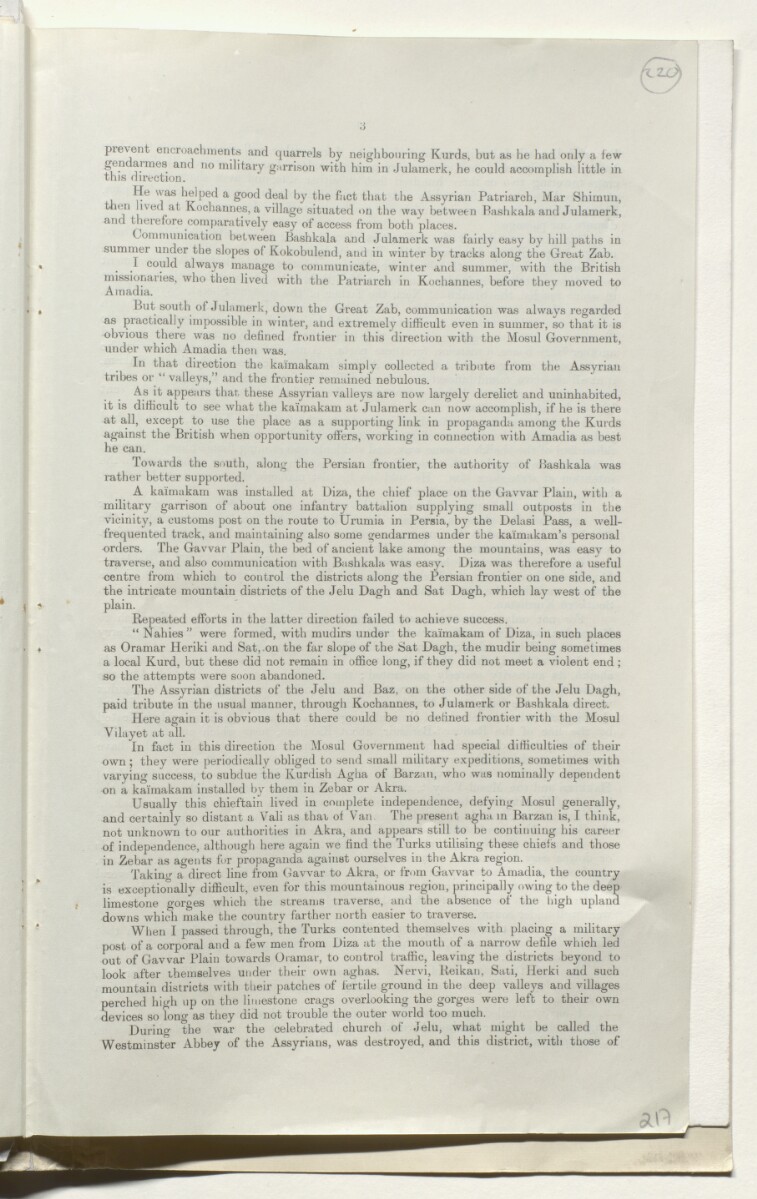
prevent eiiciodchments and quarrels by neighbouring Kurds, but as he had only a few
gem armes and no military garrison with him in Julamerk, he could accomplish little in
this direction.
^ ^i^ a good deal by the fact that the Assyrian Patriarch, Mar Shimun,
itm ived at Kochannes, a village situated on the way between Pashkala and Julamerk,
and therefore comparatively easy of access from both places.
Communication between Bashkala and Julamerk was fairly easy by hill paths in
summer under the slopes of Kokobulend, and in winter by tracks along the Great Zab.
. . could always manage to communicate, winter and summer, with the British
missionaries, who then lived with the Patriarch in Kochannes, before they moved to
A madia.
But south of Julamerk, down the Great Zab, communication was always regarded
as practically impossible in winter, and extremely difficult even in summer, so that it is
obvious there was no defined frontier in this direction with the Mosul Government,
under which Amadia then was.
In that direction the kaimakam simply collected a tribute from the Assyrian
tribes or “ valleys,” and the frontier remained nebulous.
As it appears that these Assyrian valleys are now largely derelict and uninhabited,
it is difficult to see what the kaimakam at Julamerk can now accomplish, if he is there
at all, except to use the place as a supporting link in propaganda among the Kurds
against the British when opportunity offers, working in connection with Amadia as best
he can.
Towards the south, along the Persian frontier, the authority of Bashkala was
rather better supported.
A kaimakam was installed at Diza, the chief place on the Gavvar Plain, with a
military garrison of about one infantry battalion supplying small outposts in the
vicinity, a customs post on the route to Urumia in Persia, by the Delasi Pass, a well-
frequented track, and maintaining also some gendarmes under the kaimakam’s personal
orders. The Gavvar Plain, the bed of ancient lake among the mountains, was easy to
traverse, and also communication with Bashkala was easy. Diza was therefore a useful
centre from which to control the districts along the Persian frontier on one side, and
the intricate mountain districts of the Jelu Dagh and Sat Dagh, which lay west of the
plain.
Repeated efforts in the latter direction failed to achieve success.
“ Nahies” were formed, with mudirs under the kaimakam of Diza, in such places
as Oramar Heriki and Sat, on the far slope of the Sat Dagh, the mudir being sometimes
a local Kurd, hut these did not remain in office long, if they did not meet a violent end ;
so the attempts were soon abandoned.
The Assyrian districts of the Jelu and Baz, on the other side of the Jelu Dagh,
paid tribute in the usual manner, through Kochannes, to Julamerk or Bashkala direct.
Here again it is obvious that there could be no defined frontier with the Mosul
Vilayet at all.
In fact in this direction the Mosul Government had special difficulties of their
own; they were periodically obliged to send small military expeditions, sometimes with
varying success, to subdue the Kurdish Agha of Barzan, who was nominally dependent
on a kaimakam installed by them in Zebar or Akra.
Usually this chieftain lived in complete independence, defying Mosul generally,
and certainly so distant a Vali as that, of Van. The present agha in Barzan is, I think,
not unknown to our authorities in Akra, and appears still to be continuing his career
of independence, although here again we find the Turks utilising these chiefs and those
in Zebar as agents for propaganda against ourselves in the Akra region.
Taking a direct line from Gavvar to Akra, or from Gavvar to Amadia, the country
is exceptionally difficult, even for this mountainous region, principally owing to the deep
limestone gorges which the streams traverse, and the absence of the high upland
downs which make the country farther north easier to traverse.
When I passed through, the Turks contented themselves with placing a military
post of a corporal and a few men from Diza at the mouth of a narrow defile which led
out of Gavvar Plain towards Oramar, to control traffic, leaving the districts beyond to
look after themselves under their own aghas. Nervi, Reikan, Sati, Herki and such
mountain districts with their patches of fertile ground in the deep valleys and villages
perched high up on the limestone crags overlooking the gorges were left to their own
devices so Tong as they did not trouble the outer world too much.
During the war the celebrated church of oelu, what might be called the
Westminster Abbey of the Assyrians, was destroyed, and this district, with those of
3H
About this item
- Content
Letters and papers on the frontier between Iraq (also written as Irak in the file) and Turkey, with particular reference to Mosul and questions concerning oil. The file consists mainly of correspondence between Secretary of State for Foreign Affairs George Curzon, and officials in the Foreign Office, Air Ministry, Colonial Office and Ismet Pasha An Ottoman title used after the names of certain provincial governors, high-ranking officials and military commanders. [Mustafa İsmet İnönü]. The contents of the file are as follows:
- Sir John Evelyn Shuckburgh to Curzon (15 November 1922). Letter enclosing paper setting out main arguments against evacuating Iraq
- Eric Graham Forbes Adam for Curzon (3 December 1922). Interview with Mukhtar Bey [Mukhtār Beg]; submission of draft telegrams to Foreign Office
- Sir William Tyrrell to Foreign Office (Memo, 3 December 1922, circulated to the Cabinet); interview with Ismet Pasha An Ottoman title used after the names of certain provincial governors, high-ranking officials and military commanders. , 28 November 1922
- Air Staff for Cabinet (5 December 1922). Note: on Sir John Salmond’s proposal for a Forward Policy in the event of Turkish invasion of Iraq or a Resumption of Hostilities with Turkey, 4 December 1922
- Curzon to Foreign Office (6 December 1922). Telegram, 5 December 1922
- Middle East Department (7 December 1922). Note: Mosul – on above telegram
- Foreign Office to Curzon (8 December 1922). Telegram: Mosul
- Curzon to Ismet Pasha An Ottoman title used after the names of certain provincial governors, high-ranking officials and military commanders. (14 December 1922). Letter: enclosing Memo on Mosul Vilayet: reasons for refusing Turkish claim
- Curzon for Cabinet (26 December 1922). Curzon for Cabinet. Memo presented to Ismet Pasha An Ottoman title used after the names of certain provincial governors, high-ranking officials and military commanders. on Mosul, 14 December 1922
- Curzon to Cabinet (27 December 1922). Letter: Ismet Pasha An Ottoman title used after the names of certain provincial governors, high-ranking officials and military commanders. to Curzon enclosing reply to British memo, 23 December 1922
- Curzon for Cabinet (28 December 1922). Letter: Ismet Pasha An Ottoman title used after the names of certain provincial governors, high-ranking officials and military commanders. enclosing counter reply, 26 December 1922
- Ismet Pasha An Ottoman title used after the names of certain provincial governors, high-ranking officials and military commanders. (29 December 1922). Letter with annexed Memo
- Curzon for Cabinet (1 January 1923). Letter Ismet Pasha An Ottoman title used after the names of certain provincial governors, high-ranking officials and military commanders. to Curzon
- Sir Percy Cox to Colonial Office (30 December 1922)
- Sir Philip Lloyd-Greame to Sir Sydney Chapman (1 January 1923). Letter: possibility of settlement on basis of oil concessions to Turks and Italians
- Eric Graham Forbes Adam for Curzon (4 January 1923). Memo: conversation with Reader William Bullard and three Turkish experts
- Sir E Crowe to Curzon (3 January 1923). Telegram: from Colonial Office: oil
- Mr Lyndsay to Curzon (4 January 1923). Telegram: paraphrase of Colonial Office telegram to Bagdad [Baghdad], 2 January
- Curzon to Colonial Office (5 January 1923). Telegram: oil
- Sir Ronald William Graham to Curzon (8 January 1923). Letter: (printed for Cabinet) to Curzon: Italian press
- Reader William Bullard to Curzon (9 January 1923). Note: Mosul
- Sir Auckland Geddes (12 January 1923) Telegram: American attitude
- Notes by Curzon (16 January 1923). Handwritten: visit of Aga Petros to Ismet Pasha An Ottoman title used after the names of certain provincial governors, high-ranking officials and military commanders.
- Shuckburgh to Forbes Adam (18 January 1923). Letter enclosing draft of telegram to Curzon
- Forbes Adam for Curzon (18 January 1923). Note attaching statement of the history and position with regard to the Mandates in Syria and Iraq and the question of frontiers
- British Case for Northern Frontier of Iraq with Map (19 January 1923). Folder containing notes ‘mostly taken from the memoranda which you (i.e. Curzon) exchanged with Ismet Pasha’ – December 1922
- Forbes Adam for Curzon (20 January 1923). Note: Plebiscite and Mosul
- Forbes Adam for Curzon: ‘Note attaching detailed minute as to the oil in Iraq and the history and present position of the claim of the Turkish Petroleum Company’
- Mr Childs's Statement for the American representatives (23 January 1923)
- Daily Telegraph cutting on League of Nations and Mosul Problem (27 January 1923)
- Curzon for Cabinet (26 January 1923). Speech: reply to Ismet Pasha An Ottoman title used after the names of certain provincial governors, high-ranking officials and military commanders. respecting Mosul, 23 January 1923
- Secretary of State for Colonies to Acting High Commissioner for Iraq (26 January 1923). Paraphrase: telegram: British proposal that question of Northern Frontier of Iraq should be referred to the League of Nations
- High Commissioner, Bagdad to Lord Crew (29 January 1923) Telegram: Enclosing telegram from Iraq Government to Lord Balfour for communication to League of Nations
- Lord Crewe to Curzon (31 January 1923). Telegram: Iraq frontier
- Telegram to Ankara signed by Ismet Hassan [‘Iṣmat Ḥasan] and Rozor Nur [Riḍa Nūr]
- Oil engineering and finance (17 February 1923). Article: The Mesopotamian Oilfields
- The Graphic (17 February 1923). Article: The Mystic City of Mosul
- Colonel Francis Richard Maunsell for Cabinet (24 September 1923). Notes on the Mosul frontier question
- Sir James Edward Masterton-Smith to Foreign Office (3 November 1923). Printed for the information of Curzon, copy of a despatch from the High Commissioner for Iraq, on the subject of the delimitation of the Turco-Irak frontier.
Following documents are undated:
- Lord Balfour to League of Nations. Speech: The frontier between Turkish territory and the territory of Iraq
- The President of the League of Nations. Reply: after Speech by Balfour
- Typewritten report: The question of Mosul
- Typewritten report: The Question of Mosul
The file also includes handwritten notes by Curzon on the Mosul vilayet and groups residing there.
- Extent and format
- 251 folios (1 file)
- Arrangement
The papers are arranged in approximate chronological order from the front to the rear of the file.
- Physical characteristics
Foliation: the foliation sequence (used for referencing) commences at the front cover with 1, and terminates at the inside back cover with 251; these numbers are written in pencil, are circled, and are located in the top right corner of the recto The front of a sheet of paper or leaf, often abbreviated to 'r'. side of each folio.
- Written in
- English in Latin script View the complete information for this record
Use and share this item
- Share this item
'Mosul Question, Lausanne 1922-1923 and after - Papers, despatches, speeches - Hotel de la Mer at Lausanne - Correspondence about oil' [220r] (438/501), British Library: India Office Records and Private Papers, Mss Eur F112/294, in Qatar Digital Library <https://www.qdl.qa/archive/81055/vdc_100130546289.0x000027> [accessed 5 June 2026]
https://www.qdl.qa/en/archive/81055/vdc_100130546289.0x000027
Copy and paste the code below into your web page where you would like to embed the image.
<meta charset="utf-8"><a href="https://www.qdl.qa/en/archive/81055/vdc_100130546289.0x000027">'Mosul Question, Lausanne 1922-1923 and after - Papers, despatches, speeches - Hotel de la Mer at Lausanne - Correspondence about oil' [‎220r] (438/501)</a> <a href="https://www.qdl.qa/en/archive/81055/vdc_100130546289.0x000027"> <img src="https://iiif.qdl.qa/iiif/images/81055/vdc_100000001491.0x0002c2/Mss Eur F112_294_0446.jp2/full/!280,240/0/default.jpg" alt="" /> </a>
This record has a IIIF manifest available as follows. If you have a compatible viewer you can drag the icon to load it.https://www.qdl.qa/en/iiif/81055/vdc_100000001491.0x0002c2/manifestOpen in Universal viewerOpen in Mirador viewerMore options for embedding images
Copyright: How to use this content
- Reference
- Mss Eur F112/294
- Title
- 'Mosul Question, Lausanne 1922-1923 and after - Papers, despatches, speeches - Hotel de la Mer at Lausanne - Correspondence about oil'
- Pages
- 1r:28v, 28ar:28av, 29r:72v, 91r:167v, 170r:218r, 218r:251v
- Author
- East India Company, the Board of Control, the India Office, or other British Government Department
- Usage terms
- Open Government Licence