
!['Lord Curzon's Notes on Persia' [‎383r] (766/1386)](https://iiif.qdl.qa/iiif/images/81055/vdc_100000001491.0x000333/Mss Eur F112_611_0831.jp2/full/!1200,1200/0/default.jpg "'Lord Curzon's Notes on Persia' [‎383r] (766/1386)")
'Lord Curzon's Notes on Persia' [383r] (766/1386)
The record is made up of 1 file (692 folios). It was created in c 1880-1891. It was written in English. The original is part of the British Library: India Office The department of the British Government to which the Government of India reported between 1858 and 1947. The successor to the Court of Directors. Records and Private Papers Documents collected in a private capacity. .
Transcription
This transcription is created automatically. It may contain errors.
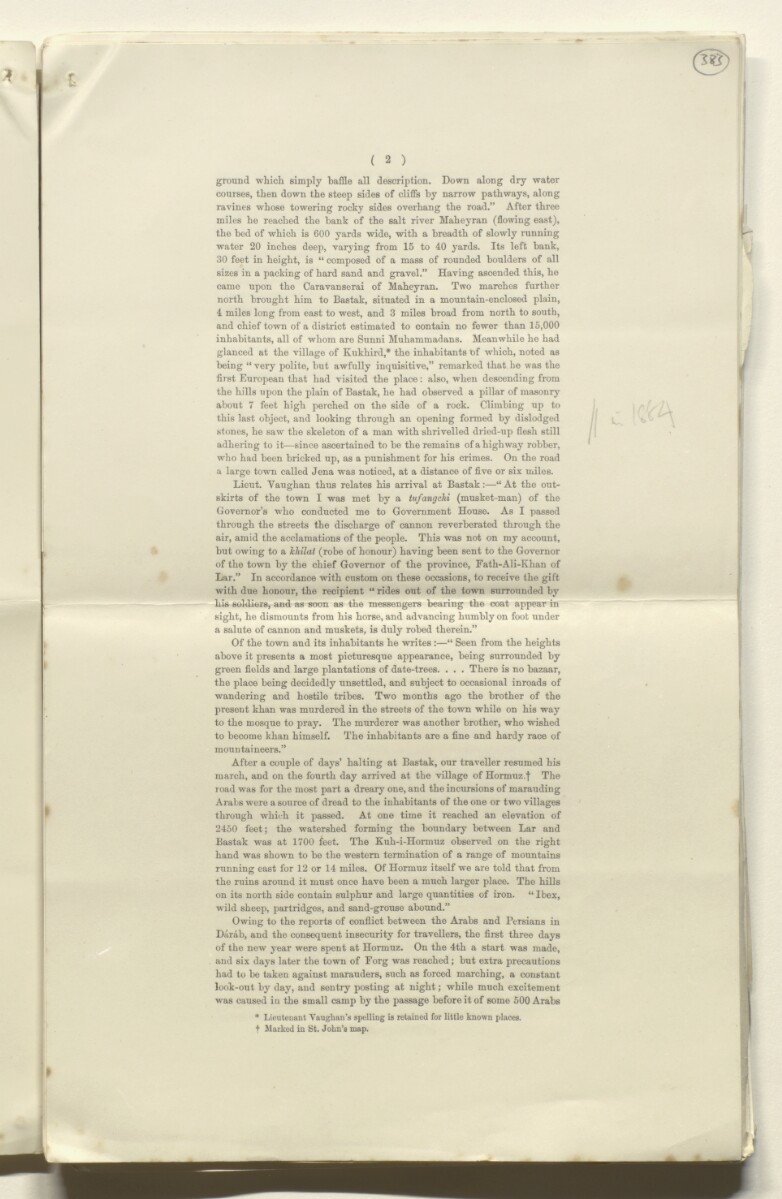
( 2 )
ground which simply baffle all description. Down along dry water
courses, then down the steep sides of cliffs by narrow pathways, along
ravines whose towering rocky sides overhang the road.” After three
miles he reached the bank of the salt river Maheyran (flowing east),
the bed of which is 600 yards wide, with a breadth of slowly running
water 20 inches deep, varying from 15 to 40 yards. Its left bank,
30 feet in height, is “ composed of a mass of rounded boulders of all
sizes in a packing of hard sand and gravel.” Having ascended this, he
came upon the
Caravanserai
A roadside inn providing accommodation for caravans (groups of travellers).
of Maheyran. Two marches further
north brought him to Bastak, situated in a mountain-enclosed plain,
4 miles long from east to west, and 3 miles broad from north to south,
and chief town of a district estimated to contain no fewer than 15,000
inhabitants, all of whom are Sunni Muhammadans. Meanwhile he had
glanced at the village of Kukhird,* the inhabitants of which, noted as
being “ very polite, but awfully inquisitive,” remarked that he was the
first European that had visited the place: also, when descending from
the hills upon the plain of Bastak, he had observed a pillar of masonry
about 7 feet high perched on the side of a rock. Climbing up to
this last object, and looking through an opening formed by dislodged
stones, he saw the skeleton of a man with shrivelled dried-up flesh still
adhering to it—since ascertained to be the remains of a highway robber,
who had been bricked up, as a punishment for his crimes. On the road
a large town called Jena was noticed, at a distance of five or six miles.
Lieut. Vaughan thus relates his arrival at Bastak:—“ At the out
skirts of the town I was met by a tufangchi (musket-man) of the
Governor’s who conducted me to Government House. As I passed
through the streets the discharge of cannon reverberated through the
air, amid the acclamations of the people. This was not on my account,
but owing to a khilat (robe of honour) having been sent to the Governor
of the town by the chief Governor of the province, Fath-Ali-Khan of
Lar.” In accordance with custom on these occasions, to receive the gift
with due honour, the recipient “ rides out of the town surrounded by
his soldiers, and as soon as the messengers bearing the coat appear in
sight, he dismounts from his horse, and advancing humbly on foot under
a salute of cannon and muskets, is duly robed therein.”
Of the town and its inhabitants he writes :—“ Seen from the heights
above it presents a most picturesque appearance, being surrounded by
green fields and large plantations of date-trees. . . . There is no bazaar,
the place being decidedly unsettled, and subject to occasional inroads of
wandering and hostile tribes. Two months ago the brother of the
present khan was murdered in the streets of the town while on his way
to the mosque to pray. The murderer was another brother, who wished
to become khan himself. The inhabitants are a fine and hardy race of
mountaineers.”
After a couple of days’ halting at Bastak, our traveller resumed his
march, and on the fourth day arrived at the village of Hormuz. The
road was for the most part a dreary one, and the incursions of marauding
Arabs were a source of dread to the inhabitants of the one or two villages
through which it passed. At one time it reached an elevation of
2450 feet; the
watershed
The boundary between adjacent drainage basins.
forming the boundary between Lar and
Bastak was at 1700 feet. The Kuh-i-Hormuz observed on the right
hand was shown to be the western termination of a range of mountains
running east for 12 or 14 miles. Of Hormuz itself we are told that from
the ruins around it must once have been a much larger place. The hills
on its north side contain sulphur and large quantities of iron. “ Ibex,
wild sheep, partridges, and sand-grouse abound.”
Owing to the reports of conflict between the Arabs and Persians in
Darab, and the consequent insecurity for travellers, the first three days
of the new year were spent at Hormuz. On the 4th a start was made,
and six days later the town of Forg was reached; but extra precautions
had to be taken against marauders, such as forced marching, a constant
look-out by day, and sentry posting at night; while much excitement
was caused in the small camp by the passage before it of some 500 Arabs
* Lieutenant Vaughan’s spelling is retained for little known places,
f Marked in St. John’s map.
About this item
- Content
This file consists of letters, notes, and printed material on Persia compiled by George Curzon in the course of conducting research prior to the writing of his book: Persia and the Persian Question . The papers' contents and type vary considerably, but consists primarily of handwritten notes, some of which are organised roughly for individual chapters of the book. The rest of the file includes newspaper clippings, official reports, printed maps, and other published material on the history and geography of Persia. The official government reports are primarily government of India balance of trade reports, while published material consisted mainly of academic and non-academic papers on Persian archaeology by members of the Scottish Geographical Magazine and the history of the telegraph published by the Indo-European Telegraph Department.
- Extent and format
- 1 file (692 folios)
- Arrangement
The papers are arranged in approximate chronological order from the rear to the front of the file.
- Physical characteristics
Foliation: the foliation sequence (used for referencing) commences at the first folio with 1 and terminates at the last folio with 692; these numbers are written in pencil, are circled, and are located in the top right corner of the recto The front of a sheet of paper or leaf, often abbreviated to 'r'. side of each folio.
- Written in
- English in Latin script View the complete information for this record
Use and share this item
- Share this item
'Lord Curzon's Notes on Persia' [383r] (766/1386), British Library: India Office Records and Private Papers, Mss Eur F112/611, in Qatar Digital Library <https://www.qdl.qa/archive/81055/vdc_100149372608.0x0000a7> [accessed 4 July 2026]
https://www.qdl.qa/en/archive/81055/vdc_100149372608.0x0000a7
Copy and paste the code below into your web page where you would like to embed the image.
<meta charset="utf-8"><a href="https://www.qdl.qa/en/archive/81055/vdc_100149372608.0x0000a7">'Lord Curzon's Notes on Persia' [‎383r] (766/1386)</a> <a href="https://www.qdl.qa/en/archive/81055/vdc_100149372608.0x0000a7"> <img src="https://iiif.qdl.qa/iiif/images/81055/vdc_100000001491.0x000333/Mss Eur F112_611_0831.jp2/full/!280,240/0/default.jpg" alt="" /> </a>
This record has a IIIF manifest available as follows. If you have a compatible viewer you can drag the icon to load it.https://www.qdl.qa/en/iiif/81055/vdc_100000001491.0x000333/manifestOpen in Universal viewerOpen in Mirador viewerMore options for embedding images
Copyright: How to use this content
- Reference
- Mss Eur F112/611
- Title
- 'Lord Curzon's Notes on Persia'
- Pages
- 382r:394v
- Author
- Goldsmid, Sir Frederic John
- Copyright
- ©Royal Geographical Society
- Usage terms
- Creative Commons Non-Commercial Licence