
!['Lord Curzon's Notes on Persia' [‎541r] (1083/1386)](https://iiif.qdl.qa/iiif/images/81055/vdc_100000001491.0x000333/Mss Eur F112_611_1153.jp2/full/!1200,1200/0/default.jpg "'Lord Curzon's Notes on Persia' [‎541r] (1083/1386)")
'Lord Curzon's Notes on Persia' [541r] (1083/1386)
The record is made up of 1 file (692 folios). It was created in c 1880-1891. It was written in English. The original is part of the British Library: India Office The department of the British Government to which the Government of India reported between 1858 and 1947. The successor to the Court of Directors. Records and Private Papers Documents collected in a private capacity. .
Transcription
This transcription is created automatically. It may contain errors.
21
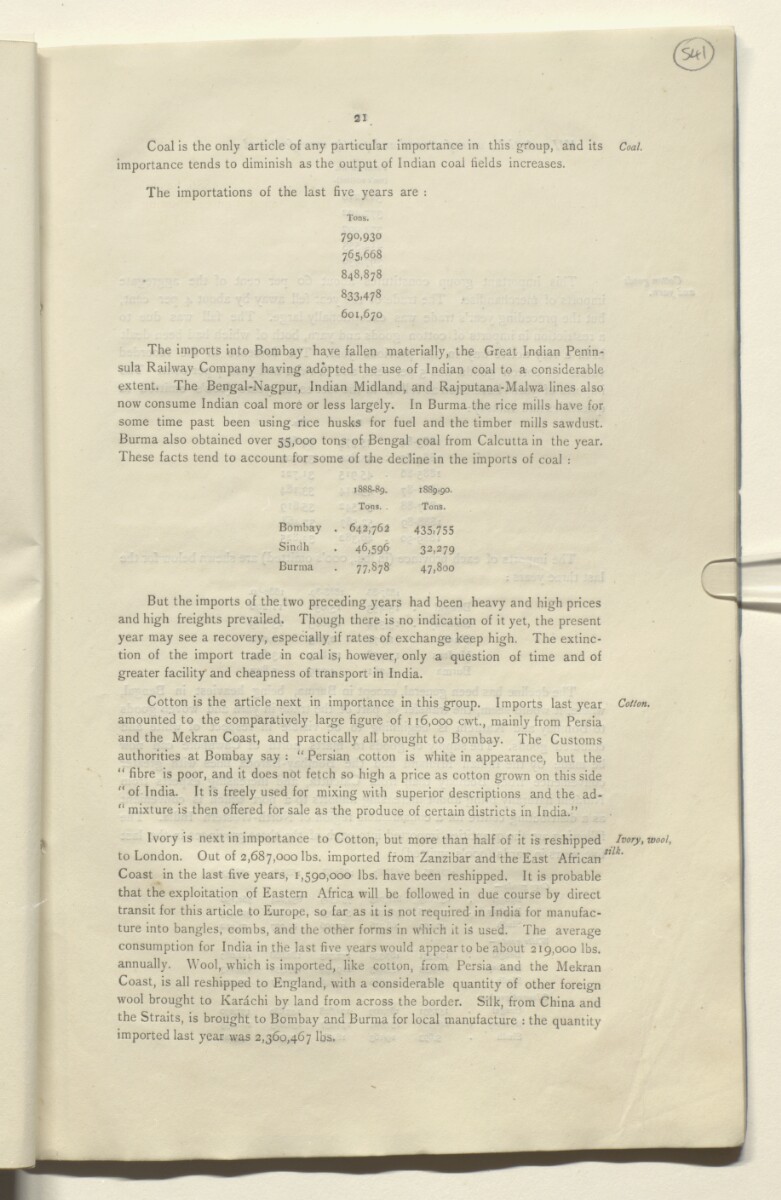
Coal is the only article of any particular importance in this group, and its Coal.
importance tends to diminish as the output of Indian coal fields increases.
The importations of the last five years are :
Tons.
790,930
765,668
848,878
833,478
601,670
The imports into Bombay have fallen materially, the Great Indian Penin
sula Railway Company having adopted the use of Indian coal to a considerable
extent. The Bengal-Nagpur, Indian Midland, and Rajputana-Malwa lines also
now consume Indian coal more or less largely. In Burma the rice mills have for
some time past been using rice husks for fuel and the timber mills sawdust.
Burma also obtained over 55,000 tons of Bengal coal from Calcutta in the year.
These facts tend to account for some of the decline in the imports of coal :
1888-89.
18S9-90.
Tons.
Tons.
Bombay .
. 642,762
435,755
Sindh
• 46,596
32,279
Burma
■ 77,878
47,800
But the imports of the two preceding years had been heavy and high prices
and high freights prevailed. Though there is no indication of it yet, the present
year may see a recovery, especially if rates of exchange keep high. The extinc
tion of the import trade in coal is, however, only a question of time and of
greater facility and cheapness of transport in India.
Cotton is the article next in importance in this group. Imports last year Cotton.
amounted to the comparatively large figure of 116,000 cwt., mainly from Persia
and the Mekran Coast, and practically all brought to Bombay. The Customs
authorities at Bombay say : " Persian cotton is white in appearance, but the
“ fibre is poor, and it does not fetch so high a price as cotton grown on this side
“of India. It is freely used for mixing with superior descriptions and the ad-
“ mixture is then offered for sale as the produce of certain districts in India.”
Ivory is next in importance to Cotton, but more than half of it is reshipped Ivory, wool,
to London. Out of 2,687,000 lbs. imported from Zanzibar and the East African St"
Coast in the last five years, 1,590,000 lbs. have been reshipped. It is probable
that the exploitation of Eastern Africa will be followed in due course by direct
transit for this article to Europe, so far as it is not required in India for manufac
ture into bangles, combs, and the other forms in which it is used. The average
consumption for India in the last five years would appear to be about 219,000 lbs.
annually. Wool, which is imported, like cotton, from Persia and the Mekran
Coast, is all reshipped to England, with a considerable quantity of other foreign
wool brought to Karachi by land from across the border. Silk, from China and
the Straits, is brought to Bombay and Burma for local manufacture : the quantity
imported last year was 2,360,467 lbs.
About this item
- Content
This file consists of letters, notes, and printed material on Persia compiled by George Curzon in the course of conducting research prior to the writing of his book: Persia and the Persian Question . The papers' contents and type vary considerably, but consists primarily of handwritten notes, some of which are organised roughly for individual chapters of the book. The rest of the file includes newspaper clippings, official reports, printed maps, and other published material on the history and geography of Persia. The official government reports are primarily government of India balance of trade reports, while published material consisted mainly of academic and non-academic papers on Persian archaeology by members of the Scottish Geographical Magazine and the history of the telegraph published by the Indo-European Telegraph Department.
- Extent and format
- 1 file (692 folios)
- Arrangement
The papers are arranged in approximate chronological order from the rear to the front of the file.
- Physical characteristics
Foliation: the foliation sequence (used for referencing) commences at the first folio with 1 and terminates at the last folio with 692; these numbers are written in pencil, are circled, and are located in the top right corner of the recto The front of a sheet of paper or leaf, often abbreviated to 'r'. side of each folio.
- Written in
- English in Latin script View the complete information for this record
Use and share this item
- Share this item
'Lord Curzon's Notes on Persia' [541r] (1083/1386), British Library: India Office Records and Private Papers, Mss Eur F112/611, in Qatar Digital Library <https://www.qdl.qa/archive/81055/vdc_100149372611.0x000054> [accessed 14 June 2026]
https://www.qdl.qa/en/archive/81055/vdc_100149372611.0x000054
Copy and paste the code below into your web page where you would like to embed the image.
<meta charset="utf-8"><a href="https://www.qdl.qa/en/archive/81055/vdc_100149372611.0x000054">'Lord Curzon's Notes on Persia' [‎541r] (1083/1386)</a> <a href="https://www.qdl.qa/en/archive/81055/vdc_100149372611.0x000054"> <img src="https://iiif.qdl.qa/iiif/images/81055/vdc_100000001491.0x000333/Mss Eur F112_611_1153.jp2/full/!280,240/0/default.jpg" alt="" /> </a>
This record has a IIIF manifest available as follows. If you have a compatible viewer you can drag the icon to load it.https://www.qdl.qa/en/iiif/81055/vdc_100000001491.0x000333/manifestOpen in Universal viewerOpen in Mirador viewerMore options for embedding images
Copyright: How to use this content
- Reference
- Mss Eur F112/611
- Title
- 'Lord Curzon's Notes on Persia'
- Pages
- 2av, 7r:7v, 22r:22v, 27r:27v, 36r:37v, 288r:288v, 291r:380v, 467r:467v, 470r:470v, 505r:575v, 584r:584v, 600r:692v
- Author
- East India Company, the Board of Control, the India Office, or other British Government Department
- Usage terms
- Open Government Licence