
!['Lord Curzon's Notes on Persia' [‎553v] (1108/1386)](https://iiif.qdl.qa/iiif/images/81055/vdc_100000001491.0x000333/Mss Eur F112_611_1178.jp2/full/!1200,1200/0/default.jpg "'Lord Curzon's Notes on Persia' [‎553v] (1108/1386)")
'Lord Curzon's Notes on Persia' [553v] (1108/1386)
The record is made up of 1 file (692 folios). It was created in c 1880-1891. It was written in English. The original is part of the British Library: India Office The department of the British Government to which the Government of India reported between 1858 and 1947. The successor to the Court of Directors. Records and Private Papers Documents collected in a private capacity. .
Transcription
This transcription is created automatically. It may contain errors.
46
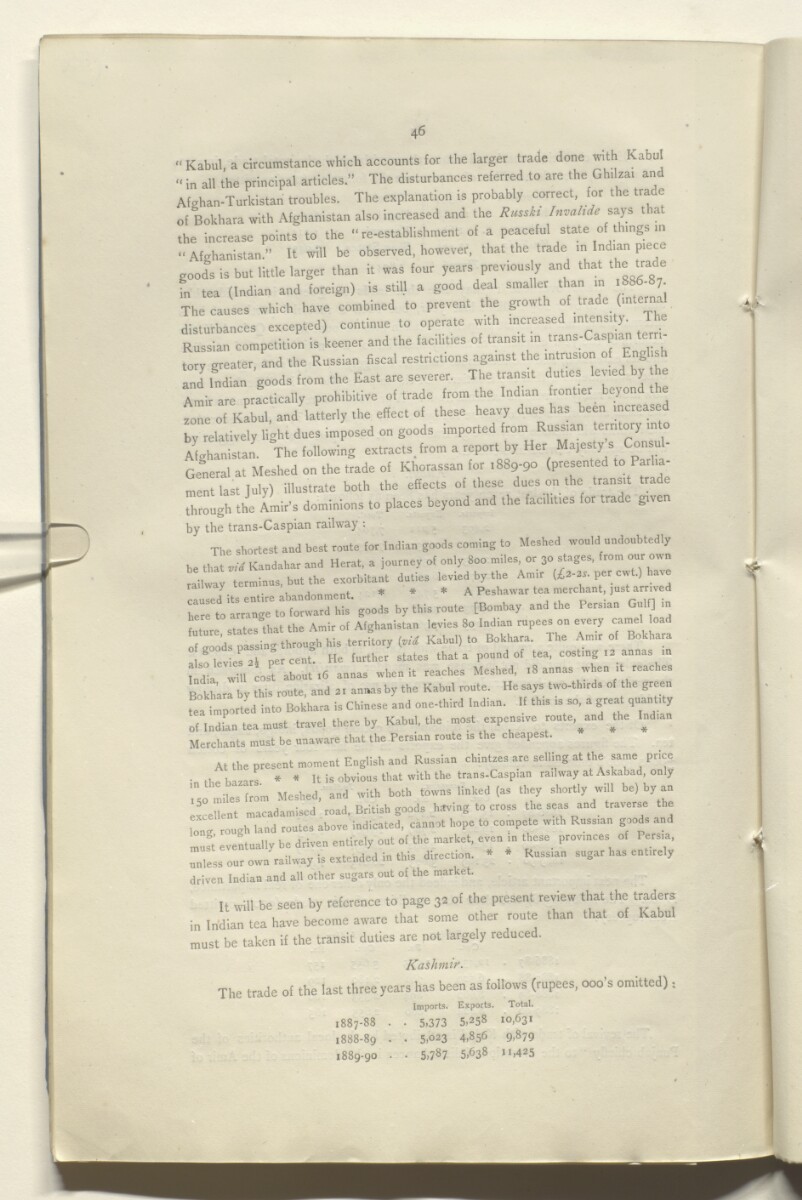
" Kabul, a circumstance which accounts for the larger trade done with Kabul
"‘in all the principal articles.” The disturbances referred to are the Ghilzai and
Afghan-Turkistan troubles. The explanation is probably correct, for the trade
of Bokhara with Afghanistan also increased and the Russki Invalide says that
the increase points to the " re-establishment of a peaceful state of things in
"Afghanistan.” It will be observed, however, that the trade in Indian piece
goods is but little larger than it was four years previously and that the trade
in tea (Indian and foreign) is still a good deal smaller than in 1886-87.
The causes which have combined to prevent the growth of trade (internal
disturbances excepted) continue to operate with increased intensity. The
Russian competition is keener and the facilities of transit in trans-Caspian terri
tory greater, and the Russian fiscal restrictions against the intrusion of English
and Indian goods from the East are severer. The transit duties levied by the
Amir are practically prohibitive of trade from the Indian frontier beyond the
zone of Kabul, and latterly the effect of these heavy dues has been increased
by relatively light dues imposed on goods imported from Russian territory into
Afghanistan. The following extracts from a report by Her Majesty’s Consul-
General at Meshed on the trade of Khorassan for 1889-90 (presented to Parlia
ment last July) illustrate both the effects of these dues on the transit trade
through the Amir’s dominions to places beyond and the facilities for trade given
by the trans-Caspian railway :
The shortest and best route for Indian goods coming to Meshed would undoubtedly
be that vid Kandahar and Herat, a journey of only 800 miles, or 30 stages, from our own
railway terminus, but the exorbitant duties levied by the Amir (L2-2s. per cwt.) have
caused its entire abandonment. * * * A Peshawar tea merchant, just arrived
here to arrange to forward his goods by this route [Bombay and the
Persian Gulf
The historical term used to describe the body of water between the Arabian Peninsula and Iran.
] in
future, states that the Amir of Afghanistan levies 80 Indian
rupees
Indian silver coin also widely used in the Persian Gulf.
on every camel load
of goods passing through his territory [vid Kabul) to Bokhara. The Amir of Bokhara
also levies percent. He further states that a pound of tea, costing 12 annas in
India, will cost about 16 annas when it reaches Meshed, 18 annas when it reaches
Bokhara by this route, and 21 annas by the Kabul route. He says two-thirds of the green
tea imported into Bokhara is Chinese and one-third Indian. If this is so, a great quantity
of Indian tea must travel there by Kabul, the most expensive route, and the Indian
Merchants must be unaware that the Persian route is the cheapest. * * *
At the present moment English and Russian chintzes are selling at the same price
in the bazars. * * It is obvious that with the trans-Caspian railway at Askabad, only
150 miles from Meshed, and with both towns linked (as they shortly will be) by an
excellent macadamised road, British goods having to cross the seas and traverse the
long, rough land routes above indicated, cannot hope to compete with Russian goods and
must eventually be driven entirely out of the market, even in these provinces of Persia,
unless our own railway is extended in this direction. * * Russian sugar has entirely
driven Indian and all other sugars out of the market.
It will be seen by reference to page 32 of the present review that the traders
in Indian tea have become aware that some other route than that of Kabul
must be taken if the transit duties are not largely reduced.
Kashmir.
The trade of the last three years has been as follows (
rupees
Indian silver coin also widely used in the Persian Gulf.
, ooo’s omitted) ;
Imports.
Exports.
Total.
1887-88 .
• 5,373
5,258
10,631
1888-89 .
• 5,023
4,856
9,879
1889-90 .
• 5,787
5>638
11,425
About this item
- Content
This file consists of letters, notes, and printed material on Persia compiled by George Curzon in the course of conducting research prior to the writing of his book: Persia and the Persian Question . The papers' contents and type vary considerably, but consists primarily of handwritten notes, some of which are organised roughly for individual chapters of the book. The rest of the file includes newspaper clippings, official reports, printed maps, and other published material on the history and geography of Persia. The official government reports are primarily government of India balance of trade reports, while published material consisted mainly of academic and non-academic papers on Persian archaeology by members of the Scottish Geographical Magazine and the history of the telegraph published by the Indo-European Telegraph Department.
- Extent and format
- 1 file (692 folios)
- Arrangement
The papers are arranged in approximate chronological order from the rear to the front of the file.
- Physical characteristics
Foliation: the foliation sequence (used for referencing) commences at the first folio with 1 and terminates at the last folio with 692; these numbers are written in pencil, are circled, and are located in the top right corner of the recto The front of a sheet of paper or leaf, often abbreviated to 'r'. side of each folio.
- Written in
- English in Latin script View the complete information for this record
Use and share this item
- Share this item
'Lord Curzon's Notes on Persia' [553v] (1108/1386), British Library: India Office Records and Private Papers, Mss Eur F112/611, in Qatar Digital Library <https://www.qdl.qa/archive/81055/vdc_100149372611.0x00006d> [accessed 17 June 2026]
https://www.qdl.qa/en/archive/81055/vdc_100149372611.0x00006d
Copy and paste the code below into your web page where you would like to embed the image.
<meta charset="utf-8"><a href="https://www.qdl.qa/en/archive/81055/vdc_100149372611.0x00006d">'Lord Curzon's Notes on Persia' [‎553v] (1108/1386)</a> <a href="https://www.qdl.qa/en/archive/81055/vdc_100149372611.0x00006d"> <img src="https://iiif.qdl.qa/iiif/images/81055/vdc_100000001491.0x000333/Mss Eur F112_611_1178.jp2/full/!280,240/0/default.jpg" alt="" /> </a>
This record has a IIIF manifest available as follows. If you have a compatible viewer you can drag the icon to load it.https://www.qdl.qa/en/iiif/81055/vdc_100000001491.0x000333/manifestOpen in Universal viewerOpen in Mirador viewerMore options for embedding images
Copyright: How to use this content
- Reference
- Mss Eur F112/611
- Title
- 'Lord Curzon's Notes on Persia'
- Pages
- 2av, 7r:7v, 22r:22v, 27r:27v, 36r:37v, 288r:288v, 291r:380v, 467r:467v, 470r:470v, 505r:575v, 584r:584v, 600r:692v
- Author
- East India Company, the Board of Control, the India Office, or other British Government Department
- Usage terms
- Open Government Licence