
!['Lord Curzon's Notes on Persia' [‎577v] (1156/1386)](https://iiif.qdl.qa/iiif/images/81055/vdc_100000001491.0x000333/Mss Eur F112_611_1226.jp2/full/!1200,1200/0/default.jpg "'Lord Curzon's Notes on Persia' [‎577v] (1156/1386)")
'Lord Curzon's Notes on Persia' [577v] (1156/1386)
The record is made up of 1 file (692 folios). It was created in c 1880-1891. It was written in English. The original is part of the British Library: India Office The department of the British Government to which the Government of India reported between 1858 and 1947. The successor to the Court of Directors. Records and Private Papers Documents collected in a private capacity. .
Transcription
This transcription is created automatically. It may contain errors.
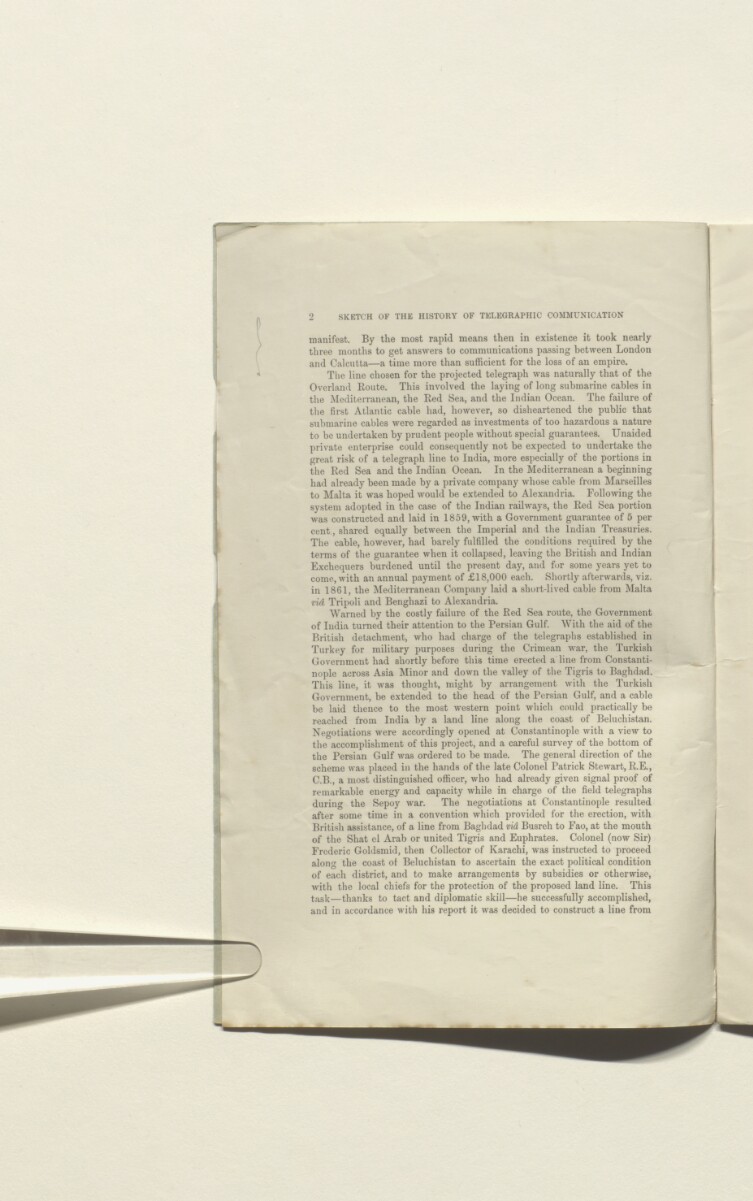
2 SKETCH OF THE HISTORY OF TELEGRAPHIC COMMUNICATION
manifest. By the most rapid means then in existence it took nearly
three months to get answers to communications passing between London
and Calcutta—a time more than sufficient for the loss of an empire.
The line chosen for the projected telegraph was naturally that of the
Overland Route. This involved the laying of long submarine cables in
the Mediterranean, the Red Sea, and the Indian Ocean. The failure of
the first Atlantic cable had, however, so disheartened the public that
submarine cables were regarded as investments of too hazardous a nature
to be undertaken by prudent people without special guarantees. Unaided
private enterprise could consequently not be expected to undertake the
great risk of a telegraph line to India, more especially of the portions in
the Red Sea and the Indian Ocean. In the Mediterranean a beginning
had already been made by a private company whose cable from Marseilles
to Malta it was hoped would be extended to Alexandria. Following the
system adopted in the case of the Indian railways, the Red Sea portion
was constructed and laid in 1859, with a Government guarantee of 5 per
cent, shared equally between the Imperial and the Indian Treasuries.
The cable, however, had barely fulfilled the conditions required by the
terms of the guarantee when it collapsed, leaving the British and Indian
Exchequers burdened until the present day, and for some years yet to
come, with an annual payment of £18,000 each. Shortly afterwards, viz.
in 1861, the Mediterranean Company laid a short-lived cable from Malta
vid Tripoli and Benghazi to Alexandria.
Warned by the costly failure of the Red Sea route, the Government
of India turned their attention to the
Persian Gulf
The historical term used to describe the body of water between the Arabian Peninsula and Iran.
. With the aid of the
British detachment, who had charge of the telegraphs established in
Turkey for military purposes during the Crimean war, the Turkish
Government had shortly before this time erected a line from Constanti
nople across Asia Minor and down the valley of the Tigris to Baghdad.
This line, it was thought, might by arrangement with the Turkish
Government, be extended to the head of the
Persian Gulf
The historical term used to describe the body of water between the Arabian Peninsula and Iran.
, and a cable
be laid thence to the most western point which could practically be
reached from India by a land line along the coast of Beluchistan.
Negotiations were accordingly opened at Constantinople with a view to
the accomplishment of this project, and a careful survey of the bottom of
the
Persian Gulf
The historical term used to describe the body of water between the Arabian Peninsula and Iran.
was ordered to be made. The general direction of the
scheme was placed in the hands of the late Colonel Patrick Stewart, R.E.,
C.B., a most distinguished officer, who had already given signal proof of
remarkable energy and capacity while in charge of the field telegraphs
during the
Sepoy
Term used in English to refer to an Indian infantryman. Carries some derogatory connotations as sometimes used as a means of othering and emphasising race, colour, origins, or rank.
war. The negotiations at Constantinople resulted
after some time in a convention which provided for the erection, with
British assistance, of a line from Baghdad vid Busreh to Fao, at the mouth
of the Shat el Arab or united Tigris and Euphrates. Colonel (now Sir)
Frederic Goldsmid, then Collector of Karachi, was instructed to proceed
along the coast of Beluchistan to ascertain the exact political condition
of each district, and to make arrangements by subsidies or otherwise,
with the local chiefs for the protection of the proposed land line. This
task—thanks to tact and diplomatic skill—he successfully accomplished,
and in accordance with his report it was decided to construct a line from
About this item
- Content
This file consists of letters, notes, and printed material on Persia compiled by George Curzon in the course of conducting research prior to the writing of his book: Persia and the Persian Question . The papers' contents and type vary considerably, but consists primarily of handwritten notes, some of which are organised roughly for individual chapters of the book. The rest of the file includes newspaper clippings, official reports, printed maps, and other published material on the history and geography of Persia. The official government reports are primarily government of India balance of trade reports, while published material consisted mainly of academic and non-academic papers on Persian archaeology by members of the Scottish Geographical Magazine and the history of the telegraph published by the Indo-European Telegraph Department.
- Extent and format
- 1 file (692 folios)
- Arrangement
The papers are arranged in approximate chronological order from the rear to the front of the file.
- Physical characteristics
Foliation: the foliation sequence (used for referencing) commences at the first folio with 1 and terminates at the last folio with 692; these numbers are written in pencil, are circled, and are located in the top right corner of the recto The front of a sheet of paper or leaf, often abbreviated to 'r'. side of each folio.
- Written in
- English in Latin script View the complete information for this record
Use and share this item
- Share this item
'Lord Curzon's Notes on Persia' [577v] (1156/1386), British Library: India Office Records and Private Papers, Mss Eur F112/611, in Qatar Digital Library <https://www.qdl.qa/archive/81055/vdc_100149372611.0x00009d> [accessed 15 July 2026]
https://www.qdl.qa/en/archive/81055/vdc_100149372611.0x00009d
Copy and paste the code below into your web page where you would like to embed the image.
<meta charset="utf-8"><a href="https://www.qdl.qa/en/archive/81055/vdc_100149372611.0x00009d">'Lord Curzon's Notes on Persia' [‎577v] (1156/1386)</a> <a href="https://www.qdl.qa/en/archive/81055/vdc_100149372611.0x00009d"> <img src="https://iiif.qdl.qa/iiif/images/81055/vdc_100000001491.0x000333/Mss Eur F112_611_1226.jp2/full/!280,240/0/default.jpg" alt="" /> </a>
This record has a IIIF manifest available as follows. If you have a compatible viewer you can drag the icon to load it.https://www.qdl.qa/en/iiif/81055/vdc_100000001491.0x000333/manifestOpen in Universal viewerOpen in Mirador viewerMore options for embedding images
Copyright: How to use this content
- Reference
- Mss Eur F112/611
- Title
- 'Lord Curzon's Notes on Persia'
- Pages
- 576r:583v
- Author
- Smith, Sir Robert Murdoch
- Copyright
- ©Courtesy of the Royal Scottish Geographical Society
- Usage terms
- Creative Commons Non-Commercial Licence