
!['Lord Curzon's Notes on Persia' [‎644v] (1290/1386)](https://iiif.qdl.qa/iiif/images/81055/vdc_100000001491.0x000333/Mss Eur F112_611_1366.jp2/full/!1200,1200/0/default.jpg "'Lord Curzon's Notes on Persia' [‎644v] (1290/1386)")
'Lord Curzon's Notes on Persia' [644v] (1290/1386)
The record is made up of 1 file (692 folios). It was created in c 1880-1891. It was written in English. The original is part of the British Library: India Office The department of the British Government to which the Government of India reported between 1858 and 1947. The successor to the Court of Directors. Records and Private Papers Documents collected in a private capacity. .
Transcription
This transcription is created automatically. It may contain errors.
26
No. 45.
Mr. Goschen to Earl Granville.—{Received November 23.)
(Extract.) Constantinople, November 16, 1880.
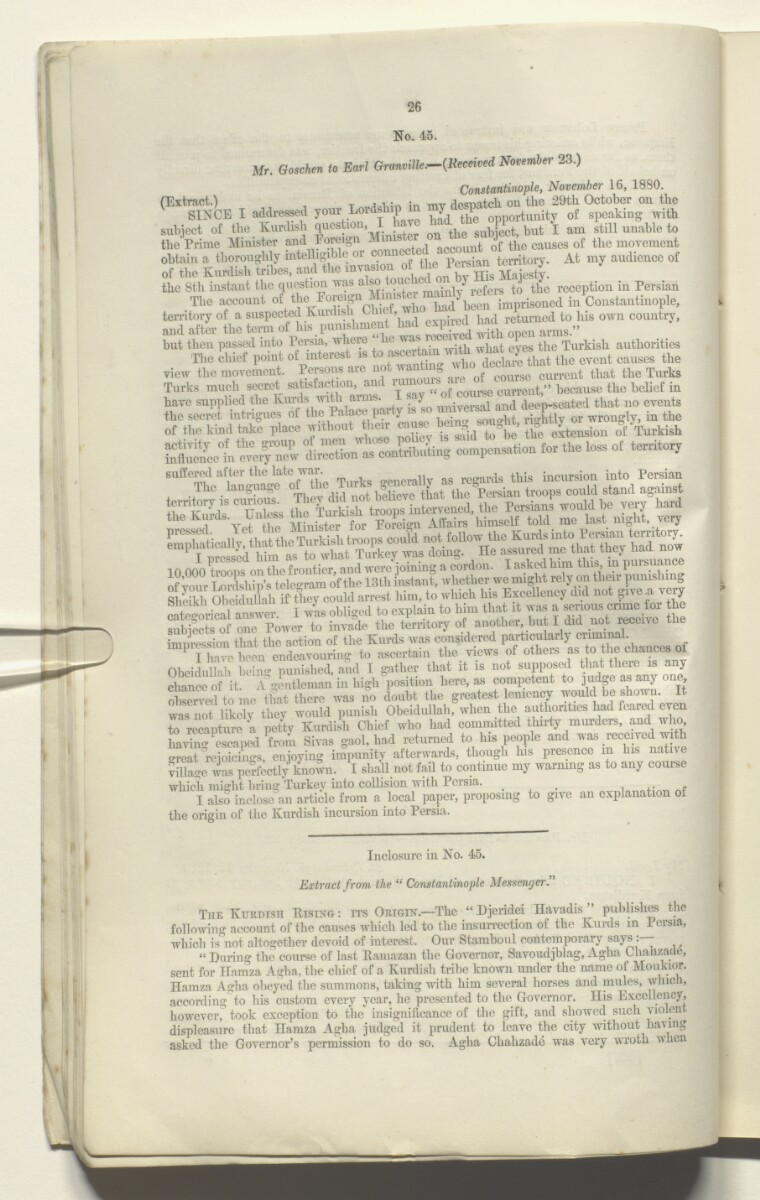
SINCE I addressed your Lordship in my despatch on the 29th October on the
subject of the Kurdish question, I have had the opportunity of speaking with
the'Prime Minister and Foreign Minister on the subject, but I am still unable to
obtain a thoroughly intelligible or connected account of the causes of the movement
of the Kurdish tribes, and the invasion of the Persian territory. At my audience of
the 8th instant the question was also touched on by His Majesty.
The account of the Foreign Minister mainly refers to . the reception in Persian
territory of a suspected Kurdish Chief, who had been imprisoned in Constantinople,
and after the term of his punishment had expired had returned to his own country,
but then passed into Persia, where “he was received with open arms.”
The chief point of interest is to ascertain with what eyes the Turkish authorities
view the movement. Persons are not wanting who declare that the event causes the
Turks much secret satisfaction, and rumours are of course current that the Turks
have supplied the Kurds with arms. I say " of course current,” because the belief in
the secret intrigues of the Palace party is so universal and deep-seated that no events
of the kind take place without their cause being sought, rightly or wrongly, in the
activity of the group of men whose policy is said to be the extension of Turkish
influence in every new direction as contributing compensation for the loss of territory
suffered after the late war.
The language of the Turks generally as regards this incursion into Persian
territory is curious. They did not believe that the Persian troops could stand against
the Kurds. Unless the Turkish troops intervened, the Persians would be very hard
pressed. Yet the Minister for Foreign Affairs himself told me last night, very
emphatically, that the Turkish troops could not follow the Kurds into Persian territory.
I pressed him as to what Turkey was doing. He assured me that they had now
10,000 troops on the frontier, and were joining a cordon. I asked him this, in pursuance
of your Lordship’s telegram of the 13th instant, whether we might rely on their punishing
Sheikh Obeidullah if'they could arrest him, to which his Excellency did not give .a very
categorical answer. I was obliged to explain to him that it was a serious crime for the
subjects of one Power to invade the territory of another, but I did not receive the
impression that the action of the Kurds was considered particularly criminal.
I have been endeavouring to ascertain the views of others as to the chances of
Obeidullah being punished, and I gather that it is not supposed that there is any
chance of it. A gentleman in high position here, as competent to judge as any one,
observed to me that there was no doubt the greatest leniency would be shown. It
was not likely they would punish Obeidullah, when the authorities had feared even
to recapture a petty Kurdish Chief who had committed thirty murders, and who,
having escaped from Sivas gaol, had returned to his people and was received with
great rejoicings, enjoying impunity afterwards, though his presence in his native
village was perfectly known. I shall not fail to continue my warning as to any course
which might bring Turkey into collision with Persia.
I also inclose an article from a local paper, proposing to give an explanation of
the origin of the Kurdish incursion into Persia.
Inclosure in No. 45.
Extract from the " Constantinople Messenger f
Tiie Kurdish Rising: its Origin.—The "Djeridei Havadis ” publishes the
following account of the causes which led to the insurrection of the Kurds in Persia,
which is not altogether devoid of interest. Our Stamboul contemporary says :—
" During the course of last Ramazan the Governor, Savoudjblag, Agha Chahzad,
sent for Hamza Agha, the chief of a Kurdish tribe known under the name of Moukior.
Hamza Agha obeyed the summons, taking with him several horses and mules, which,
according to his custom every year, he presented to the Governor. His Excellency,
however, took exception to the insignificance of the gift, and showed such violent
displeasure that Hamza Agha judged it prudent to leave the city without having
asked the Governor’s permission to do so. Agha Chahzad was very wroth when
About this item
- Content
This file consists of letters, notes, and printed material on Persia compiled by George Curzon in the course of conducting research prior to the writing of his book: Persia and the Persian Question . The papers' contents and type vary considerably, but consists primarily of handwritten notes, some of which are organised roughly for individual chapters of the book. The rest of the file includes newspaper clippings, official reports, printed maps, and other published material on the history and geography of Persia. The official government reports are primarily government of India balance of trade reports, while published material consisted mainly of academic and non-academic papers on Persian archaeology by members of the Scottish Geographical Magazine and the history of the telegraph published by the Indo-European Telegraph Department.
- Extent and format
- 1 file (692 folios)
- Arrangement
The papers are arranged in approximate chronological order from the rear to the front of the file.
- Physical characteristics
Foliation: the foliation sequence (used for referencing) commences at the first folio with 1 and terminates at the last folio with 692; these numbers are written in pencil, are circled, and are located in the top right corner of the recto The front of a sheet of paper or leaf, often abbreviated to 'r'. side of each folio.
- Written in
- English in Latin script View the complete information for this record
Use and share this item
- Share this item
'Lord Curzon's Notes on Persia' [644v] (1290/1386), British Library: India Office Records and Private Papers, Mss Eur F112/611, in Qatar Digital Library <https://www.qdl.qa/archive/81055/vdc_100149372612.0x00005b> [accessed 20 August 2026]
https://www.qdl.qa/en/archive/81055/vdc_100149372612.0x00005b
Copy and paste the code below into your web page where you would like to embed the image.
<meta charset="utf-8"><a href="https://www.qdl.qa/en/archive/81055/vdc_100149372612.0x00005b">'Lord Curzon's Notes on Persia' [‎644v] (1290/1386)</a> <a href="https://www.qdl.qa/en/archive/81055/vdc_100149372612.0x00005b"> <img src="https://iiif.qdl.qa/iiif/images/81055/vdc_100000001491.0x000333/Mss Eur F112_611_1366.jp2/full/!280,240/0/default.jpg" alt="" /> </a>
This record has a IIIF manifest available as follows. If you have a compatible viewer you can drag the icon to load it.https://www.qdl.qa/en/iiif/81055/vdc_100000001491.0x000333/manifestOpen in Universal viewerOpen in Mirador viewerMore options for embedding images
Copyright: How to use this content
- Reference
- Mss Eur F112/611
- Title
- 'Lord Curzon's Notes on Persia'
- Pages
- 2av, 7r:7v, 22r:22v, 27r:27v, 36r:37v, 288r:288v, 291r:380v, 467r:467v, 470r:470v, 505r:575v, 584r:584v, 600r:692v
- Author
- East India Company, the Board of Control, the India Office, or other British Government Department
- Usage terms
- Open Government Licence