
!['Lord Curzon's Notes on Persia' [‎662v] (1326/1386)](https://iiif.qdl.qa/iiif/images/81055/vdc_100000001491.0x000333/Mss Eur F112_611_1402.jp2/full/!1200,1200/0/default.jpg "'Lord Curzon's Notes on Persia' [‎662v] (1326/1386)")
'Lord Curzon's Notes on Persia' [662v] (1326/1386)
The record is made up of 1 file (692 folios). It was created in c 1880-1891. It was written in English. The original is part of the British Library: India Office The department of the British Government to which the Government of India reported between 1858 and 1947. The successor to the Court of Directors. Records and Private Papers Documents collected in a private capacity. .
Transcription
This transcription is created automatically. It may contain errors.
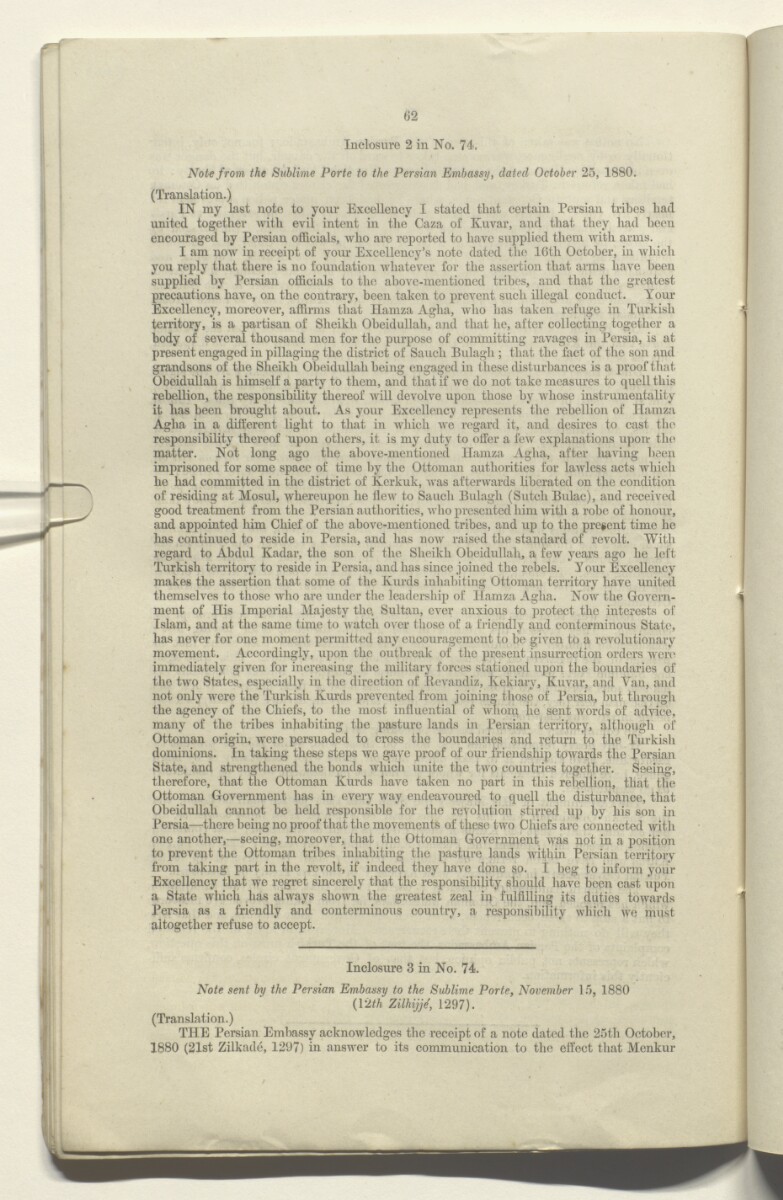
62
Inclosure 2 in No. 74.
Not-e from the Sublime Porte to the Persian Embassy, dated October 25, 1880.
(Translation.)
IN my last note to your Excellency I stated that certain Persian tribes had
united together with evil intent in the Caza of Kuvar, and that they had been
encouraged by Persian officials, who are reported to have supplied them with arms.
I am now in receipt of your Excellency’s note dated the 16th October, in which
you reply that there is no foundation whatever for the assertion that arms have been
supplied by Persian officials to the above-mentioned tribes, and that the greatest
precautions have, on the contrary, been taken to prevent such illegal conduct. Your
Excellency, moreover, affirms that Hamza Agha, who has taken refuge in Turkish
territory, is a partisan of Sheikh Obeidullah, and that he, after collecting together a
body of several thousand men for the purpose of committing ravages in Persia, is at
present engaged in pillaging the district of Sauch Bulagh ; that the fact of the son and
grandsons of the Sheikh Obeidullah being engaged in these disturbances is a proof that
Obeidullah is himself a party to them, and that if we do not take measures to quell this
rebellion, the responsibility thereof will devolve upon those by whose instrumentality
it has been brought about. As your Excellency represents the rebellion of Hamza
Agha in a different light to that in which we regard it, and desires to cast the
responsibility thereof upon others, it is my duty to offer a few explanations upon- the
matter. Not long ago the above-mentioned Hamza Agha, after having been
imprisoned for some space of time by the Ottoman authorities for lawless acts which
he had committed in the district of Kerkuk, was afterwards liberated on the condition
of residing at Mosul, whereupon he flew to Sauch Bulagh (Sutch Bulac), and received
good treatment from the Persian authorities, who presented him with a robe of honour,
and appointed him Chief of the above-mentioned tribes, and up to the present time he
has continued to reside in Persia, and has now raised the standard of revolt. With
regard to Abdul Kadar, the son of the Sheikh Obeidullah, a few years ago he left
Turkish territory to reside in Persia, and has since joined the rebels. Your Excellency
makes the assertion that some of the Kurds inhabiting Ottoman territory have united
themselves to those who are under the leadership of Hamza Agha. Now the Govern
ment of His Imperial Majesty the. Sultan, ever anxious to protect the interests of
Islam, and at the same time to watch over those of a friendly and conterminous State,
has never for one moment permitted any encouragement to be given to a revolutionary
movement. Accordingly, upon the outbreak of the present insurrection orders were
immediately given for increasing the military forces stationed upon the boundaries of
the two States, especially in the direction of Revandiz, Kekiary, Kuvar, and Van, and
not only were the Turkish Kurds prevented from joining those of Persia, but through
the
agency
An office of the East India Company and, later, of the British Raj, headed by an agent.
of the Chiefs, to the most influential of whom he sent words of advice,
many of the tribes inhabiting the pasture lands in Persian territory, although of
Ottoman origin, were persuaded to cross the boundaries and return to the Turkish
dominions. In taking these steps we gave proof of our friendship towards the Persian
State, and strengthened the bonds which unite the two countries together. Seeing,
therefore, that the Ottoman Kurds have taken no part in this rebellion, that the
Ottoman Government has in every way endeavoured to quell the disturbance, that
Obeidullah cannot be held responsible for the revolution stirred up by his son in
Persia—there being no proof that the movements of these two Chiefs are connected with
one another,—seeing, moreover, that the Ottoman Government was not in a position
to prevent the Ottoman tribes inhabiting the pasture lands within Persian territory
from taking part in the revolt, if indeed they have done so. I beg to inform your
Excellency that we regret sincerely that the responsibility should have been cast upon
a State which has always shown the greatest zeal in fulfilling its duties towards
Persia as a friendly and conterminous country, a responsibility which we must
altogether refuse to accept.
Inclosure 3 in No. 74.
Note sent by the Persian Embassy to the Sublime Porte, November 15, 1880
(\2th Zilhijje, 1297).
(Translation.)
THE Persian Embassy acknowledges the receipt of a note dated the 25th October,
1880 (21st Zilkade, 1297) in answer to its communication to the effect that Menkur
About this item
- Content
This file consists of letters, notes, and printed material on Persia compiled by George Curzon in the course of conducting research prior to the writing of his book: Persia and the Persian Question . The papers' contents and type vary considerably, but consists primarily of handwritten notes, some of which are organised roughly for individual chapters of the book. The rest of the file includes newspaper clippings, official reports, printed maps, and other published material on the history and geography of Persia. The official government reports are primarily government of India balance of trade reports, while published material consisted mainly of academic and non-academic papers on Persian archaeology by members of the Scottish Geographical Magazine and the history of the telegraph published by the Indo-European Telegraph Department.
- Extent and format
- 1 file (692 folios)
- Arrangement
The papers are arranged in approximate chronological order from the rear to the front of the file.
- Physical characteristics
Foliation: the foliation sequence (used for referencing) commences at the first folio with 1 and terminates at the last folio with 692; these numbers are written in pencil, are circled, and are located in the top right corner of the recto The front of a sheet of paper or leaf, often abbreviated to 'r'. side of each folio.
- Written in
- English in Latin script View the complete information for this record
Use and share this item
- Share this item
'Lord Curzon's Notes on Persia' [662v] (1326/1386), British Library: India Office Records and Private Papers, Mss Eur F112/611, in Qatar Digital Library <https://www.qdl.qa/archive/81055/vdc_100149372612.0x00007f> [accessed 5 July 2026]
https://www.qdl.qa/en/archive/81055/vdc_100149372612.0x00007f
Copy and paste the code below into your web page where you would like to embed the image.
<meta charset="utf-8"><a href="https://www.qdl.qa/en/archive/81055/vdc_100149372612.0x00007f">'Lord Curzon's Notes on Persia' [‎662v] (1326/1386)</a> <a href="https://www.qdl.qa/en/archive/81055/vdc_100149372612.0x00007f"> <img src="https://iiif.qdl.qa/iiif/images/81055/vdc_100000001491.0x000333/Mss Eur F112_611_1402.jp2/full/!280,240/0/default.jpg" alt="" /> </a>
This record has a IIIF manifest available as follows. If you have a compatible viewer you can drag the icon to load it.https://www.qdl.qa/en/iiif/81055/vdc_100000001491.0x000333/manifestOpen in Universal viewerOpen in Mirador viewerMore options for embedding images
Copyright: How to use this content
- Reference
- Mss Eur F112/611
- Title
- 'Lord Curzon's Notes on Persia'
- Pages
- 2av, 7r:7v, 22r:22v, 27r:27v, 36r:37v, 288r:288v, 291r:380v, 467r:467v, 470r:470v, 505r:575v, 584r:584v, 600r:692v
- Author
- East India Company, the Board of Control, the India Office, or other British Government Department
- Usage terms
- Open Government Licence