
!['Lord Curzon's Notes on Persia' [‎664r] (1329/1386)](https://iiif.qdl.qa/iiif/images/81055/vdc_100000001491.0x000333/Mss Eur F112_611_1405.jp2/full/!1200,1200/0/default.jpg "'Lord Curzon's Notes on Persia' [‎664r] (1329/1386)")
'Lord Curzon's Notes on Persia' [664r] (1329/1386)
The record is made up of 1 file (692 folios). It was created in c 1880-1891. It was written in English. The original is part of the British Library: India Office The department of the British Government to which the Government of India reported between 1858 and 1947. The successor to the Court of Directors. Records and Private Papers Documents collected in a private capacity. .
Transcription
This transcription is created automatically. It may contain errors.
65
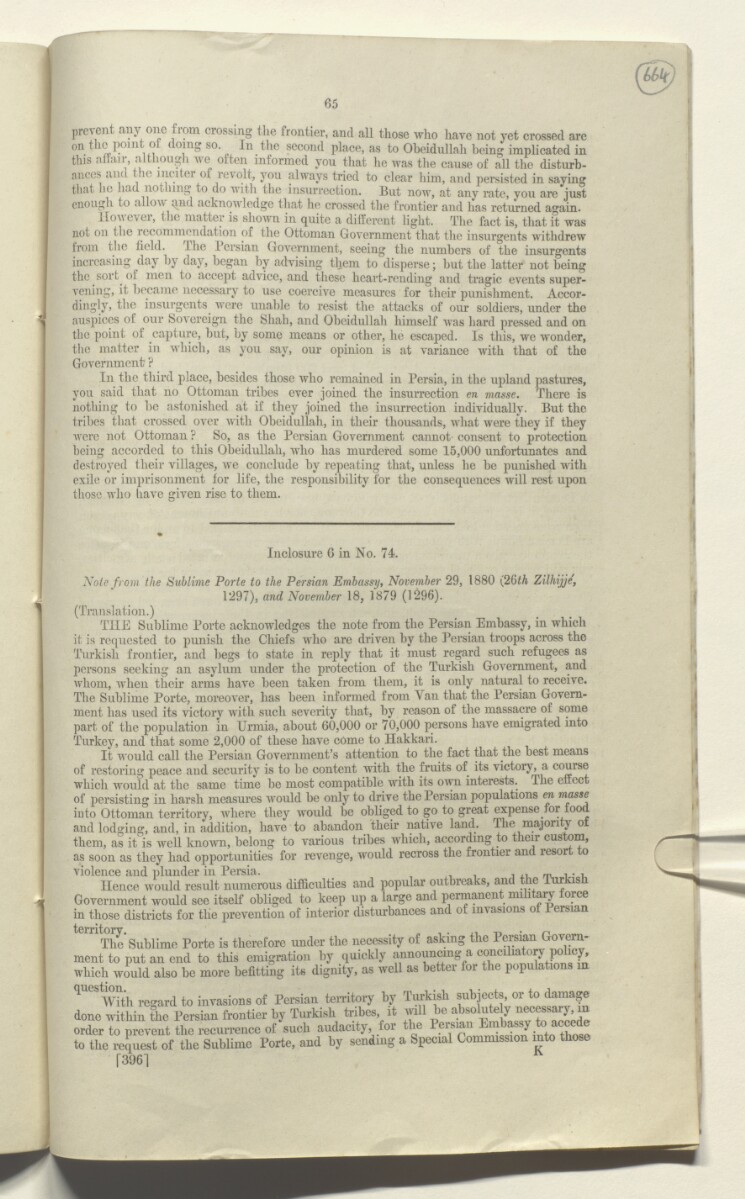
prevent any one from crossing the frontier, and all those who have not yet crossed arc
on thpointofdoing so. , In the second place, as to Obeidullah being implicated in
tins affair although we often informed you that he was the cause of all the disturb
ances and the inciter of revolt you always tried to clear him, and persisted in saying
that he had nothing to do with the insurrection. But now, at any rate, you are just
enough to allow and acknowledge that he crossed the frontier and has returned again.
However, the matter is shown in quite a different light. The fact is, that it was
not on the recommendation of the Ottoman Government that the insurgents withdrew
from the field. Lhe Persian Government, seeing the numbers of the insurgents
increasing day by day, began by advising them to disperse; but the latter not being
the .sort .01 men to accept advice, and these heart-rending and tragic events super-
vening, it became necessary to use coercive measures for their punishment. Accor
dingly, the insurgents, were unable to resist the attacks of our soldiers, under the
auspices ol oul Sovereign the Shah, and Obeidullah himself was hard pressed and on
the point ol capture, but, by some means or other, he escaped. Is this, we wonder,
the matter in which, as you say, our opinion is at variance with that of the
Government ?
In the third place, besides those who remained in Persia, in the upland pastures,
you said that no Ottoman tribes ever joined the insurrection en masse. There is
nothing to be astonished at if they joined the insurrection individually. But the
tribes that crossed over with Obeidullah, in their thousands, what were they if they
were not Ottoman ? So, as the Persian Government cannot consent to protection
being accorded to this Obeidullah, who has murdered some 15,000 unfortunates and
destroyed their villages, we conclude by repeating that, unless he be punished with
exile or imprisonment for life, the responsibility for the consequences will rest upon
those who have given rise to them.
Inclosure 6 in No. 74.
Note from the Sublime Porte to the Persian Embassy, November 29, 1880 (26th Zilhijje,
1297), and November 18, 1879 (1296).
(Translation.)
THE Sublime Porte acknowledges the note from the Persian Embassy, in which
it is requested to punish the Chiefs who are driven by the Persian troops across the
Turkish frontier, and begs to state in reply that it must regard such refugees as
persons seeking an asylum under the protection of the Turkish Government, and
whom, when their arms have been taken from them, it is only natural to receive.
The Sublime Porte, moreover, has been informed from Van that the Persian Govern
ment has used its victory with such severity that, by reason of the massacre of some
part of the population in Urmia, about 60,000 or 70,000 persons have emigrated into
Turkey, and that some 2,000 of these have come to Hakkari.
It would call the Persian Government’s attention to the fact that the best means
of restoring peace and security is to be content with the fruits of its victory, a course
which would at the same time be most compatible with its own interests. The effect
of persisting in harsh measures would be only to drive the Persian populations en masse
into Ottoman territory, where they would be obliged to go to great expense for food
and lodging, and, in addition, have to abandon their native land. The majority of
them, as it is well known, belong to various tribes which, according to their custom,
as soon as they had opportunities for revenge, would recross the frontier and resort to
violence and plunder in Persia.
Hence would result numerous difficulties and popular outbreaks, and the Turkish
Government would see itself obliged to keep up a large and permanent military force
in those districts for the prevention of interior disturbances and of invasions of I ersian
territory. . .
The Sublime Porte is therefore under the necessity of asking the I ersian Govern
ment to put an end to this emigration by quickly announcing a conciliatory policy,
which would also be more befitting its dignity, as well as better for the populations in
question. , , ,
With regard to invasions of Persian territory by Turkish subjects, or to damage
done within the Persian frontier by Turkish tribes, it will be absolute y necessary, in
order to prevent the recurrence of such audacity, for the Persian Embassy to accede
to the request of the Sublime Porte, and by sending a Special Commission into those
[3961
About this item
- Content
This file consists of letters, notes, and printed material on Persia compiled by George Curzon in the course of conducting research prior to the writing of his book: Persia and the Persian Question . The papers' contents and type vary considerably, but consists primarily of handwritten notes, some of which are organised roughly for individual chapters of the book. The rest of the file includes newspaper clippings, official reports, printed maps, and other published material on the history and geography of Persia. The official government reports are primarily government of India balance of trade reports, while published material consisted mainly of academic and non-academic papers on Persian archaeology by members of the Scottish Geographical Magazine and the history of the telegraph published by the Indo-European Telegraph Department.
- Extent and format
- 1 file (692 folios)
- Arrangement
The papers are arranged in approximate chronological order from the rear to the front of the file.
- Physical characteristics
Foliation: the foliation sequence (used for referencing) commences at the first folio with 1 and terminates at the last folio with 692; these numbers are written in pencil, are circled, and are located in the top right corner of the recto The front of a sheet of paper or leaf, often abbreviated to 'r'. side of each folio.
- Written in
- English in Latin script View the complete information for this record
Use and share this item
- Share this item
'Lord Curzon's Notes on Persia' [664r] (1329/1386), British Library: India Office Records and Private Papers, Mss Eur F112/611, in Qatar Digital Library <https://www.qdl.qa/archive/81055/vdc_100149372612.0x000082> [accessed 8 August 2026]
https://www.qdl.qa/en/archive/81055/vdc_100149372612.0x000082
Copy and paste the code below into your web page where you would like to embed the image.
<meta charset="utf-8"><a href="https://www.qdl.qa/en/archive/81055/vdc_100149372612.0x000082">'Lord Curzon's Notes on Persia' [‎664r] (1329/1386)</a> <a href="https://www.qdl.qa/en/archive/81055/vdc_100149372612.0x000082"> <img src="https://iiif.qdl.qa/iiif/images/81055/vdc_100000001491.0x000333/Mss Eur F112_611_1405.jp2/full/!280,240/0/default.jpg" alt="" /> </a>
This record has a IIIF manifest available as follows. If you have a compatible viewer you can drag the icon to load it.https://www.qdl.qa/en/iiif/81055/vdc_100000001491.0x000333/manifestOpen in Universal viewerOpen in Mirador viewerMore options for embedding images
Copyright: How to use this content
- Reference
- Mss Eur F112/611
- Title
- 'Lord Curzon's Notes on Persia'
- Pages
- 2av, 7r:7v, 22r:22v, 27r:27v, 36r:37v, 288r:288v, 291r:380v, 467r:467v, 470r:470v, 505r:575v, 584r:584v, 600r:692v
- Author
- East India Company, the Board of Control, the India Office, or other British Government Department
- Usage terms
- Open Government Licence