
!['Lord Curzon's Notes on Persia' [‎668v] (1338/1386)](https://iiif.qdl.qa/iiif/images/81055/vdc_100000001491.0x000333/Mss Eur F112_611_1414.jp2/full/!1200,1200/0/default.jpg "'Lord Curzon's Notes on Persia' [‎668v] (1338/1386)")
'Lord Curzon's Notes on Persia' [668v] (1338/1386)
The record is made up of 1 file (692 folios). It was created in c 1880-1891. It was written in English. The original is part of the British Library: India Office The department of the British Government to which the Government of India reported between 1858 and 1947. The successor to the Court of Directors. Records and Private Papers Documents collected in a private capacity. .
Transcription
This transcription is created automatically. It may contain errors.
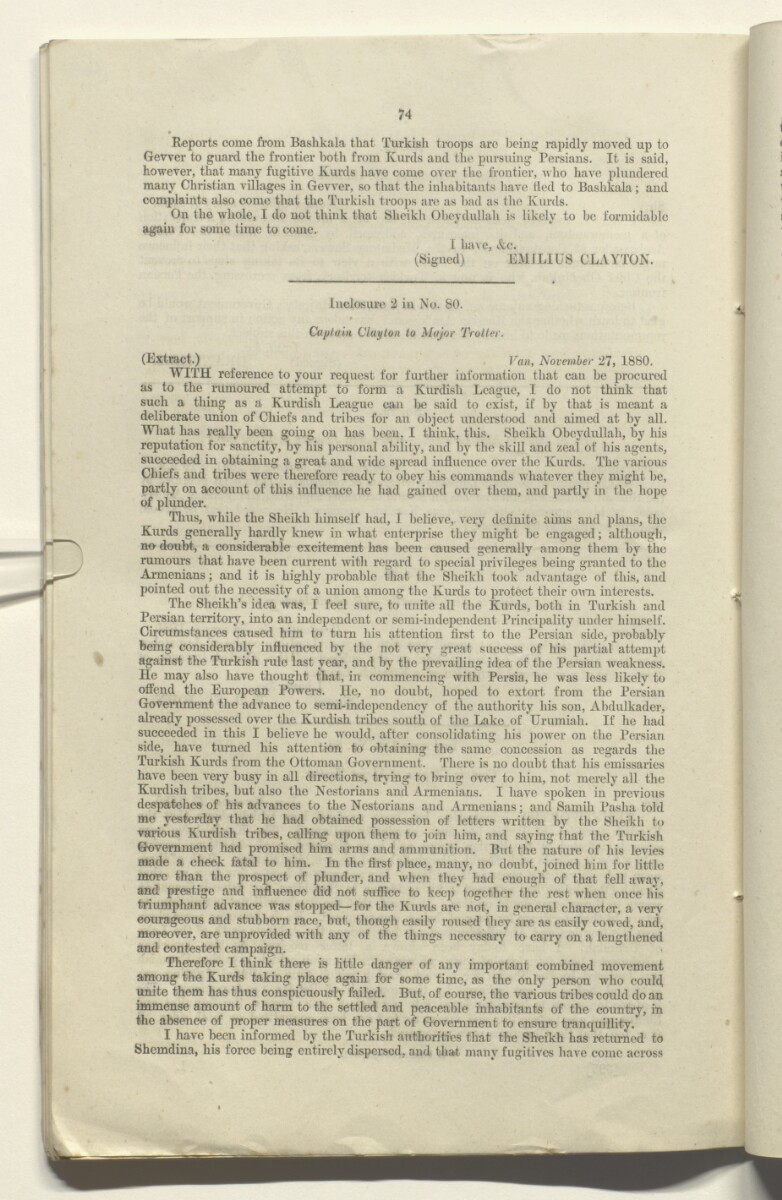
74
Reports come from Bashkala that Turkish troops are being rapidly moved up to
Gevver to guard the frontier both from Kurds and the pursuing Persians. It is said,
however, that many fugitive Kurds have come over the frontier, who have plundered
many Christian villages in Gevver, so that the inhabitants have fled to Bashkala; and
complaints also come that the Turkish troops are as had as the Kurds.
On the whole, I do not think that Sheikh Obeydullah is likely to be formidable
again for some time to come.
I have, &c.
(Signed) EMI .LIUS CLAYTON.
Inclosure 2 in No. 80.
Captain Clayton to Major Trotter.
(Extract.) Van, November 27, 1880.
WITH reference to your request for further information that can be procured
as to the rumoured attempt to form a Kurdish League, I do not think that
such a thing as a Kurdish League can be said to exist, if by that is meant a
deliberate union of Chiefs and tribes for an object understood and aimed at by all.
What has really been going on has been, I think, this. Sheikh Obeydullah, by his
reputation for sanctity, by his personal ability, and by the skill and zeal of his agents,
succeeded in obtaining a great and wide spread influence over the Kurds. The various
Chiefs and tribes were therefore readv to obev his commands whatever they might be,
partly on account of this influence he had gained over them, and partly in the hope
of plunder.
Thus, while the Sheikh himself had, I believe, very definite aims and plans, the
Kurds generally hardly knew’ in what enterprise they might be engaged; although,
no doubt, a considerable excitement has been caused generally among them by the
rumours that have been current with regard to special privileges being granted to the
Armenians; and it is highly probable that the Sheikh took advantage of this, and
pointed out the necessity of a union among the Kurds to protect their own interests.
The Sheikh’s idea was, I feel sure, to unite all the Kurds, both in Turkish and
Persian territory, into an independent or semi-independent Principality under himself.
Circumstances caused him to turn his attention first to the Persian side, probably
being considerably influenced by the not very great success of his partial attempt
against the Turkish rule last year, and by the prevailing idea of the Persian weakness.
He may also have thought that, in commencing with Persia, he was less likely to
offend the European Powers. He, no doubt, hoped to extort from the Persian
Government the advance to semi-independency of the authority his son, Abdulkader,
already possessed over the Kurdish tribes south of the Lake of Urumiah. If he had
succeeded in this I believe he would, after consolidating his power on the Persian
side, have turned his attention to obtaining the same concession as regards the
Turkish Kurds from the Ottoman Government. There is no doubt that his emissaries
have been very busy in all directions, trying to bring over to him, not merely all the
Kurdish tribes, but also the Nestorians and Armenians. I have spoken in previous
despatches of his advances to the Nestorians and Armenians; and Samih
Pasha
An Ottoman title used after the names of certain provincial governors, high-ranking officials and military commanders.
told
me yesterday that he had obtained possession of letters written by the Sheikh to
various Kurdish tribes, calling upon them to join him, and saying that the Turkish
Government had promised him arms and ammunition. But the nature of his levies
made a check fatal to him. In the first place, many, no doubt, joined him for little
more than the prospect of plunder, and when they had enough of that fell away,
and prestige and influence did not suffice to keep together the rest when once his
triumphant advance was stopped—for the Kurds are not, in general character, a very
courageous and stubborn race, but, though easily roused they are as easily cowed, and,
moreover, are unprovided with any of the things necessary to carry on a lengthened
and contested campaign.
Therefore I think there is little danger of any important combined movement
among the Kurds taking place again for some time, as the only person who could,
unite them has thus conspicuously failed. But, of course, the various tribes could do an
immense amount of harm to the settled and peaceable inhabitants of the country, in
the absence of proper measures on the part of Government to ensure tranquillity.
I have been informed by the Turkish authorities that the Sheikh has returned to
Shemdina, his force being entirely dispersed, and that many fugitives have come across
About this item
- Content
This file consists of letters, notes, and printed material on Persia compiled by George Curzon in the course of conducting research prior to the writing of his book: Persia and the Persian Question . The papers' contents and type vary considerably, but consists primarily of handwritten notes, some of which are organised roughly for individual chapters of the book. The rest of the file includes newspaper clippings, official reports, printed maps, and other published material on the history and geography of Persia. The official government reports are primarily government of India balance of trade reports, while published material consisted mainly of academic and non-academic papers on Persian archaeology by members of the Scottish Geographical Magazine and the history of the telegraph published by the Indo-European Telegraph Department.
- Extent and format
- 1 file (692 folios)
- Arrangement
The papers are arranged in approximate chronological order from the rear to the front of the file.
- Physical characteristics
Foliation: the foliation sequence (used for referencing) commences at the first folio with 1 and terminates at the last folio with 692; these numbers are written in pencil, are circled, and are located in the top right corner of the recto The front of a sheet of paper or leaf, often abbreviated to 'r'. side of each folio.
- Written in
- English in Latin script View the complete information for this record
Use and share this item
- Share this item
'Lord Curzon's Notes on Persia' [668v] (1338/1386), British Library: India Office Records and Private Papers, Mss Eur F112/611, in Qatar Digital Library <https://www.qdl.qa/archive/81055/vdc_100149372612.0x00008b> [accessed 8 July 2026]
https://www.qdl.qa/en/archive/81055/vdc_100149372612.0x00008b
Copy and paste the code below into your web page where you would like to embed the image.
<meta charset="utf-8"><a href="https://www.qdl.qa/en/archive/81055/vdc_100149372612.0x00008b">'Lord Curzon's Notes on Persia' [‎668v] (1338/1386)</a> <a href="https://www.qdl.qa/en/archive/81055/vdc_100149372612.0x00008b"> <img src="https://iiif.qdl.qa/iiif/images/81055/vdc_100000001491.0x000333/Mss Eur F112_611_1414.jp2/full/!280,240/0/default.jpg" alt="" /> </a>
This record has a IIIF manifest available as follows. If you have a compatible viewer you can drag the icon to load it.https://www.qdl.qa/en/iiif/81055/vdc_100000001491.0x000333/manifestOpen in Universal viewerOpen in Mirador viewerMore options for embedding images
Copyright: How to use this content
- Reference
- Mss Eur F112/611
- Title
- 'Lord Curzon's Notes on Persia'
- Pages
- 2av, 7r:7v, 22r:22v, 27r:27v, 36r:37v, 288r:288v, 291r:380v, 467r:467v, 470r:470v, 505r:575v, 584r:584v, 600r:692v
- Author
- East India Company, the Board of Control, the India Office, or other British Government Department
- Usage terms
- Open Government Licence