
![Annotated Copy of <em>Persia and the Persian Question</em> by George Curzon, with Inserted Papers [‎407r] (816/1814)](https://iiif.qdl.qa/iiif/images/81055/vdc_100000001491.0x00033b/Mss Eur F111_33_0828.jp2/full/!1200,1200/0/default.jpg "Annotated Copy of <em>Persia and the Persian Question</em> by George Curzon, with Inserted Papers [‎407r] (816/1814)")
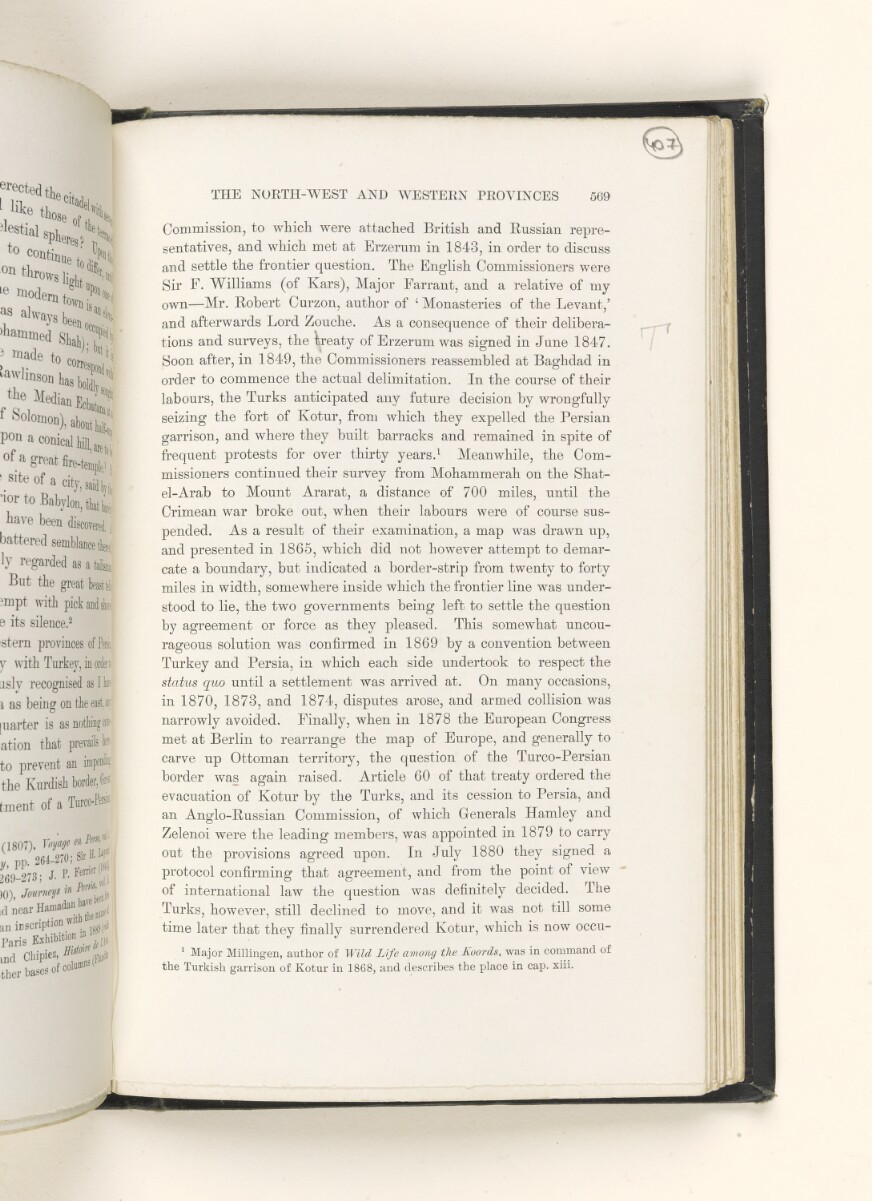
Annotated Copy of Persia and the Persian Question by George Curzon, with Inserted Papers [407r] (816/1814)
The record is made up of 2 volumes with inserts (898 folios). It was created in 1892-1924. It was written in English, Urdu and German. The original is part of the British Library: India Office The department of the British Government to which the Government of India reported between 1858 and 1947. The successor to the Court of Directors. Records and Private Papers Documents collected in a private capacity. .
Transcription
This transcription is created automatically. It may contain errors.
eStlal s Plier es ?
t0 Co iitiii ae * 1 , h
oa throws
16 mo dern to g w ;h»
ns a lways been
'tamined C 1
.V n , ade t0 cot ^
ia ''' lln sonh asbo ,;
^ Median Ecfei
Solomon), about,
P°n a conical biii s
ofa great fire-teij
‘. Slte of a eity, sa i (
’ior to Babylon, th
Ba\e been discove:
battered semblance
!y regarded as a t
But the great be,
^mpt with pick and slii
e its silence . 2
stern provinces of Pei,
y T with Turkey, in order i
isly recognised as I k
i as being on the eastpif
[uarter is as notbingct
ation that prevails k
to prevent an impend
the Kurdish border, W
tment of a Turcot
’ 0 ; Sir H. k
p > perrier
in PerA d
nth
m in l 1
istcin
iluinn 8
THE NORTH-AVEST AND AVESTERN PROVINCES 569
Commission, to which were attached British and Russian repre
sentatives, and which met at Erzerum in 1843, in order to discuss
and settle the frontier question. The English Commissioners were
Sir F. Williams (of Kars), Major Farrant, and a relative of my
own—Mr. Robert Curzon, author of ‘Monasteries of the
Levant
A geographical area corresponding to the region around the eastern Mediterranean Sea.
/
and afterwards Lord Zonche. As a consequence of their delibera
tions and surveys, the treaty of Erzernm was signed in June 1847.
Soon after, in 1849, the Commissioners reassembled at Baghdad in
order to commence the actual delimitation. In the course of their
labours, the Turks anticipated any future decision by wrongfully
seizing the fort of Kotur, from which they expelled the Persian
garrison, and where they built barracks and remained in spite of
frequent protests for over thirty years . 1 Meanwhile, the Com
missioners continued their survey from Mohammerah on the Shat-
el-Arab to Mount Ararat, a distance of 700 miles, until the
Crimean war broke out, when their labours were of course sus
pended. As a result of their examination, a map was drawn up,
and presented in 1865, which did not however attempt to demar
cate a boundary, but indicated a border-strip from twenty to forty
miles in width, somewhere inside which the frontier line was under
stood to lie, the two governments being left to settle the question
by agreement or force as they pleased. This somewhat uncou-
rageons solution was confirmed in 1869 by a convention between
Turkey and Persia, in which each side undertook to respect the
status quo until a settlement was arrived at. On many occasions,
in 1870, 1873, and 1874, disputes arose, and armed collision was
narrowly avoided. Finally, when in 1878 the European Congress
met at Berlin to rearrange the map of Europe, and generally to
carve up Ottoman territory, the question of the Turco-Persian
border was again raised. Article 60 of that treaty ordered the
evacuation of Kotur by the Turks, and its cession to Persia, and
an Anglo-Pussian Commission, of which Generals Hamley and
Zelenoi were the leading members, was appointed in 1879 to carry
out the provisions agreed upon. In July 1880 they signed a
protocol confirming that agreement, and from the point of view
of international law the question was definitely decided. The
Turks, however, still declined to move, and it was not till some
time later that they finally surrendered Kotur, which is now occu-
1 Major Millingen, author of Wild Life among the Koords, was in command of
the Turkish garrison of Kotur in 1868, and describes the place in cap. xiii.
About this item
- Content
These two volumes are George Curzon's own personal annotated copies of both volumes of his book Persia and the Persian Question , which was published in 1892. Alongside the volumes are various loose papers relating to Persia [Iran], consisting of the following: received correspondence; newspaper cuttings; publishers' press releases; cuttings from various booksellers' catalogues; various journal and magazine articles; two items of printed official British correspondence; several prints of photographs and sketches; and a few handwritten notes by Curzon.
In most cases these papers, which range in date from 1892 to 1924, relate to the chapters in the book where they were originally inserted, suggesting that they were kept by Curzon with the intention of using them to inform a revised edition of the book.
Of particular note among the small amount of correspondence are two letters received by Curzon in 1914 and 1915 from retired schoolmaster and Islamic scholar Sayyid Mazhar Hasan Musawi of Saharanpur, Uttar Pradesh, India (ff 5-9 and ff 44-53). These letters, which are written in Urdu and are accompanied by English translations, discuss in detail several inaccuracies found in the Urdu version of Persia and the Persian Question .
The various prints of photographs and sketches, which were originally inserted into volume two, are of different locations in the Gulf region. Several of these appear to have been produced in preparation for the publication of the second volume of John Gordon Lorimer's Gazetteer of the Persian Gulf The historical term used to describe the body of water between the Arabian Peninsula and Iran. , Oman and Central Arabia (i.e. the 'Geographical and Statistical' section) in 1908, as they are identical to the versions found in that volume.
Also of note among the loose papers are an illustrated article from Country Life dated 5 June 1920, entitled 'The People of Persia' (ff 36-37), and a printed family tree of the Shah of Persia [Aḥmad Shah Qājār], produced in preparation of his visit to Britain in 1919 (f 233).
Volume one of Persia and the Persian Question contains a map of Persia, Afghanistan and Beluchistan [Balochistan], which is folded inside the front cover (f 1).
The German language material consists of a publisher's press release for two books authored by German archaeologist Ernst Emil Herzfeld (ff 29-30).
- Extent and format
- 2 volumes with inserts (898 folios)
- Physical characteristics
Foliation: this shelfmark consists of two physical volumes. The foliation sequence commences at the first folio of volume one (1-463), and terminates at the last folio of volume two (ff 464-898); these numbers are written in pencil, are circled, and are located in the top right corner of the recto The front of a sheet of paper or leaf, often abbreviated to 'r'. side of each folio. Each volume contains a large number of loose leaves, which have been foliated in the order that they were inserted into the volume; for conservation reasons, these loose folios have been removed from the volume and stored separately. The foliation sequence does not include the front and back covers of the two volumes.
Pagination: the file also contains an original printed pagination sequence.
- Written in
- English, Urdu and German in Latin and Arabic script View the complete information for this record
Use and share this item
- Share this item
Annotated Copy of Persia and the Persian Question by George Curzon, with Inserted Papers [407r] (816/1814), British Library: India Office Records and Private Papers, Mss Eur F111/33, in Qatar Digital Library <https://www.qdl.qa/archive/81055/vdc_100157213846.0x000017> [accessed 5 July 2026]
https://www.qdl.qa/en/archive/81055/vdc_100157213846.0x000017
Copy and paste the code below into your web page where you would like to embed the image.
<meta charset="utf-8"><a href="https://www.qdl.qa/en/archive/81055/vdc_100157213846.0x000017">Annotated Copy of <em>Persia and the Persian Question</em> by George Curzon, with Inserted Papers [‎407r] (816/1814)</a> <a href="https://www.qdl.qa/en/archive/81055/vdc_100157213846.0x000017"> <img src="https://iiif.qdl.qa/iiif/images/81055/vdc_100000001491.0x00033b/Mss Eur F111_33_0828.jp2/full/!280,240/0/default.jpg" alt="" /> </a>
This record has a IIIF manifest available as follows. If you have a compatible viewer you can drag the icon to load it.https://www.qdl.qa/en/iiif/81055/vdc_100000001491.0x00033b/manifestOpen in Universal viewerOpen in Mirador viewerMore options for embedding images
Copyright: How to use this content
- Reference
- Mss Eur F111/33
- Title
- Annotated Copy of Persia and the Persian Questionby George Curzon, with Inserted Papers
- Pages
- 54r:135v, 147r:149v, 158r:180v, 183r:221v, 224r:224v, 227r:246v, 248r:257v, 259r:260v, 268r:362v, 364r:364v, 367r:388v, 390r:400v, 402r:416v, 419r:432v, 434r:444v, 448r:462v, 464r:471v, 475r:481v, 483r:513v, 516r:525v, 527r:544v, 546r:563v, 566r:598v, 600r:622v, 624r:656v, 658r:665v, 667r:675v, 678r:684v, 687r:688v, 691r:691v, 693r:693v, 695r:708v, 711r:721v, 724r:726v, 728r:729v, 731r:736v, 742r:742v, 746r:757v, 759r:761v, 763r:763v, 765r:765v, 772r:777v, 780r:789v, 793r:794v, 797r:809v, 811r:821v, 825r:840v, 843r:898v
- Author
- Curzon, George Nathaniel, 1st Marquess Curzon of Kedleston
- Usage terms
- Public Domain