
![Annotated Copy of <em>Persia and the Persian Question</em> by George Curzon, with Inserted Papers [‎768r] (1552/1814)](https://iiif.qdl.qa/iiif/images/81055/vdc_100000001491.0x00033b/Mss Eur F111_33_1572.jp2/full/!1200,1200/0/default.jpg "Annotated Copy of <em>Persia and the Persian Question</em> by George Curzon, with Inserted Papers [‎768r] (1552/1814)")
Annotated Copy of Persia and the Persian Question by George Curzon, with Inserted Papers [768r] (1552/1814)
The record is made up of 2 volumes with inserts (898 folios). It was created in 1892-1924. It was written in English, Urdu and German. The original is part of the British Library: India Office The department of the British Government to which the Government of India reported between 1858 and 1947. The successor to the Court of Directors. Records and Private Papers Documents collected in a private capacity. .
Transcription
This transcription is created automatically. It may contain errors.
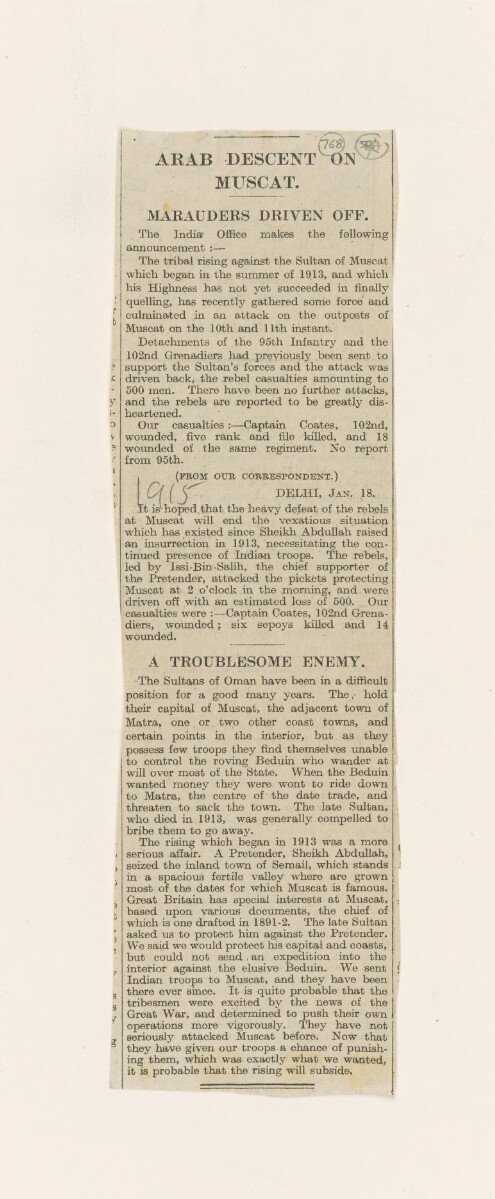
ARAB DESCENT
MUSCAT.
MARAUDERS DRIVEN OFF.
The
India Office
The department of the British Government to which the Government of India reported between 1858 and 1947. The successor to the Court of Directors.
makes the following
announcement :—
The tribal rising against the Sultan of Muscat
which began in the summer of 1913, and which
his Highness has not yet succeeded in finally
quelling, has recently gathered some force and
culminated in an attack on the outposts of
Muscat on the 10th and 11th instant.
Detachments of the 95th Infantry and the
102nd Grenadiers had previously been sent to
support the Sultan’s forces and the attack was
driven back, the rebel casualties amounting to
500 men. There have been no further attacks,
and the rebels are reported to be greatly dis
heartened.
Our casualties :—Captain Coates, 102nd,
wounded, five rank and file killed, and 18
wounded of the same regiment. No report
from 95th.
(from our correspondent.)
DELHI, Jan. 18.
It is 1 hoped that the heavy defeat of the rebels
at Muscat will end the vexatious situation
which has existed since Sheikh Abdullah raised
an insurrection in 1913, necessitating the con
tinued presence of Indian troops. The rebels,
led by Issi-Bin-Salih, the chief supporter of
the Pretender, attacked the pickets protecting
Muscat at 2 o’clock in the morning, and were
driven off with an estimated loss of 500. Our
casualties were :—Captain Coates, 102nd Grena
diers, wounded; six
sepoys
Term used in English to refer to an Indian infantryman. Carries some derogatory connotations as sometimes used as a means of othering and emphasising race, colour, origins, or rank.
killed and 14
wounded.
A TROUBLESOME ENEMY.
The Sultans of Oman have been in a difficult
position for a good many years. The/ hold
their capital of Muscat, the adjacent town of
Matra, one or two other coast towns, and
certain points in the interior, but as they
possess few troops they find themselves unable
to control the roving Beduin who wander at
will over most of the State. When the Beduin
wanted money they were wont to ride down
to Matra, the centre of the date trade, and
threaten to sack the town. The late Sultan,
who died in 1913, was generally compelled to
bribe them to go away.
The rising which began in 1913 was a more
serious affair. A Pretender, Sheikh Abdullah,
seized the inland town of Semail, which stands
in a spacious fertile valley where are grown
most of the dates for which Muscat is famous.
Great Britain has special interests at Muscat,
based upon various documents, the chief of
which is one drafted in 1891-2. The late Sultan
asked us to protect him against the Pretender.
We said we would protect his capital and coasts,
but could not send , an expedition into the
interior against the elusive Beduin. We sent
Indian troops to Muscat, and they have been
there ever smce. It is quite probable that the
tribesmen were excited by the news of the
Great War, and determined to push their own
operations more vigorously. They have not
seriously attacked Muscat before. Now that
they have given our troops a chance of punish
ing them, which was exactly what we wanted,
it is probable that the rising will subside.
About this item
- Content
These two volumes are George Curzon's own personal annotated copies of both volumes of his book Persia and the Persian Question , which was published in 1892. Alongside the volumes are various loose papers relating to Persia [Iran], consisting of the following: received correspondence; newspaper cuttings; publishers' press releases; cuttings from various booksellers' catalogues; various journal and magazine articles; two items of printed official British correspondence; several prints of photographs and sketches; and a few handwritten notes by Curzon.
In most cases these papers, which range in date from 1892 to 1924, relate to the chapters in the book where they were originally inserted, suggesting that they were kept by Curzon with the intention of using them to inform a revised edition of the book.
Of particular note among the small amount of correspondence are two letters received by Curzon in 1914 and 1915 from retired schoolmaster and Islamic scholar Sayyid Mazhar Hasan Musawi of Saharanpur, Uttar Pradesh, India (ff 5-9 and ff 44-53). These letters, which are written in Urdu and are accompanied by English translations, discuss in detail several inaccuracies found in the Urdu version of Persia and the Persian Question .
The various prints of photographs and sketches, which were originally inserted into volume two, are of different locations in the Gulf region. Several of these appear to have been produced in preparation for the publication of the second volume of John Gordon Lorimer's Gazetteer of the Persian Gulf The historical term used to describe the body of water between the Arabian Peninsula and Iran. , Oman and Central Arabia (i.e. the 'Geographical and Statistical' section) in 1908, as they are identical to the versions found in that volume.
Also of note among the loose papers are an illustrated article from Country Life dated 5 June 1920, entitled 'The People of Persia' (ff 36-37), and a printed family tree of the Shah of Persia [Aḥmad Shah Qājār], produced in preparation of his visit to Britain in 1919 (f 233).
Volume one of Persia and the Persian Question contains a map of Persia, Afghanistan and Beluchistan [Balochistan], which is folded inside the front cover (f 1).
The German language material consists of a publisher's press release for two books authored by German archaeologist Ernst Emil Herzfeld (ff 29-30).
- Extent and format
- 2 volumes with inserts (898 folios)
- Physical characteristics
Foliation: this shelfmark consists of two physical volumes. The foliation sequence commences at the first folio of volume one (1-463), and terminates at the last folio of volume two (ff 464-898); these numbers are written in pencil, are circled, and are located in the top right corner of the recto The front of a sheet of paper or leaf, often abbreviated to 'r'. side of each folio. Each volume contains a large number of loose leaves, which have been foliated in the order that they were inserted into the volume; for conservation reasons, these loose folios have been removed from the volume and stored separately. The foliation sequence does not include the front and back covers of the two volumes.
Pagination: the file also contains an original printed pagination sequence.
- Written in
- English, Urdu and German in Latin and Arabic script View the complete information for this record
Use and share this item
- Share this item
Annotated Copy of Persia and the Persian Question by George Curzon, with Inserted Papers [768r] (1552/1814), British Library: India Office Records and Private Papers, Mss Eur F111/33, in Qatar Digital Library <https://www.qdl.qa/archive/81055/vdc_100157213849.0x000099> [accessed 14 July 2026]
https://www.qdl.qa/en/archive/81055/vdc_100157213849.0x000099
Copy and paste the code below into your web page where you would like to embed the image.
<meta charset="utf-8"><a href="https://www.qdl.qa/en/archive/81055/vdc_100157213849.0x000099">Annotated Copy of <em>Persia and the Persian Question</em> by George Curzon, with Inserted Papers [‎768r] (1552/1814)</a> <a href="https://www.qdl.qa/en/archive/81055/vdc_100157213849.0x000099"> <img src="https://iiif.qdl.qa/iiif/images/81055/vdc_100000001491.0x00033b/Mss Eur F111_33_1572.jp2/full/!280,240/0/default.jpg" alt="" /> </a>
This record has a IIIF manifest available as follows. If you have a compatible viewer you can drag the icon to load it.https://www.qdl.qa/en/iiif/81055/vdc_100000001491.0x00033b/manifestOpen in Universal viewerOpen in Mirador viewerMore options for embedding images
Copyright: How to use this content
- Reference
- Mss Eur F111/33
- Title
- Annotated Copy of Persia and the Persian Questionby George Curzon, with Inserted Papers
- Pages
- 767r:768v
- Author
- Unknown
- Usage terms
- Public Domain