
![Printed papers on the political situation and military policy in Egypt [‎41r] (81/176)](https://iiif.qdl.qa/iiif/images/81055/vdc_100000001491.0x000298/Mss Eur F112_263_0083.jp2/full/!1200,1200/0/default.jpg "Printed papers on the political situation and military policy in Egypt [‎41r] (81/176)")
Printed papers on the political situation and military policy in Egypt [41r] (81/176)
The record is made up of 1 file (88 folios). It was created in 23 Apr 1923-17 Nov 1923. It was written in English. The original is part of the British Library: India Office The department of the British Government to which the Government of India reported between 1858 and 1947. The successor to the Court of Directors. Records and Private Papers Documents collected in a private capacity. .
Transcription
This transcription is created automatically. It may contain errors.
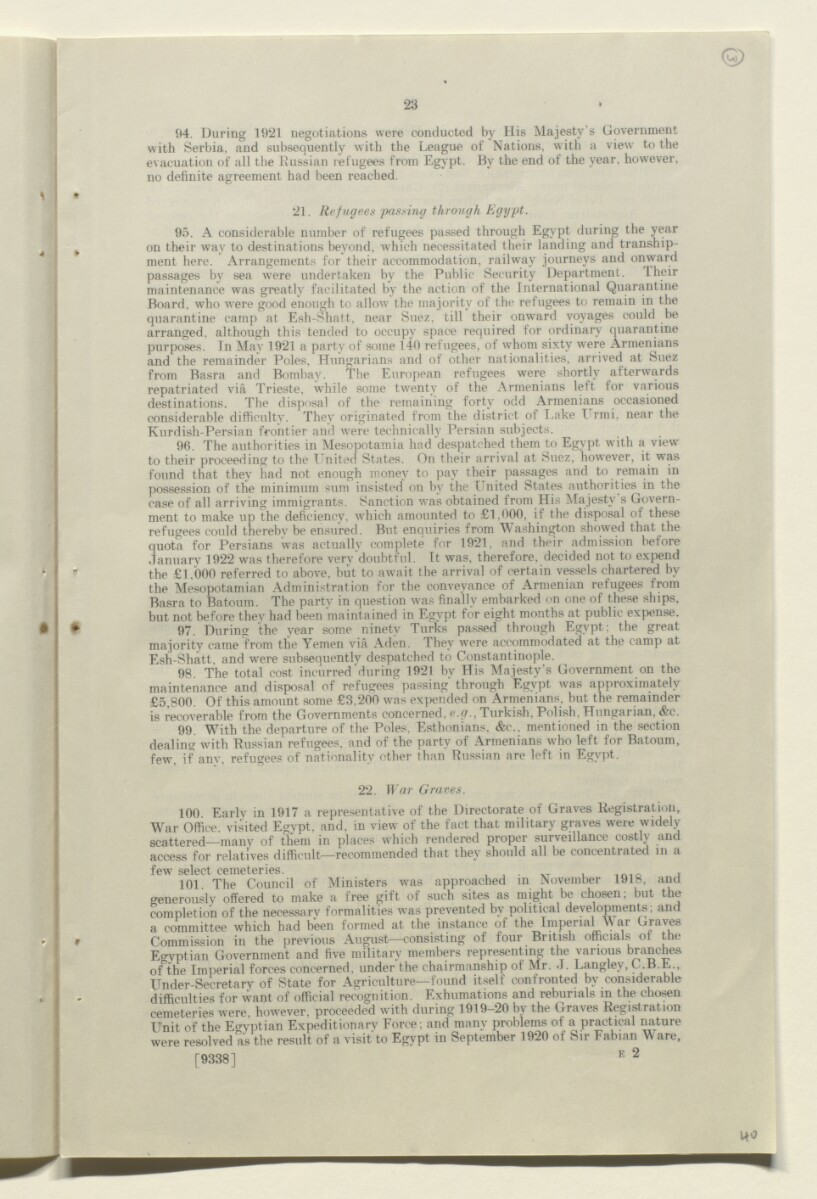
23
94. During 1921 negotiations were conducted by His Majesty’s Government
with Serbia, and subsequently with the League of Nations, with a view to the
evacuation of all the Russian refugees from Egypt. By the end of the year, however,
no definite agreement had been reached.
21. Refugees 'passing through Egypt.
95. A considerable number of refugees passed through Egypt during the year
on their way to destinations beyond, which necessitated their landing and tranship
ment here. Arrangements for their accommodation, railway journeys and onward
passages by sea were undertaken by the Public Security Department. Iheir
maintenance was greatly facilitated by the action of the International Quarantine
Board, who wore good enough to allow the majority of the refugees to remain in the
quarantine camp at Esh-Shatt, near Suez, till their onward voyages could be
arranged, although this tended to occupy space required for ordinary quarantine
purposes. In May 1921 a party of some 140 refugees, of whom sixty were Armenians
and the remainder Poles, Hungarians and of other nationalities, arrived at Suez
from Basra and Bombay. The European refugees were shortly afterwards
repatriated via Trieste, while some twenty of the Armenians left for various
destinations. The disposal of the remaining forty odd Armenians occasioned
considerable difficulty. They originated from the district of Lake I rmi. near the
Kurdish-Persian frontier and were technically Persian subjects.
96. The authorities in Mesopotamia had despatched them to Egypt with a view r
to their proceeding to the United States. On their arrival at Suez, however, it was
found that they had not enough money to pay their passages and to remain in
possession of the minimum sum insisted on by the United States authorities in the
case of all arriving immigrants. Sanction w r as obtained from His Majesty s Govern
ment to make up the deficiency, which amounted to £1,000, if the disposal of these
refugees could thereby be ensured. But enquiries from Washington showed that the
quota for Persians was actually complete for 1921, and their admission before
January 1922 was therefore very doubtful. It was, therefore, decided not to expend
the £1,000 referred to above, but to await the arrival of certain vessels chartered by
the Mesopotamian Administration for the conveyance of Armenian refugees from
Basra to Batoum. The party in question was finally embarked on one of these ships,
but not before they had been maintained in Egypt for eight months at public expense.
97. During the year some ninety Turks passed through Egypt; the great
majority came from the Yemen via Aden. They were accommodated at the camp at
Esh-Shatt, and were subsequently despatched to Constantinople.
98 The total cost incurred during 1921 by His Majesty’s Government on the
maintenance and disposal of refugees passing through Egypt was approximately
£5,800. Of this amount some £3,200 was expended on Armenians, but the remainder
is recoverable from the Governments concerned, e.g., Turkish, Polish, Hungarian, &c.
99. With the departure of the Poles, Esthonians. &c., mentioned in the section
dealing with Russian refugees, and of the party of Armenians who left for Batoum,
few. if any, refugees of nationality other than Russian are left in Egypt.
22. War Graves.
100. Earlv in 1917 a representative of the Directorate of Graves Registration,
War Office, visited Egypt, and, in view of the fact that military graves were widely
scattered—many of them in places which rendered proper surveillance costly and
access for relatives difficult—recommended that they should all be concentrated in a
f ew select cemeteries
101. The Council of Ministers was approached in November 1918, and
generously offered to make a tree gift of such sites as might be chosen, but the
completion of the necessarv formalities was prevented by political developments; and
a committee which had been formed at the instance of the Imperial W ar Graves
Commission in the previous August—consisting of four British officials ot the
Egyptian Government and five military members representing the various branches
of the Imperial forces concerned, under the chairmanship of Mr. J. Langley, C-B.L
Under-Secretary of State for Agriculture—found itself confronted by considerable
difficulties for want of official recognition. Exhumations and reburials in the chosen
cemeteries were, however, proceeded with during 1919-20 by the Graves Registration
Unit of the Egyptian Expeditionary Force; and many problems of a practical nature
were resolved as the result of a visit to Egypt in September 1920 of Sir Fabian Ware,
[9338] E 2
About this item
- Content
The file contains correspondence, memoranda, reports, and newspaper cuttings relating to the political situation in Egypt. The memoranda are written by officials at the War Office, Admiralty, Colonial Office, and Foreign Office and mostly concern military policy in Egypt and the defence of the Suez Canal. The Annual Report on Egypt for the year 1921, written by Field Marshall Edmund Henry Hynman Allenby, High Commissioner of Egypt, is also included. The report covers matters such as politics, finance, agriculture, public works, education, justice, and communications. Some correspondence from Ernest Scott, Acting High Commissioner in Egypt, to Lord Curzon can also be found within the file.
- Extent and format
- 1 file (88 folios)
- Arrangement
The file is arranged in roughly chronological order, from the front to the rear.
- Physical characteristics
Foliation: the main foliation sequence (used for referencing) commences at the first folio with 1, and terminates at the last folio with 88; these numbers are written in pencil, are circled, and are located in the top right corner of the recto The front of a sheet of paper or leaf, often abbreviated to 'r'. side of each folio. An additional foliation sequence is present in parallel between ff 1-88; these numbers are also written in pencil, but are not circled.
Pagination: the file also contains an original printed pagination sequence.
- Written in
- English in Latin script View the complete information for this record
Use and share this item
- Share this item
Printed papers on the political situation and military policy in Egypt [41r] (81/176), British Library: India Office Records and Private Papers, Mss Eur F112/263, in Qatar Digital Library <https://www.qdl.qa/archive/81055/vdc_100168512401.0x000052> [accessed 8 July 2026]
https://www.qdl.qa/en/archive/81055/vdc_100168512401.0x000052
Copy and paste the code below into your web page where you would like to embed the image.
<meta charset="utf-8"><a href="https://www.qdl.qa/en/archive/81055/vdc_100168512401.0x000052">Printed papers on the political situation and military policy in Egypt [‎41r] (81/176)</a> <a href="https://www.qdl.qa/en/archive/81055/vdc_100168512401.0x000052"> <img src="https://iiif.qdl.qa/iiif/images/81055/vdc_100000001491.0x000298/Mss Eur F112_263_0083.jp2/full/!280,240/0/default.jpg" alt="" /> </a>
This record has a IIIF manifest available as follows. If you have a compatible viewer you can drag the icon to load it.https://www.qdl.qa/en/iiif/81055/vdc_100000001491.0x000298/manifestOpen in Universal viewerOpen in Mirador viewerMore options for embedding images
Copyright: How to use this content
- Reference
- Mss Eur F112/263
- Title
- Printed papers on the political situation and military policy in Egypt
- Pages
- 2r:86v
- Author
- East India Company, the Board of Control, the India Office, or other British Government Department
- Usage terms
- Open Government Licence