
![Printed papers on the political situation and military policy in Egypt [‎80v] (160/176)](https://iiif.qdl.qa/iiif/images/81055/vdc_100000001491.0x000298/Mss Eur F112_263_0162.jp2/full/!1200,1200/0/default.jpg "Printed papers on the political situation and military policy in Egypt [‎80v] (160/176)")
Printed papers on the political situation and military policy in Egypt [80v] (160/176)
The record is made up of 1 file (88 folios). It was created in 23 Apr 1923-17 Nov 1923. It was written in English. The original is part of the British Library: India Office The department of the British Government to which the Government of India reported between 1858 and 1947. The successor to the Court of Directors. Records and Private Papers Documents collected in a private capacity. .
Transcription
This transcription is created automatically. It may contain errors.
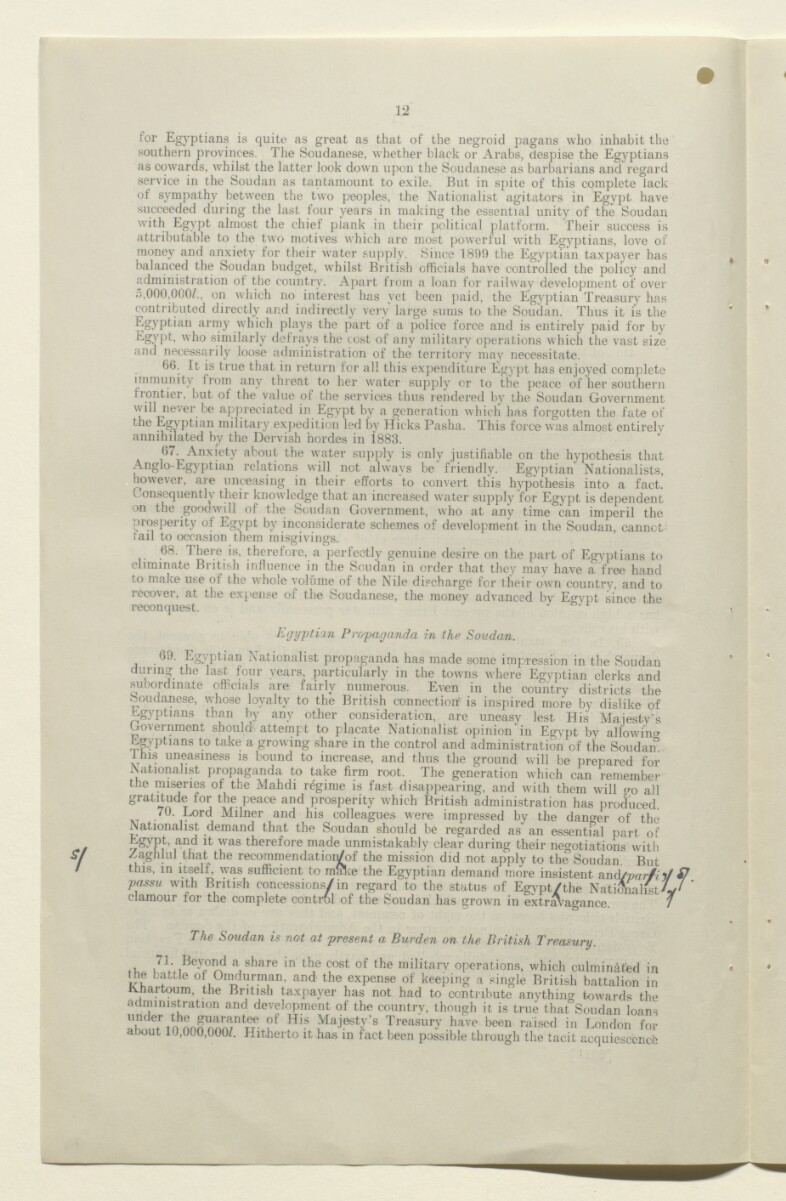
12
for Egyptians is quite as great as that of the negroid pagans who inhabit the
southern provinces. The Soudanese, whether black or Arabs, despise the Egyptians
as cowards, whilst the latter look down upon the Soudanese as barbarians and regard
service in the Soudan as tantamount to exile. But in spite of this complete lack
of sympathy between the two peoples, the Nationalist agitators in Egypt have
succeeded during the last four years in making the essential unity of the Soudan
with Egypt almost the chief plank in their political platform. Their success is
attributable to the two motives which are most powerful with Egyptians, love of
money and anxiety for their water supply. Since 1899 the Egyptian taxpayer has
balanced the Soudan budget, whilst British officials have controlled the policy and
administration of the country. Apart from a loan for railway development of over
5,000,000/., on which no interest has yet been paid, the Egyptian Treasury has
contributed directly and indirectly very large sums to the Soudan. Thus it is the
Egyptian army which plays the part of a police force and is entirely paid for by
Egypt, who similarly defrays the tost of any military operations which the vast size
and necessarily loose administration of the territory may necessitate.
66. It is true that in return for all this expenditure Egypt has enjoyed complete
immunity from any threat to her water supply or to the peace of her southern
frontier, but of the value of the services thus rendered by the Soudan Government
will never be appreciated in Egypt by a generation which has forgotten the fate of
the Egyptian military expedition led by Hicks
Pasha
An Ottoman title used after the names of certain provincial governors, high-ranking officials and military commanders.
. This force was almost entirely
annihilated by the Dervish hordes in i883.
67. Anxiety about the water supply is only justifiable on the hypothesis that
Anglo-Egyptian relations will not always be friendly. Egyptian" Nationalists,
however, are unceasing in their efforts 'to convert this hypothesis into a fact,’
Consequently their knowledge that an increased water supply "for Egypt is dependent
on the goodwill of the Soudan Government, who at any time can imperil the
prosperity of Egypt by inconsiderate schemes of development in the Soudan, cannot
rail to occasion them misgivings.
68. There is, therefore, a perfectly genuine desire on the part of Egyptians to
eliminate British influence in the Soudan in order that they may have a free hand
to make use of the whole volume of the Nile discharge for their own country, and to
i ecovei, at the expense or the Soudanese, the money advanced by Egypt since the
reconquest.
Egyptian Propaganda in the Soudan.
69. Egyptian Nationalist propaganda has made some imp-ression in the Soudan
during the last four years, particularly in the towns where Egyptian clerks and
suoordinate officials are fairly numerous. Even in the country districts the
Soudanese, whose loyalty to the British connection' is inspired more by dislike of
Egyptians than by any other consideration, are uneasy lest His Majesty’s
Government should attempt to placate Nationalist opinion "in Egypt by allowing
Egyptians to take a growing share in the control and administration of the Soudan
ibis uneasiness is bound to increase, and thus the ground will be prepared for
Nationalist propaganda to take firm root. The generation which can remember
the miseries of the Mahdi regime is fast disappearing, and with them will o- 0 all
gratitude for the peace and prosperity which British administration has produced.
. ’ .. rc * Mil ner and his colleagues were impressed by the danger of the
Nationalist demand that the Soudan should be regarded as an essential part of
Egypt, and it was therefore made unmistakably clear during their neo-otiations with
Zaghlul that the recommendation/of the mission did not apply to the Soudan But
this, in itself, was sufficient to m&ke the Egyptian demand more insistent imd/yur/ii/ SJ
passu with British concessions/in regard to the status of Egypt/the Nationalist//'
clamour for the complete control of the Soudan has grown in extr^agance. /
The Soudan is not at present a Burden on the British Treasury.
tP i 71 ;., Bey ^ d share in the cost of the military operations, which culminated in
the battle of Omdurman, and the expense of keeping a single British battalion in
Khartoum, the British taxpayer has not had to contribute anything towards the
administration and development of the country, though it is true that Soudan loans
in h noA • ? f HlS 1 Ma l esl T s Treasur y have been raised in London for
about 10,000,000/. Hitherto it has in fact been possible through the tacit acquiescence
About this item
- Content
The file contains correspondence, memoranda, reports, and newspaper cuttings relating to the political situation in Egypt. The memoranda are written by officials at the War Office, Admiralty, Colonial Office, and Foreign Office and mostly concern military policy in Egypt and the defence of the Suez Canal. The Annual Report on Egypt for the year 1921, written by Field Marshall Edmund Henry Hynman Allenby, High Commissioner of Egypt, is also included. The report covers matters such as politics, finance, agriculture, public works, education, justice, and communications. Some correspondence from Ernest Scott, Acting High Commissioner in Egypt, to Lord Curzon can also be found within the file.
- Extent and format
- 1 file (88 folios)
- Arrangement
The file is arranged in roughly chronological order, from the front to the rear.
- Physical characteristics
Foliation: the main foliation sequence (used for referencing) commences at the first folio with 1, and terminates at the last folio with 88; these numbers are written in pencil, are circled, and are located in the top right corner of the recto The front of a sheet of paper or leaf, often abbreviated to 'r'. side of each folio. An additional foliation sequence is present in parallel between ff 1-88; these numbers are also written in pencil, but are not circled.
Pagination: the file also contains an original printed pagination sequence.
- Written in
- English in Latin script View the complete information for this record
Use and share this item
- Share this item
Printed papers on the political situation and military policy in Egypt [80v] (160/176), British Library: India Office Records and Private Papers, Mss Eur F112/263, in Qatar Digital Library <https://www.qdl.qa/archive/81055/vdc_100168512401.0x0000a1> [accessed 23 June 2026]
https://www.qdl.qa/en/archive/81055/vdc_100168512401.0x0000a1
Copy and paste the code below into your web page where you would like to embed the image.
<meta charset="utf-8"><a href="https://www.qdl.qa/en/archive/81055/vdc_100168512401.0x0000a1">Printed papers on the political situation and military policy in Egypt [‎80v] (160/176)</a> <a href="https://www.qdl.qa/en/archive/81055/vdc_100168512401.0x0000a1"> <img src="https://iiif.qdl.qa/iiif/images/81055/vdc_100000001491.0x000298/Mss Eur F112_263_0162.jp2/full/!280,240/0/default.jpg" alt="" /> </a>
This record has a IIIF manifest available as follows. If you have a compatible viewer you can drag the icon to load it.https://www.qdl.qa/en/iiif/81055/vdc_100000001491.0x000298/manifestOpen in Universal viewerOpen in Mirador viewerMore options for embedding images
Copyright: How to use this content
- Reference
- Mss Eur F112/263
- Title
- Printed papers on the political situation and military policy in Egypt
- Pages
- 2r:86v
- Author
- East India Company, the Board of Control, the India Office, or other British Government Department
- Usage terms
- Open Government Licence