
![Printed papers on the political situation and military policy in Egypt [‎83r] (165/176)](https://iiif.qdl.qa/iiif/images/81055/vdc_100000001491.0x000298/Mss Eur F112_263_0167.jp2/full/!1200,1200/0/default.jpg "Printed papers on the political situation and military policy in Egypt [‎83r] (165/176)")
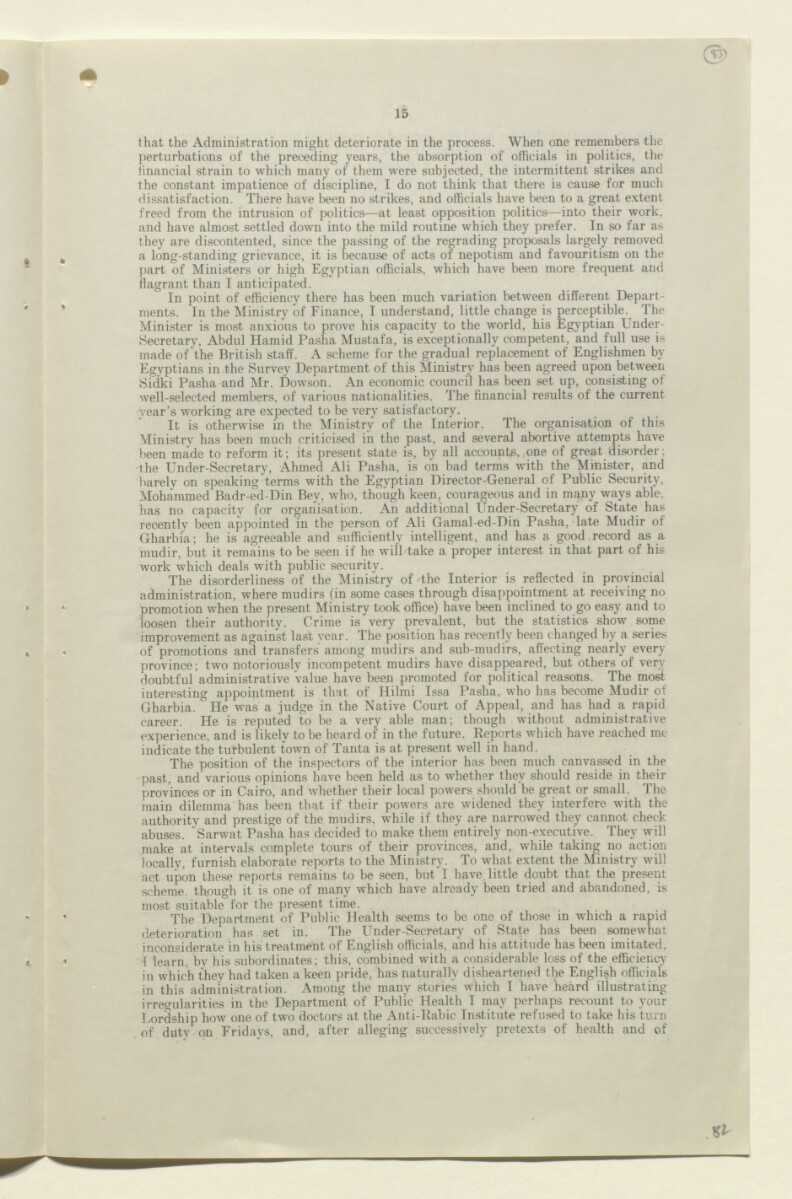
Printed papers on the political situation and military policy in Egypt [83r] (165/176)
The record is made up of 1 file (88 folios). It was created in 23 Apr 1923-17 Nov 1923. It was written in English. The original is part of the British Library: India Office The department of the British Government to which the Government of India reported between 1858 and 1947. The successor to the Court of Directors. Records and Private Papers Documents collected in a private capacity. .
Transcription
This transcription is created automatically. It may contain errors.
15
I
« ft
t •
* i
% *
that the Administration might deteriorate in the process. When one remembers the
perturbations of the preceding years, the absorption of officials in politics, the
linancial strain to which many of them were subjected, the intermittent strikes and
the constant impatience of discipline, I do not think that there is cause for much
dissatisfaction. There have been no strikes, and officials have been to a great extent
freed from the intrusion of politics—at least opposition politics—into their work,
and have almost settled down into the mild routine which they prefer. In so far as
they are discontented, since the passing of the regrading proposals largely removed
a long-standing grievance, it is because of acts of nepotism and favouritism on the
part of Ministers or high Egyptian officials, which have been more frequent and
flagrant than I anticipated.
In point of efficiency there has been much variation between different Depart
ments. In the Ministry of Finance, I understand, little change is perceptible. The
Minister is most anxious to prove his capacity to the world, his Egyptian Under
secretary, Abdul Hamid
Pasha
An Ottoman title used after the names of certain provincial governors, high-ranking officials and military commanders.
Mustafa, is exceptionally competent, and full use is
made of the British staff. A scheme for the gradual replacement of Englishmen by
Egyptians in the Survey Department of this Ministry has been agreed upon between
Sidki
Pasha
An Ottoman title used after the names of certain provincial governors, high-ranking officials and military commanders.
and Mr. Dowson. An economic council has been set up, consisting of
well-selected members, of various nationalities. The financial results of the current
vear’s working are expected to be very satisfactory.
It is otherwise in the Ministry of the Interior. The organisation of this
Ministry has been much criticised in the past, and several abortive attempts have
been made to reform it; its present state is, by all accounts, one of great disorder;
the Under-Secretary, Ahmed Ali
Pasha
An Ottoman title used after the names of certain provincial governors, high-ranking officials and military commanders.
, is on bad terms with the Minister, and
barely on speaking terms with the Egyptian Director-General of Public Security,
Mohammed Badr-ed-Din Bey, who, though keen, courageous and in mnny ways able,
has no capacitv for organisation. An additional Under-Secretary of State has
recently been appointed in the person of Ali Gamal-ed-Din
Pasha
An Ottoman title used after the names of certain provincial governors, high-ranking officials and military commanders.
, Tate Mudir of
Gharbia; he is agreeable and sufficiently intelligent, and has a good record as a
mudir, but it remains to be seen if he will take a proper interest in that part of his
work which deals with public security.
The disorderliness of the Ministry of the Interior is reflected in provincial
administration, where mudirs (in some cases through disappointment at receiving no
promotion when the present Ministry took office) have been inclined to go easy and to
loosen their authority. Crime is very prevalent, but the statistics show some
improvement as against last year. The position has recently been changed by a series
of promotions and transfers among mudirs and sub-mudirs, affecting nearly every
province; two notoriously incompetent mudirs have disappeared, but others of very
doubtful administrative value have been promoted for political reasons. The most
interesting appointment is that of Hilmi Issa
Pasha
An Ottoman title used after the names of certain provincial governors, high-ranking officials and military commanders.
, who has become Mudir of
Gharbia. He was a judge in the Native Court of iVppeal, and has had a rapid
career. He is reputed to be a very able man; though without administrative
experience, and is likely to be heard of in the future. Reports which have reached me
indicate the turbulent town of Tanta is at present well in hand.
The position of the inspectors of the interior has been much canvassed in the
past, and various opinions have been held as to whether they should reside in their
provinces or in Cairo, and whether their local powers should be great or small. The
main dilemma has been that if their powers are widened they interfere with the
authority and prestige of the mudirs, while if they are narrowed they cannot check
abuses. Sarwat
Pasha
An Ottoman title used after the names of certain provincial governors, high-ranking officials and military commanders.
has decided to make them entirely non-executive. They will
make at intervals complete tours of their provinces, and, while taking no action
locally, furnish elaborate reports to the Ministry. To what extent the Ministry will
act upon these reports remains to be seen, but I have, little doubt that the present
scheme, though it is one of many which have already been tried and abandoned, is
most suitable for the present time.
The Department of Public Health seems to be one of those in which a rapid
deterioration has set in. The Under-Secretary of State has been somewhat
inconsiderate in his treatment of English officials, and his attitude has been imitated,
f learn, by his subordinates; this, combined with a considerable loss of the efficiency
in which they had taken a keen pride, has naturally disheartened the English officials
in this administration. Among the many stories which I have heard illustrating
irregularities in the Department of Public Health I may perhaps recount to your
Lordship how one of two doctors at the Anti-Rabic Institute refused to take his turn
of duty on Fridays, and, after alleging successively pretexts of health and of
About this item
- Content
The file contains correspondence, memoranda, reports, and newspaper cuttings relating to the political situation in Egypt. The memoranda are written by officials at the War Office, Admiralty, Colonial Office, and Foreign Office and mostly concern military policy in Egypt and the defence of the Suez Canal. The Annual Report on Egypt for the year 1921, written by Field Marshall Edmund Henry Hynman Allenby, High Commissioner of Egypt, is also included. The report covers matters such as politics, finance, agriculture, public works, education, justice, and communications. Some correspondence from Ernest Scott, Acting High Commissioner in Egypt, to Lord Curzon can also be found within the file.
- Extent and format
- 1 file (88 folios)
- Arrangement
The file is arranged in roughly chronological order, from the front to the rear.
- Physical characteristics
Foliation: the main foliation sequence (used for referencing) commences at the first folio with 1, and terminates at the last folio with 88; these numbers are written in pencil, are circled, and are located in the top right corner of the recto The front of a sheet of paper or leaf, often abbreviated to 'r'. side of each folio. An additional foliation sequence is present in parallel between ff 1-88; these numbers are also written in pencil, but are not circled.
Pagination: the file also contains an original printed pagination sequence.
- Written in
- English in Latin script View the complete information for this record
Use and share this item
- Share this item
Printed papers on the political situation and military policy in Egypt [83r] (165/176), British Library: India Office Records and Private Papers, Mss Eur F112/263, in Qatar Digital Library <https://www.qdl.qa/archive/81055/vdc_100168512401.0x0000a6> [accessed 7 August 2026]
https://www.qdl.qa/en/archive/81055/vdc_100168512401.0x0000a6
Copy and paste the code below into your web page where you would like to embed the image.
<meta charset="utf-8"><a href="https://www.qdl.qa/en/archive/81055/vdc_100168512401.0x0000a6">Printed papers on the political situation and military policy in Egypt [‎83r] (165/176)</a> <a href="https://www.qdl.qa/en/archive/81055/vdc_100168512401.0x0000a6"> <img src="https://iiif.qdl.qa/iiif/images/81055/vdc_100000001491.0x000298/Mss Eur F112_263_0167.jp2/full/!280,240/0/default.jpg" alt="" /> </a>
This record has a IIIF manifest available as follows. If you have a compatible viewer you can drag the icon to load it.https://www.qdl.qa/en/iiif/81055/vdc_100000001491.0x000298/manifestOpen in Universal viewerOpen in Mirador viewerMore options for embedding images
Copyright: How to use this content
- Reference
- Mss Eur F112/263
- Title
- Printed papers on the political situation and military policy in Egypt
- Pages
- 2r:86v
- Author
- East India Company, the Board of Control, the India Office, or other British Government Department
- Usage terms
- Open Government Licence