
Overview
In the aftermath of the First World War, British imperialist strategists faced ‘a problem with peculiar and difficult features’ in the borderland between Iraq and Najd (IOR/L/PS/20/C204, f. 5v). Founded in 1921 from the Mesopotamian territories of the collapsed Ottoman Empire, the Kingdom of Iraq was a nominally independent entity, but was administered by British officials. The latter sought to stabilise Iraq’s borders and assert the legitimacy of their new client state by safeguarding the nomadic populations of the southern desert. Of particular concern were cross-border raids conducted by al-Ikhwān Islamist military force that contributed to Ibn Saud's rise to power. , which severely disrupted the routine of nomadic herding life. Attacks were also made into Najd, both by Iraqi tribes and by Najdi subjects of ‘Abd al-‘Aziz bin ‘Abd al-Rahman Al Sa‘ud (popularly known as Ibn Sa‘ud) who had relocated beyond his jurisdiction.
This cycle of violence heightened the risk of a broader conflict between Najd and Iraq, which would have been detrimental to British imperialist aims in the region. Controlling the border was therefore a key priority for British administrators. British anti-raiding policy during this period can be broadly divided into two phases. Initial efforts focused on establishing an early warning system and responding to attacks in real time. Later, British forces militarised the border to try to prevent raids altogether.
Intelligence Gathering and Communication Networks
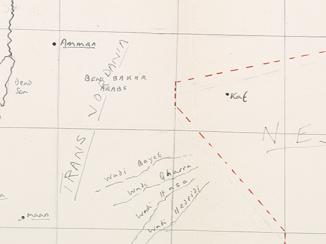
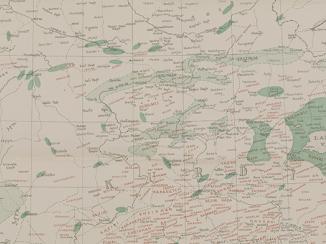
Combating raiding in this large and sparsely inhabited area was a formidable challenge. British officials began by dispatching surveyors to map it, identifying landing grounds for the Royal Air Force (RAF) and sites suitable for wireless stations. The shared experience of military service in the First World War evidently shaped the ways in which British personnel approached the raiding issue. For example, one of the maps created from these surveys has the Western Front superimposed ‘[t]o give an idea of distances.’
Archive items in this article


Mapping the desert depended on relatively new technologies. By using cars and planes, Lieutenant Walter James Dynes was able to re-map 30,000 square miles of desert between February and May 1925. Mapping efforts were combined with aerial patrols and the construction of wireless stations. By concerting these elements, the British Iraqi administration hoped to gain an active intelligence system that could detect imminent strikes, warn nearby herders to flee, and send an armed response before potential strikes.

Although this system had some successes, overall it neither meaningfully reduced cross-border raids nor built confidence in the Iraqi Government among the affected tribes.
Air Power
British imperialist strategists embraced the advancements in aerial warfare made during the First World War. Aircraft offered a realistic way to locate, pursue, and attack raiding parties before they retreated from the border. Air patrols seemed to have some deterrent effect. In 1925, John Frederick Higgins, the Air Officer Commanding in Iraq, reported that raiding had significantly reduced following a concentrated period of air patrols. The British officers overseeing operations against the Ikhwan also believed that aerial bombardment exerted a powerful psychological effect and could ‘remind the short-memoried bedouins [sic] that Government was still in earnest’ (IOR/R/15/5/38, f. 100r). Nevertheless, this was clearly not enough to deter raiders, and air power was primarily employed reactively. Any raiding party that evaded detection before its attack still had an excellent chance of escaping unhindered. Through the 1920s, British strategists took a more aggressive approach.
Related Articles

Buffer Zones: Akforce and the 1928 Operation
In 1928, British forces deployed a new strategy against raiders. A buffer zone was created on the Najdi side of the border by expelling all inhabitants from the area. This was intended to prevent assailants congregating before an attack or concealing themselves amongst peaceful groups. A specific military unit known as Akforce was formed that included aircraft, armoured cars, and infantry. The base of operations was at the Ur Railroad Station, with advanced bases in the desert protected by armoured cars. Once these were secured, RAF aircraft began to ‘sweep the country up to the border, and for a distance of seventy miles beyond it, clear of all Najd tribes’ (IOR/L/MIL/17/15/62, f. 7r). British air forces first dropped leaflets, ordering the tribes to vacate, and then also dropped warning bombs near groups that had not complied. Contemporary British sources claim that the buffer zone was cleared without any casualties among the Najdi tribes, though some of their animals were shot.
Under ideal circumstances, this militarised zone enabled Akforce to detect raids and respond pre-emptively. In April 1928, for instance, intelligence warned of an imminent attack into Najd, and Akforce aircraft located the raiding party before it could launch, ordering it to return to Iraqi territory. Armoured cars then arrested the leaders, who were handed over to the civil authorities. However, such successes were rare, and the border remained impossible to secure. To avoid disrupting negotiations that had begun in Jeddah between the Ikhwan and Ibn Sa‘ud, Akforce suspended its activities on the Najdi side of the border. The unit was dissolved in June that year.
The End of the Ikhwan
The British administration in Iraq struggled for over a decade against the problem of cross-border incursions. Its application of new methods and technologies yielded only marginal results. It was only through a political shift within Najd itself that the threat of raiding was lifted. By March 1929, relations between Ibn Sa‘ud and his Ikhwan subjects had deteriorated, largely due to the former’s prohibition of raiding, and several prominent Ikhwan leaders were in open rebellion. The defeat of the rebel Ikhwan movement at the Battle of Sabilla led to its fragmentation and drove its leaders to surrender or flee. The anti-raiding methods developed in the preceding decade were not entirely wasted, however. Ibn Sa‘ud owed part of his victory to the armoured cars and machine guns provided by Britain, as well as to the RAF aircraft that fought alongside his forces. Technological advances alone did not defeat the Ikhwan nor end cross-border raiding. However, when combined with a decisive shift in Najdi politics, they proved highly effective.