
![Papers written by Curzon on the Near and Middle East [‎97r] (193/348)](https://iiif.qdl.qa/iiif/images/81055/vdc_100000001491.0x00028c/Mss Eur F112_278_0193.jp2/full/!1200,1200/0/default.jpg "Papers written by Curzon on the Near and Middle East [‎97r] (193/348)")
Papers written by Curzon on the Near and Middle East [97r] (193/348)
The record is made up of 1 file (174 folios). It was created in 16 Nov 1917-17 Jan 1924. It was written in English and French. The original is part of the British Library: India Office The department of the British Government to which the Government of India reported between 1858 and 1947. The successor to the Court of Directors. Records and Private Papers Documents collected in a private capacity. .
Transcription
This transcription is created automatically. It may contain errors.
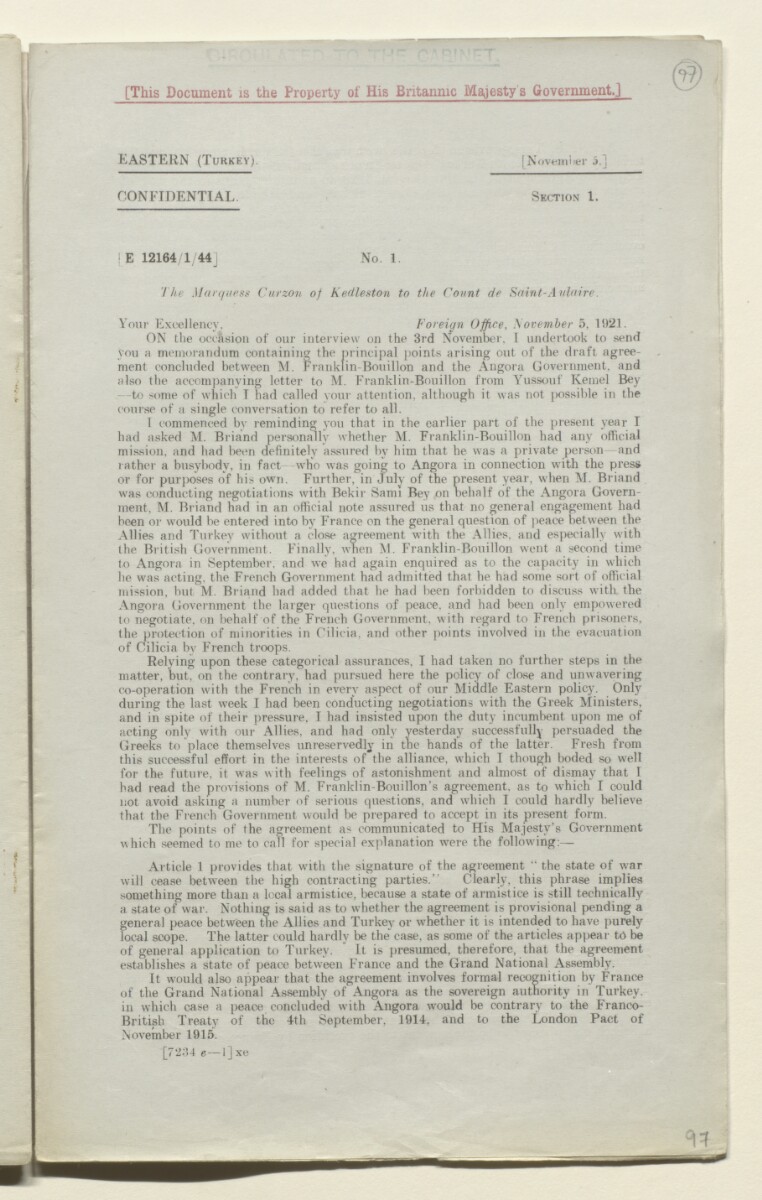
[This Document is the Property of His Britannic Majesty s Government.]
EASTERN (Turkey) f Noveni wer 5. i
CONFIDENTIAL. Section 1.
[E 12164/1/44 No. 1 .
The Marquess Curzou oj Kedleston to the Count de Saint-A via ire.
Your Excellency, Foreign Office, November o, 1921.
ON the occasion of our interview on the 3rd November. I undertook to send
you a memorandum containing the principal points arising out of the draft agree
ment concluded between M. Franklin-Bouillon and the Angora Government, and
also the accompanying letter to M. Franklin-Bouillon from Yussouf Kernel Bey
to some of which I had called your attention, although it was not possible in the
course of a single conversation to refer to all.
1 commenced by reminding you that in the earlier part of the present year I
had asked M. Briand personally whether M. Franklin-Bouillon had any official
mission, and had been definitely assured by him that he was a private person and
rather a busybody, in fact- who was going to Angora in connection with the press
or for purposes of his own. Further, in July of the present year, when M. Briand
was conducting negotiations with Bekir Sami Bey on oehalf of the Angora Govern
ment, M. Briand had in an official note assured us that no general engagement had
been or would be entered into by France on the general question of peace between the
Allies and Turkey without a close agreement with the Allies, and especially with
the British Government. Finally, when M. Franklin-Bouillon went a second time
to Angora in September, and we had again enquired as to the capacity in which
he was acting, the French Government had admitted that he had some sort of official
mission, but M. Briand had added that he had been forbidden to discuss with the
Angora Government the larger questions of peace, and had been only empowered
to negotiate, on behalf of the French Government, with regard to French prisoners,
the protection of minorities in Cilicia, and other points involved in the evacuation
of Cilicia by French troops.
Relying upon these categorical assurances, I had taken no further steps in the
matter, but, on the contrary, had pursued here the policy of close and unwavering
co-operation with the French in every aspect of our Middle Eastern policy. Only
during the last week I had been conducting negotiations with the Greek Ministers,
and in spite of their pressure. I had insisted upon the duty incumbent upon me of
acting only with our Allies, and had only yesterday successfully persuaded the
Greeks to place themselves unreservedly in the hands of the latter. Fresh from
this successful effort in the interests of the alliance, which I though boded so well
for the future, it was with feelings of astonishment and almost of dismay that I
had read the provisions of M. Franklin-Bouillon’s agreement, as to which I could
not avoid asking a number of serious questions, and which I could hardly believe
that the French Government would be prepared to accept in its present form.
The points of the agreement as communicated to His Majesty’s Government
which seemed to me to call for special explanation were the following:—
Article 1 provides that with the signature of the agreement “ the state of war
will cease between the high contracting parties.” Clearly, this phrase implies
something more than a local armistice, because a state of armistice is still technically
a state of war. Nothing is said as to whether the agreement is provisional pending a
general peace between the Allies and Turkey or whether it is intended to have purely
local scope. The latter could hardly be the case, as some of the articles appear to be
of general application to Turkey. ' It is presumed, therefore, that the agreement
establishes a state of peace between France and the Grand National Assembly.
It would also appear that the agreement involves formal recognition by France
of the Grand National Assembly of Angora as the sovereign authority in Turkey,
in which case a peace concluded with Angora would be contrary to the Franco-
British Treaty of the 4th September, 1914, and to the London Pact of
November 1915.
[7234 e — 1] xe
About this item
- Content
The file contains correspondence, memoranda, maps, and notes on various subjects connected to the Near and Middle East. The majority of the papers are written by George Curzon himself and concern the settlement of former territories of the Ottoman Empire following its break up after the First World War. Matters such as the Greek occupation of Smyrna, the division of Thrace, the Greco-Turkish War, Georgian independence, and the Treaties of Sèvres and Lausanne are all discussed.
Other matters covered by the file include those concerning the Arab territories of the former Ottoman Empire, American advisers in Persia, and the future of Palestine, including a report by the Committee on Palestine (Colonial Office) dated 27 July 1923 (folios 168-171).
Correspondence within the file is mostly between Curzon and representatives of the other Allied Powers, as well as officials from other governmental departments and diplomatic offices.
- Extent and format
- 1 file (174 folios)
- Arrangement
The file is arranged in chronological order from the front to the back.
- Physical characteristics
Foliation: the foliation sequence (used for referencing) commences at the first folio with 1, and terminates at the last folio with 174; these numbers are written in pencil, are circled, and are located in the top right corner of the recto The front of a sheet of paper or leaf, often abbreviated to 'r'. side of each folio.
- Written in
- English and French in Latin script View the complete information for this record
Use and share this item
- Share this item
Papers written by Curzon on the Near and Middle East [97r] (193/348), British Library: India Office Records and Private Papers, Mss Eur F112/278, in Qatar Digital Library <https://www.qdl.qa/archive/81055/vdc_100076917035.0x0000c2> [accessed 8 August 2026]
https://www.qdl.qa/en/archive/81055/vdc_100076917035.0x0000c2
Copy and paste the code below into your web page where you would like to embed the image.
<meta charset="utf-8"><a href="https://www.qdl.qa/en/archive/81055/vdc_100076917035.0x0000c2">Papers written by Curzon on the Near and Middle East [‎97r] (193/348)</a> <a href="https://www.qdl.qa/en/archive/81055/vdc_100076917035.0x0000c2"> <img src="https://iiif.qdl.qa/iiif/images/81055/vdc_100000001491.0x00028c/Mss Eur F112_278_0193.jp2/full/!280,240/0/default.jpg" alt="" /> </a>
This record has a IIIF manifest available as follows. If you have a compatible viewer you can drag the icon to load it.https://www.qdl.qa/en/iiif/81055/vdc_100000001491.0x00028c/manifestOpen in Universal viewerOpen in Mirador viewerMore options for embedding images
Copyright: How to use this content
- Reference
- Mss Eur F112/278
- Title
- Papers written by Curzon on the Near and Middle East
- Pages
- 2r:12v, 15r:48v, 54r:93v, 95r:105v, 118r:145r, 147v:153r, 154v, 156r:161v, 163r:173v, back, back-i
- Author
- East India Company, the Board of Control, the India Office, or other British Government Department
- Usage terms
- Open Government Licence