
![Report of the Special Mission to Egypt under Lord Milner, and related papers [‎78v] (158/473)](https://iiif.qdl.qa/iiif/images/81055/vdc_100000001491.0x000295/Mss Eur F112_260_0158.jp2/full/!1200,1200/0/default.jpg "Report of the Special Mission to Egypt under Lord Milner, and related papers [‎78v] (158/473)")
Report of the Special Mission to Egypt under Lord Milner, and related papers [78v] (158/473)
The record is made up of 1 file (237 folios). It was created in 15 May 1920-14 Oct 1921. It was written in English. The original is part of the British Library: India Office The department of the British Government to which the Government of India reported between 1858 and 1947. The successor to the Court of Directors. Records and Private Papers Documents collected in a private capacity. .
Transcription
This transcription is created automatically. It may contain errors.
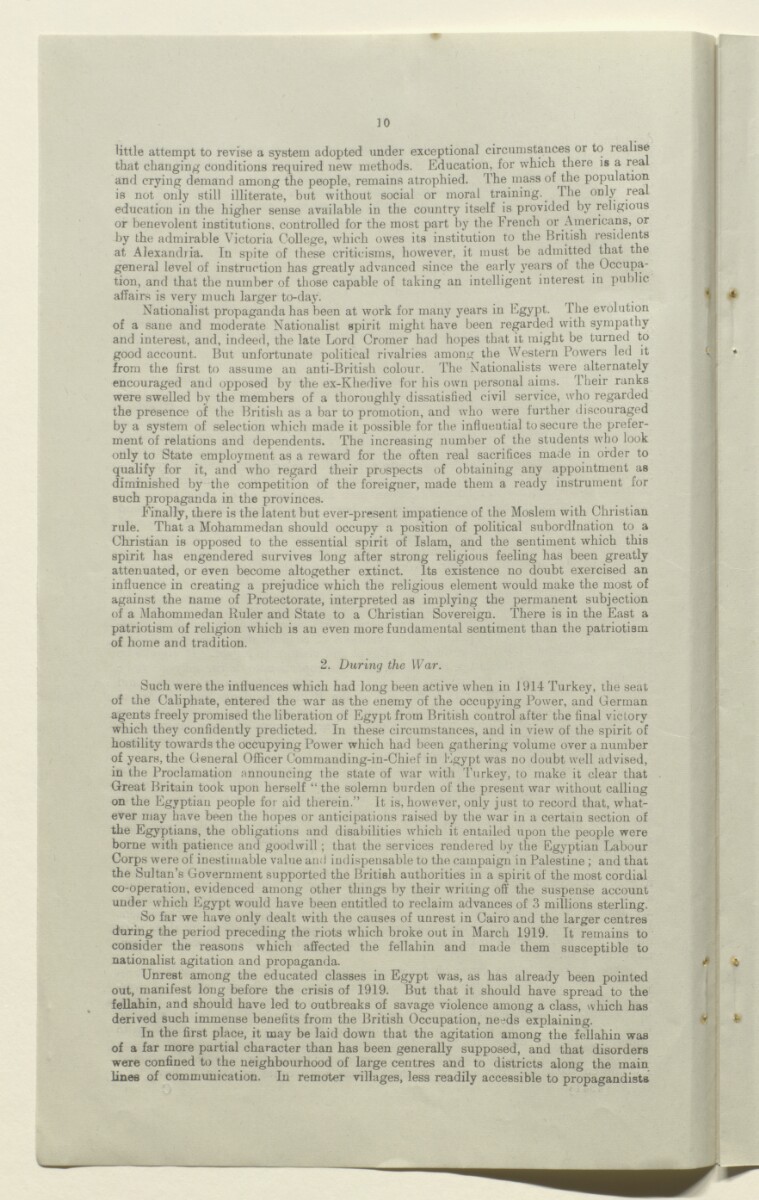
10
little attempt to revise a system adopted under exceptional circumstances or to realise
that changing conditions required new methods. Education, for which there is a real
and crying demand among the people, remains atrophied. The mass of the population
is not only still illiterate, but without social or moral training. 1 be only real
education in the higher sense available in the country itself is provided by religious
or benevolent institutions, controlled for the most part by the French or Americans, or
by the admirable Victoria College, which owes its institution to the British residents
at Alexandria. In spite of these criticisms, however, it must be admitted that the
genera] level of instruction has greatly advanced since the early years of the Occupa
tion, and that the number of those capable of taking an intelligent interest in public
affairs is very much larger to-day.
Nationalist propaganda has been at work for many years in Egypt. Lhe evolution
of a sane and moderate Nationalist spirit might have been regarded with sympathy
and interest, and, indeed, the late Lord Cromer had hopes that it might be turned to
good account. But unfortunate political rivalries among the Western Powers led it
from the first to assume an anti-British colour. The Nationalists were alternately
encouraged and opposed by the ex-Khedive for his own personal aims. Their ranks
were swelled by the members of a thoroughly dissatisfied civil service, who regarded
the presence of the British as a bar to promotion, and who were further discouraged
by a system of selection which made it possible for the influential to secure the prefer
ment of relations and dependents. The increasing number of the students who look
only to State employment as a reward for the often real sacrifices made in order to
qualify for it, and who regard their prospects of obtaining any appointment as
diminished by the competition of the foreigner, made them a ready instrument for
such propaganda in the provinces.
Finally, there is the latent but ever-present impatience of the Moslem with Christian
rule. That a Mohammedan should occupy a position of political subordination to a
Christian is opposed to the essential spirit of Islam, and the sentiment which this
spirit has engendered survives long after strong religious feeling has been greatly
attenuated, or even become altogether extinct. Its existence no doubt exercised an
influence in creating a prejudice which the religious element would make the most of
against the name of Protectorate, interpreted as implying the permanent subjection
of a Mahommedan Ruler and State to a Christian Sovereign. There is in the East a
patriotism of religion which is an even more fundamental sentiment than the patriotism
of home and tradition.
2. During the War.
Such were the influences which had long been active when in 1914 Turkey, the seat
of the Caliphate, entered the war as the enemy of the occupying Power, and German
agents freely promised the liberation of Egypt from British control after the final victory
which they confidently predicted. In these circumstances, and in view of the spirit of
hostility towards the occupying Power which had been gathering volume over a number
of years, the General Officer Commanding-in-Chief in Egypt was no doubt well advised,
in the Proclamation announcing the state of war with Turkey, to make it clear that
Great Britain took upon herself “ the solemn burden of the present war without calling
on the Egyptian people for aid therein.” It is,however, only just to record that, what
ever may have been the hopes or anticipations raised by the war in a certain section of
the Egyptians, the obligations and disabilities which it entailed upon the people were
borne with patience and goodwill ; that the services rendered by the Egyptian Labour
Corps were of inestimable value and indispensable to the campaign in Palestine ; and that
the Sultan’s Government supported the British authorities in a spirit of the most cordial
co-operation, evidenced among other things by their writing off the suspense account
under which Egypt would have been entitled to reclaim advances of 3 millions sterling.
So far we have only dealt with the causes of unrest in Cairo and the larger centres
during the period preceding the riots which broke out in March 1919. It remains to
consider the reasons which affected the
fellahin
Arabic for ‘peasant’. It was used by British officials to refer to agricultural workers or to members of a social class employed primarily in agricultural labour.
and made them susceptible to
nationalist agitation and propaganda.
Unrest among the educated classes in Egypt was, as has already been pointed
out, manifest long before the crisis of 1919. But that it should have spread to the
fellahin
Arabic for ‘peasant’. It was used by British officials to refer to agricultural workers or to members of a social class employed primarily in agricultural labour.
, and should have led to outbreaks of savage violence among a class, which has
derived such immense benefits from the British Occupation, needs explaining.
In the first place, it may be laid down that the agitation among the
fellahin
Arabic for ‘peasant’. It was used by British officials to refer to agricultural workers or to members of a social class employed primarily in agricultural labour.
was
of a far more partial character than has been generally supposed, and that disorders
were confined to the neighbourhood of large centres and to districts along the main
lines of communication. In remoter villages, less readily accessible to propagandists
About this item
- Content
The file contains official correspondence, memoranda, and reports relating to political affairs in Egypt. The correspondents and authors are officials at the Foreign Office (Lord Curzon was Secretary of State for Foreign Affairs at the time), War Office, Air Ministry, Admiralty, Colonial Office, Board of Trade, Board of Education, as well as those within the Egyptian civil service.
The file contains copies of reports of the Special Mission to Egypt (folios 1-7, 75-93, and 175-194), led by Lord Alfred Milner, whose purpose was to investigate and advise following the Egyptian Revolution of 1919. Much of the content of the file is in response to the findings and recommendations of the Mission and discusses the possibilities of a political settlement with Egypt.
- Extent and format
- 1 file (237 folios)
- Arrangement
The file is arranged in chronological order, from the front to the rear.
- Physical characteristics
Foliation: the foliation sequence (used for referencing) commences at the front cover with 1, and terminates at the inside back cover with 235; these numbers are written in pencil, are circled, and are located in the top right corner of the recto The front of a sheet of paper or leaf, often abbreviated to 'r'. side of each folio. The file has one foliation anomaly, f 76a.
- Written in
- English in Latin script View the complete information for this record
Use and share this item
- Share this item
Report of the Special Mission to Egypt under Lord Milner, and related papers [78v] (158/473), British Library: India Office Records and Private Papers, Mss Eur F112/260, in Qatar Digital Library <https://www.qdl.qa/archive/81055/vdc_100080131819.0x00009f> [accessed 29 July 2026]
https://www.qdl.qa/en/archive/81055/vdc_100080131819.0x00009f
Copy and paste the code below into your web page where you would like to embed the image.
<meta charset="utf-8"><a href="https://www.qdl.qa/en/archive/81055/vdc_100080131819.0x00009f">Report of the Special Mission to Egypt under Lord Milner, and related papers [‎78v] (158/473)</a> <a href="https://www.qdl.qa/en/archive/81055/vdc_100080131819.0x00009f"> <img src="https://iiif.qdl.qa/iiif/images/81055/vdc_100000001491.0x000295/Mss Eur F112_260_0158.jp2/full/!280,240/0/default.jpg" alt="" /> </a>
This record has a IIIF manifest available as follows. If you have a compatible viewer you can drag the icon to load it.https://www.qdl.qa/en/iiif/81055/vdc_100000001491.0x000295/manifestOpen in Universal viewerOpen in Mirador viewerMore options for embedding images
Copyright: How to use this content
- Reference
- Mss Eur F112/260
- Title
- Report of the Special Mission to Egypt under Lord Milner, and related papers
- Pages
- front, front-i, 2r:39v, 42r:50v, 53r:76v, 76ar:76av, 77r:140v, 143r:143v, 144ar, 144r:235v
- Author
- East India Company, the Board of Control, the India Office, or other British Government Department
- Usage terms
- Open Government Licence