
![Enclosures of Letter to Her Majesty's Secretary of State for India, No.213, dated 27 November 1874: Nos. 3 to 31 of Abstract of Contents, from Foreign Department, Fort William [‎32v] (64/102)](https://iiif.qdl.qa/iiif/images/81055/vdc_100000001524.0x000384/Mss Eur F126_81_0064.jp2/full/!1200,1200/0/default.jpg "Enclosures of Letter to Her Majesty's Secretary of State for India, No.213, dated 27 November 1874: Nos. 3 to 31 of Abstract of Contents, from Foreign Department, Fort William [‎32v] (64/102)")
Enclosures of Letter to Her Majesty's Secretary of State for India, No.213, dated 27 November 1874: Nos. 3 to 31 of Abstract of Contents, from Foreign Department, Fort William [32v] (64/102)
The record is made up of 51 folios. It was created in 27 Nov 1874. It was written in English. The original is part of the British Library: India Office The department of the British Government to which the Government of India reported between 1858 and 1947. The successor to the Court of Directors. Records and Private Papers Documents collected in a private capacity. .
Transcription
This transcription is created automatically. It may contain errors.
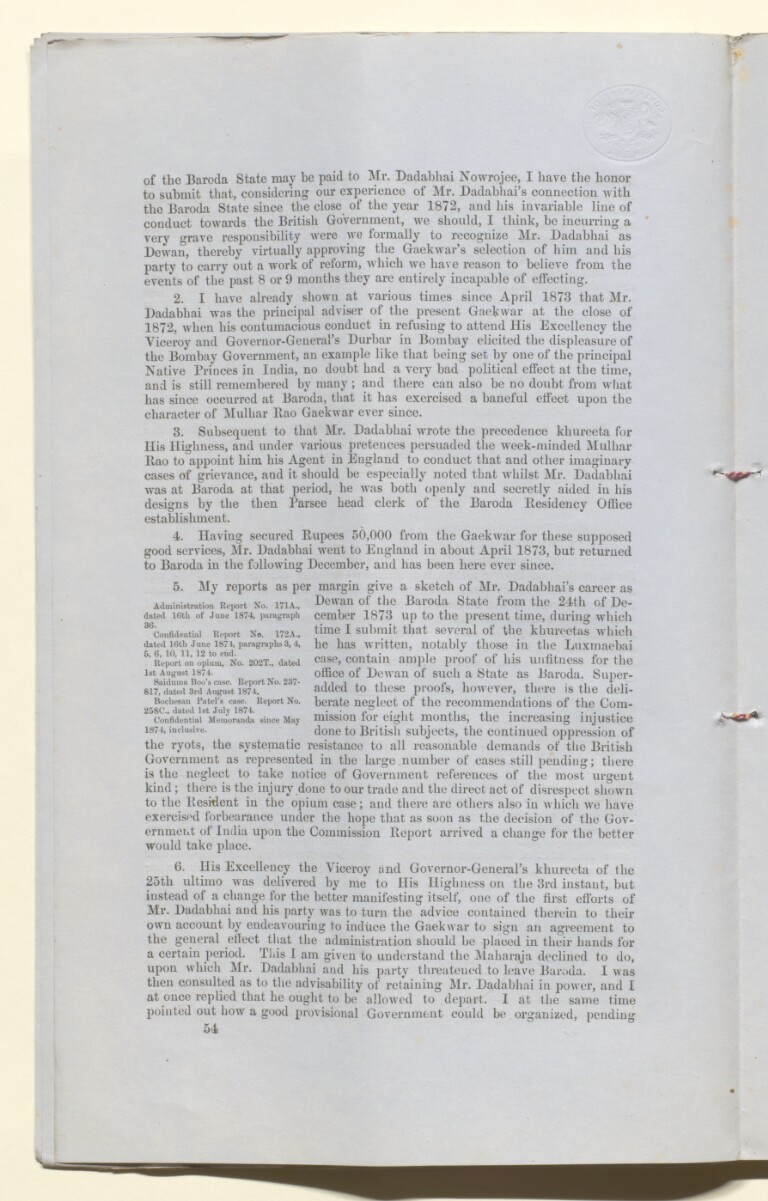
of the Baroda State may be paid to Mr. Badabhai Nowrojee, I have the honor
to submit that, coDsidering our experience of Mr. Dadabhai's connection with
the Baroda State since the close of the year 1872, and his invariable line of
conduct towards the British Government, we should, I think, be incurring a
very grave responsibility were we formally to recognize Mr. Dadabhai as
Dewan, thereby virtually approving the Gaekwar's selection of him and his
party to carry out a work of reform, which we have reason to believe from the
events of the past 8 or 9 months they are entirely incapable of effecting.
2. I have already shown at various times since April 1873 that Mr.
Dadabhai w T cis the principal adviser of the present Gaekwar at the close of
1872, when his contumacious conduct in refusing to attend His Excellency the
Viceroy and Governor-Generars
Durbar
A public or private audience held by a high-ranking British colonial representative (e.g. Viceroy, Governor-General, or member of the British royal family).
in Bombay elicited the displeasure of
the Bombay Government, an example like that being set by one of the principal
Native Princes in India, no doubt had a very bad political effect at the time,
and is still remembered by many ; and there can also be no doubt from what
has since occurred at Baroda, that it has exercised a baneful effect upon the
character of Mulhar Bao Gaekwar ever since.
3. Subsequent to that Mr. Dadabhai wrote the precedence
khureeta
An important letter usually sent in an elaborate textile pouch, dispatched as part of the royal or diplomatic correspondence of rulers and elites.
for
His Highness, and under various pretences persuaded the week-minded Mulhar
Rao to appoint him his Agent in England to conduct that and other imaginary
cases of grievance, and it should be especially noted that whilst Mr. Dadabhai
was at Baroda at that period, he was both openly and secretly aided in his
designs by the then Parsee head clerk of the Baroda Besidency Office
establishment.
4. Having secured
Rupees
Indian silver coin also widely used in the Persian Gulf.
50,000 from the Gaekwar for these supposed
good services, Mr. Dadabhai went to England in about April 1873, but returned
to Baroda in the following December, and has been here ever since.
5. My reports as per margin give a sketch of Mr. Dadabhai's career as
Administration Report No, 17U., Devvan ot ' tj" 3 Baroda State from the 24th of De-
dated i6th of June 1874, paragraph cember 1873 up to the present time, during which
^Confidential Report No. 172A., time I submit that several of the khureetas which
dated 16th June 1871, paragraphs 3,4, he liaS Written, notably tllOSC ill the Luxmaebai
5 'Report 1 (In i.pium? 1 No. 202T., dated case, contain ample proof of his unfitness for the
ist August 1874. office of Dewan of such a State as Baroda. Super-
Saiduma Boo's case. Report No. 237- iiii.j.1 -..i 4 ,.
617, dated 3rd August 1874. added to these proofs, however, there is the deh-
Bochesan Patei's case. Report No. berate neolect of the recommendations of the Com-
258C., dated 1st July 1874. •• /» • i i. i.i j.i • •
Confidential Memoranda since May miSSlOll 101 eigllt mOlltllS, tllC Increasing injustice
1874, inclusive. done to British subjects, the continued oppression of
the ryots, the systematic resistance to all reasonable demands of the British
Government as represented in the large,number of cases still pending; there
is the neglect to take notice of Government references of the most urgent
kind ; there is the injury done to our trade and the direct act of disrespect shown
to the Besklent in the opium case; and there are others also in which we have
exercised forbearance under the hope that as soon as the decision of the Gov
ernment of India upon the Commission Report arrived a change for the better
would take place.
G. His Excellency the Viceroy and Governor-General's
khureeta
An important letter usually sent in an elaborate textile pouch, dispatched as part of the royal or diplomatic correspondence of rulers and elites.
of the
25th ultimo was delivered by me to His Highness on the 3rd instant, but
instead of a change for the better manifesting itself, one of the first efforts of
Mr. Dadabhai and his party was to turn the advice contained therein to their
own account by endeavouring to induce the Gaekwar to sign an agreement to
the general ellect that the administration should be placed in their hands for
a certain period. This I am given to understand the Maharaja declined to do,
upon which Mr. Dadabhai and his party threatened to leave Baroda. I was
then consulted as to the advisability of retaining Mr. Dadabhai in power, and I
at once replied that he ought to be allowed to depart. 1 at the same time
pointed out how a good X )rovisional Government could be organized, pending
54
About this item
- Content
Enclosures 3-31 that accompanied letter No.213 to Her Majesty's Secretary of State for India, with a list of abstracts to the enclosures, comprising mainly correspondence between the Secretary to the Government of Bombay From c. 1668-1858, the East India Company’s administration in the city of Bombay [Mumbai] and western India. From 1858-1947, a subdivision of the British Raj. It was responsible for British relations with the Gulf and Red Sea regions. , the Resident at Baroda, the Gaekwar of Baroda and the Secretary to the Government of India, Financial Department.
Enclosures 3-15 are letters and telegrams regarding the Gaekwar of Baroda's work to reform his administration following the publication of the Baroda Commission Report and instructions from the Government of India in relation to it.
Enclosures 16-27 relate to an attempt to poison the British Resident at Baroda, Colonel Phayre; the Colonel's belief that the Gaekwar of Baroda had orchestrated the attempted poisoning; and the Gaekwar's subsequent request that the Colonel be removed from his position as Resident.
Enclosures 28-31 relate to the appointment of Sir Lewis Pelly, Agent to the Governor General for Rajputana [Rājasthān] as Special Commissioner at Baroda.
- Extent and format
- 51 folios
- Written in
- English in Latin script View the complete information for this record
Use and share this item
- Share this item
Enclosures of Letter to Her Majesty's Secretary of State for India, No.213, dated 27 November 1874: Nos. 3 to 31 of Abstract of Contents, from Foreign Department, Fort William [32v] (64/102), British Library: India Office Records and Private Papers, Mss Eur F126/81, ff 1-51, in Qatar Digital Library <https://www.qdl.qa/archive/81055/vdc_100023626960.0x000041> [accessed 18 July 2026]
https://www.qdl.qa/en/archive/81055/vdc_100023626960.0x000041
Copy and paste the code below into your web page where you would like to embed the image.
<meta charset="utf-8"><a href="https://www.qdl.qa/en/archive/81055/vdc_100023626960.0x000041">Enclosures of Letter to Her Majesty's Secretary of State for India, No.213, dated 27 November 1874: Nos. 3 to 31 of Abstract of Contents, from Foreign Department, Fort William [‎32v] (64/102)</a> <a href="https://www.qdl.qa/en/archive/81055/vdc_100023626960.0x000041"> <img src="https://iiif.qdl.qa/iiif/images/81055/vdc_100000001524.0x000384/Mss Eur F126_81_0064.jp2/full/!280,240/0/default.jpg" alt="" /> </a>
This record has a IIIF manifest available as follows. If you have a compatible viewer you can drag the icon to load it.https://www.qdl.qa/en/iiif/81055/vdc_100000001524.0x000384/manifestOpen in Universal viewerOpen in Mirador viewerMore options for embedding images
Copyright: How to use this content
- Reference
- Mss Eur F126/81, ff 1-51
- Title
- Enclosures of Letter to Her Majesty's Secretary of State for India, No.213, dated 27 November 1874: Nos. 3 to 31 of Abstract of Contents, from Foreign Department, Fort William
- Pages
- 1r:51v
- Author
- East India Company, the Board of Control, the India Office, or other British Government Department
- Usage terms
- Open Government Licence