
![Enclosures of Letter to Her Majesty's Secretary of State for India, No.213, dated 27 November 1874: Nos. 3 to 31 of Abstract of Contents, from Foreign Department, Fort William [‎48r] (95/102)](https://iiif.qdl.qa/iiif/images/81055/vdc_100000001524.0x000384/Mss Eur F126_81_0095.jp2/full/!1200,1200/0/default.jpg "Enclosures of Letter to Her Majesty's Secretary of State for India, No.213, dated 27 November 1874: Nos. 3 to 31 of Abstract of Contents, from Foreign Department, Fort William [‎48r] (95/102)")
Enclosures of Letter to Her Majesty's Secretary of State for India, No.213, dated 27 November 1874: Nos. 3 to 31 of Abstract of Contents, from Foreign Department, Fort William [48r] (95/102)
The record is made up of 51 folios. It was created in 27 Nov 1874. It was written in English. The original is part of the British Library: India Office The department of the British Government to which the Government of India reported between 1858 and 1947. The successor to the Court of Directors. Records and Private Papers Documents collected in a private capacity. .
Transcription
This transcription is created automatically. It may contain errors.
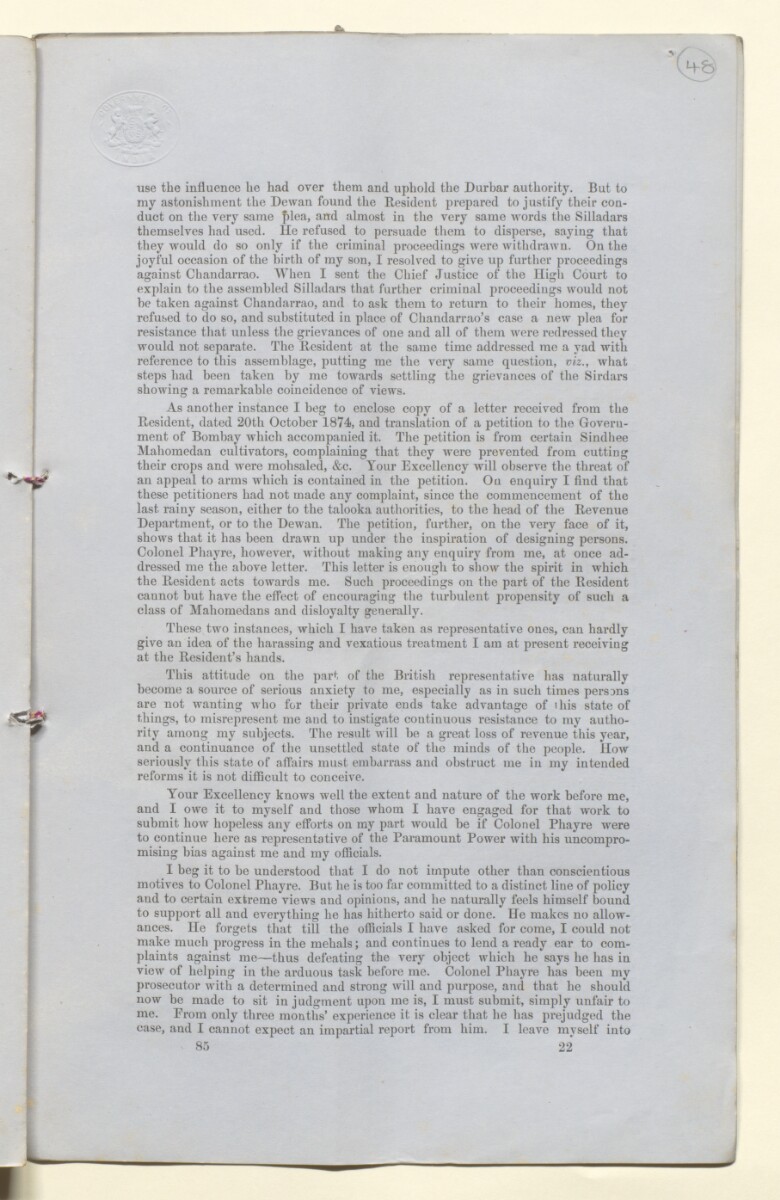
use the influence lie had over them and uphold the
Durbar
A public or private audience held by a high-ranking British colonial representative (e.g. Viceroy, Governor-General, or member of the British royal family).
authority. But to
my astonishment the Dewan found the Resident prepared to justify their con
duct on the very same plea, and almost in the very same words the Silladars
themselves had used. lie refused to persuade them to disperse, saying that
they would do so only if the criminal proceedings were withdrawn. On the
joyful occasion of the birth of my son, I resolved to give up further proceedings
against Chandarrao. When I sent the Chief Justice of the High Court to
explain to the assembled Silladars that further criminal proceedings would not
be taken against Chandarrao, and to ask them to return to their homes, they
refused to do so, and substituted in place of Chandarrao's case a new plea for
resistance that unless the grievances of one and all of them were redressed they
would not separate. The Resident at the same time addressed me a yad with
reference to this assemblage, putting me the very same question, viz., what
steps had been taken by me towards settling the grievances of the
Sirdars
Leader of a tribe or a polity; also refers to a military rank or title given to a commander of an army or division.
showing a remarkable coincidence of views.
As another instance I beg to enclose copy of a letter received from the
Resident, dated 20th October 1874, and translation of a petition to the Govern
ment of Bombay which accompanied it. The petition is from certain Sindhee
Mahomedan cultivators, complaining that they were prevented from cutting
their crops and were mohsaled, &c. Your Excellency will observe the threat of
an appeal to arms which is contained in the petition. On enquiry I find that
these petitioners had not made any complaint, since the commencement of the
last rainy season, either to the talooka authorities, to the head of the Revenue
Department, or to the Dewan. The petition, further, on the very face of it,
shows that it has been drawn up under the inspiration of designing persons.
Colonel Phayre, however, without making any enquiry from me, at once ad
dressed me the above letter. This letter is enough to show the spirit in which
the Resident acts towards me. Such proceedings on the part of the Resident
cannot but have the effect of encouraging the turbulent propensity of such a
class of Mahomedans and disloyalty generally.
These two instances, which I have taken as representative ones, can hardly
give an idea of the harassing and vexatious treatment I am at present receiving
at the Resident's hands.
This attitude on the part of the British representative has naturally
become a source of serious anxiety to me, especially as in such times persons
are not wanting who for their private ends take advantage of ihis state of
things, to misrepresent me and to instigate continuous resistance to my autho
rity among my subjects. The result will be a great loss of revenue this year,
and a continuance of the unsettled state of the minds of the people. How
seriously this state of affairs must embarrass and obstruct me in my intended
reforms it is not difficult to conceive.
Your Excellency knows well the extent and nature of the work before me,
and I owe it to myself and those whom I have engaged for that work to
submit how hopeless any efforts on my part would be if Colonel Phayre were
to continue here as representative of the Paramount Power with his uncompro
mising bias against me and my officials.
I beg it to be understood that I do not impute other than conscientious
motives to Colonel Phayre. But he is too far committed to a distinct line of policy
and to certain extreme views and opinions, and he naturally feels himself bound
to support all and everything he has hitherto said or done. He makes no allow
ances. He forgets that till the officials I have asked for come, I could not
make much progress in the mehals; and continues to lend a ready ear to com
plaints against me—thus defeating the very object which he says he has in
view of helping in the arduous task before me. Colonel Phayre has been my
prosecutor with a determined and strong will and purpose, and that he should
now be made to sit in judgment upon me is, I must submit, simply unfair to
me. From only three months' experience it is clear that he has prejudged the
case, and I cannot expect an impartial report from him. I leave myself into
v 85 22
About this item
- Content
Enclosures 3-31 that accompanied letter No.213 to Her Majesty's Secretary of State for India, with a list of abstracts to the enclosures, comprising mainly correspondence between the Secretary to the Government of Bombay From c. 1668-1858, the East India Company’s administration in the city of Bombay [Mumbai] and western India. From 1858-1947, a subdivision of the British Raj. It was responsible for British relations with the Gulf and Red Sea regions. , the Resident at Baroda, the Gaekwar of Baroda and the Secretary to the Government of India, Financial Department.
Enclosures 3-15 are letters and telegrams regarding the Gaekwar of Baroda's work to reform his administration following the publication of the Baroda Commission Report and instructions from the Government of India in relation to it.
Enclosures 16-27 relate to an attempt to poison the British Resident at Baroda, Colonel Phayre; the Colonel's belief that the Gaekwar of Baroda had orchestrated the attempted poisoning; and the Gaekwar's subsequent request that the Colonel be removed from his position as Resident.
Enclosures 28-31 relate to the appointment of Sir Lewis Pelly, Agent to the Governor General for Rajputana [Rājasthān] as Special Commissioner at Baroda.
- Extent and format
- 51 folios
- Written in
- English in Latin script View the complete information for this record
Use and share this item
- Share this item
Enclosures of Letter to Her Majesty's Secretary of State for India, No.213, dated 27 November 1874: Nos. 3 to 31 of Abstract of Contents, from Foreign Department, Fort William [48r] (95/102), British Library: India Office Records and Private Papers, Mss Eur F126/81, ff 1-51, in Qatar Digital Library <https://www.qdl.qa/archive/81055/vdc_100023626960.0x000060> [accessed 16 August 2026]
https://www.qdl.qa/en/archive/81055/vdc_100023626960.0x000060
Copy and paste the code below into your web page where you would like to embed the image.
<meta charset="utf-8"><a href="https://www.qdl.qa/en/archive/81055/vdc_100023626960.0x000060">Enclosures of Letter to Her Majesty's Secretary of State for India, No.213, dated 27 November 1874: Nos. 3 to 31 of Abstract of Contents, from Foreign Department, Fort William [‎48r] (95/102)</a> <a href="https://www.qdl.qa/en/archive/81055/vdc_100023626960.0x000060"> <img src="https://iiif.qdl.qa/iiif/images/81055/vdc_100000001524.0x000384/Mss Eur F126_81_0095.jp2/full/!280,240/0/default.jpg" alt="" /> </a>
This record has a IIIF manifest available as follows. If you have a compatible viewer you can drag the icon to load it.https://www.qdl.qa/en/iiif/81055/vdc_100000001524.0x000384/manifestOpen in Universal viewerOpen in Mirador viewerMore options for embedding images
Copyright: How to use this content
- Reference
- Mss Eur F126/81, ff 1-51
- Title
- Enclosures of Letter to Her Majesty's Secretary of State for India, No.213, dated 27 November 1874: Nos. 3 to 31 of Abstract of Contents, from Foreign Department, Fort William
- Pages
- 1r:51v
- Author
- East India Company, the Board of Control, the India Office, or other British Government Department
- Usage terms
- Open Government Licence