
![Enclosures of letter to Her Majesty's Secretary of State for India, No.11, dated 15 January 1875: Nos. 3 to 45 of Abstract of Contents, from the Officiating Under-Secretary to the Government of India, Fort William [‎82r] (63/100)](https://iiif.qdl.qa/iiif/images/81055/vdc_100000001524.0x000384/Mss Eur F126_81_0165.jp2/full/!1200,1200/0/default.jpg "Enclosures of letter to Her Majesty's Secretary of State for India, No.11, dated 15 January 1875: Nos. 3 to 45 of Abstract of Contents, from the Officiating Under-Secretary to the Government of India, Fort William [‎82r] (63/100)")
Enclosures of letter to Her Majesty's Secretary of State for India, No.11, dated 15 January 1875: Nos. 3 to 45 of Abstract of Contents, from the Officiating Under-Secretary to the Government of India, Fort William [82r] (63/100)
The record is made up of 50 folios. It was created in 15 Jan 1875. It was written in English. The original is part of the British Library: India Office The department of the British Government to which the Government of India reported between 1858 and 1947. The successor to the Court of Directors. Records and Private Papers Documents collected in a private capacity. .
Transcription
This transcription is created automatically. It may contain errors.
55
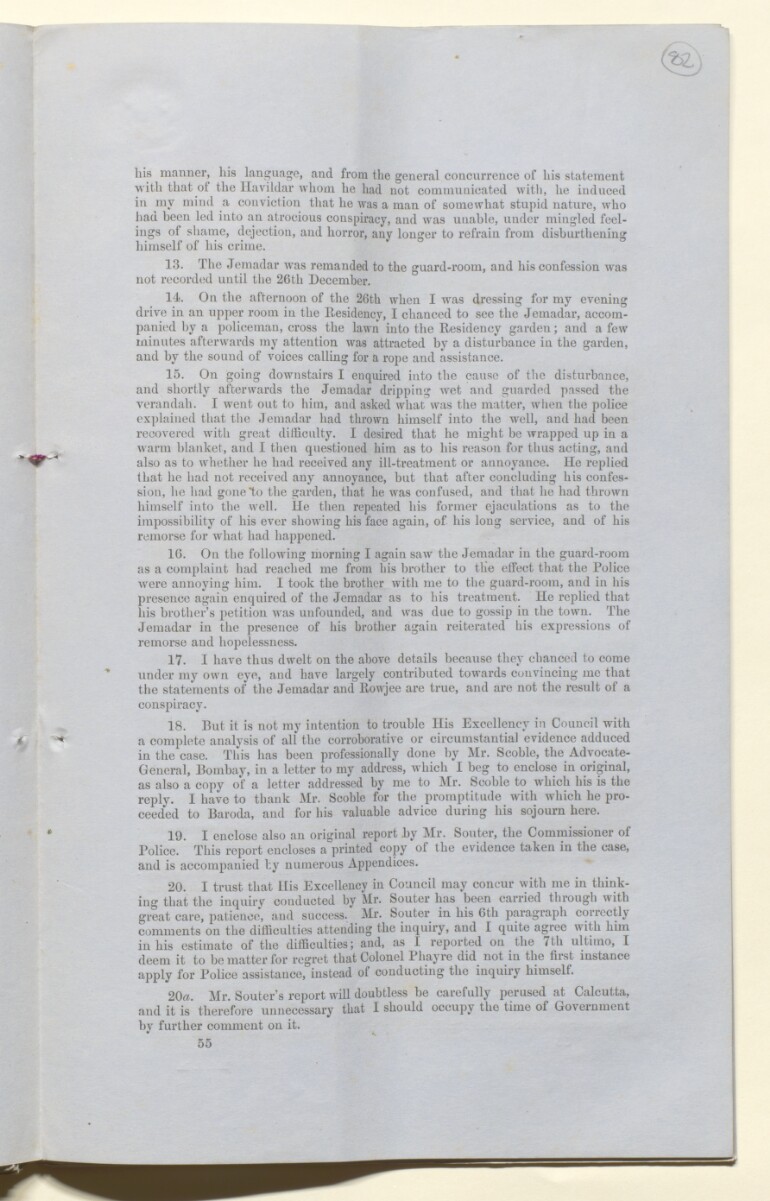
liis manner, his language, and from the general concurrence of his statement
with that ol the
Havildar
Custodian; police sergeant; jail or prison guard.
whom he had not comimmicated with, he induced
in my mind a conviction that he was a man of somewhat stupid nature, who
had been led into an atrocious conspiracy, and was unable, under mingled feel
ings of shame, dejection, and horror, any longer to refrain from disburthening
himself of his crime.
13. The Jemadar was remanded to the guard-room, and his confession was
not recorded until the 26th December.
14. On the afternoon of the 26th when I was dressing for my evening
drive in an upper room in the Eesidency, I chanced to see the Jemadar, accom
panied by a policeman, cross the lawn into the
Residency
An office of the East India Company and, later, of the British Raj, established in the provinces and regions considered part of, or under the influence of, British India.
garden; and a few
minutes afterwards my attention was attracted by a disturbance in the garden,
and by the sound of voices calling for a rope and assistance.
15. On going downstairs I enquired into the cause of the disturbance,
and shortly afterwards the Jemadar dripping wet and guarded passed the
verandah. I went out to him, and asked what was the matter, when the police
explained that the Jemadar had thrown himself into the well, and had been
recovered with great difficulty. I desired that he might be wrapped up in a
warm blanket, and I then questioned him as to his reason for thus acting, and
also as to whether he had received any ill-treatment or annoyance. He replied
that he had not received any annoyance, but that after concluding his confes
sion, he had gone to the garden, that he was confused, and that he had thrown
himself into the well. He then repeated his former ejaculations as to the
impossibility of his ever showing his face again, of his long service, and of his
remorse for what had happened.
16. On the following morning I again saw the Jemadar in the guard-room
as a complaint had reached me from his brother to tlie effect that the Police
were annoying him. I took the brother with me to the guard-room, and in his
presence again enquired of the Jemadar as to his treatment. He replied that
his brother's petition was unfounded, and was due to gossip in the town. The
Jemadar in the presence of his brother again reiterated his expressions of
remorse and hopelessness.
17. I have thus dwelt on the above details because they chanced to come
under my own eye, and have largely contributed towards convincing me that
the statements of the Jemadar and Rowjee are true, and are not the result ot a
conspiracy.
18. But it is not my intention to trouble His Excellency in Council with
a complete analysis of all the corroborative or circumstantial evidence adduced
in the case. This has been professionally done by Mr. Scoble, the Advocate-
General, Bombay, in a letter to my address, which I beg to enclose in original,
as also a copy of a letter addressed by me to Mr. Scoble to which his is the
reply. I have to thank Mr. Scoble for the promptitude with which he pro
ceeded to Baroda, and for his valuable advice during his sojourn here.
19. I enclose also an original report .by Mr. Souter, the Commissioner of
Police. This report encloses a printed copy of the evidence taken in the case,
and is accompanied by numerous Appendices.
20. I trust that His Excellency in Council may concur with me in think
ing that the inquiry conducted by Mr. Souter has been carried through with
great care, patience, and success. Mr. Souter in his 6th paragraph correctly
comments on the difficulties attending the inquiry, and I quite agree with him
in his estimate of the difficulties; and, as i reported on the 7th ultimo, I
deem it to be matter for regret that Colonel Phayre did not in the first instance
apply for Police assistance, instead ot conducting the inquiry himself.
20a. Mr. Souter's report will doubtless be carefully perused at Calcutta,
and it is therefore unnecessary that I should occupy the time of Government
by further comment on it.
About this item
- Content
The enclosures relate to the attempted poisoning of Colonel Robert Phayre, formerly Political Resident A senior ranking political representative (equivalent to a Consul General) from the diplomatic corps of the Government of India or one of its subordinate provincial governments, in charge of a Political Residency. at Baroda, including the Colonels interviews with the staff at the Residency An office of the East India Company and, later, of the British Raj, established in the provinces and regions considered part of, or under the influence of, British India. on duty the day of the poisoning, and the implication that the Gaekwar of Baroda had ordered it. Also discussed are the subsequent enquiry into the affairs of the Gaekwar, both financial and personal, and concerns that such an enquiry and any subsequent trial could lead to civil disturbances in Baroda.
The enclosed correspondence is between the Secretary to Government at Bombay (Charles Gonne); Secretary to the Government of India, Foreign Department (Charles Umpherston Aitchison and Frederick Henvey - Officiating Under-Secretary); Agent, Governor-General for Rajputana [Rājasthān] and Special Commissioner at Baroda (Lewis Pelly); the Viceroy of India (Thomas George Baring, Second Baron Northbrook); the Advocate-General at Bombay (Andrew Scoble); and the Commissioner of Police at Bombay (Frank Henry Souter).
- Extent and format
- 50 folios
- Written in
- English in Latin script View the complete information for this record
Use and share this item
- Share this item
Enclosures of letter to Her Majesty's Secretary of State for India, No.11, dated 15 January 1875: Nos. 3 to 45 of Abstract of Contents, from the Officiating Under-Secretary to the Government of India, Fort William [82r] (63/100), British Library: India Office Records and Private Papers, Mss Eur F126/81, ff 52-100, in Qatar Digital Library <https://www.qdl.qa/archive/81055/vdc_100023626960.0x0000a6> [accessed 8 July 2026]
https://www.qdl.qa/en/archive/81055/vdc_100023626960.0x0000a6
Copy and paste the code below into your web page where you would like to embed the image.
<meta charset="utf-8"><a href="https://www.qdl.qa/en/archive/81055/vdc_100023626960.0x0000a6">Enclosures of letter to Her Majesty's Secretary of State for India, No.11, dated 15 January 1875: Nos. 3 to 45 of Abstract of Contents, from the Officiating Under-Secretary to the Government of India, Fort William [‎82r] (63/100)</a> <a href="https://www.qdl.qa/en/archive/81055/vdc_100023626960.0x0000a6"> <img src="https://iiif.qdl.qa/iiif/images/81055/vdc_100000001524.0x000384/Mss Eur F126_81_0165.jp2/full/!280,240/0/default.jpg" alt="" /> </a>
This record has a IIIF manifest available as follows. If you have a compatible viewer you can drag the icon to load it.https://www.qdl.qa/en/iiif/81055/vdc_100000001524.0x000384/manifestOpen in Universal viewerOpen in Mirador viewerMore options for embedding images
Copyright: How to use this content
- Reference
- Mss Eur F126/81, ff 52-100
- Title
- Enclosures of letter to Her Majesty's Secretary of State for India, No.11, dated 15 January 1875: Nos. 3 to 45 of Abstract of Contents, from the Officiating Under-Secretary to the Government of India, Fort William
- Pages
- 52r:77v, 77ar:77av, 78r:100v
- Author
- East India Company, the Board of Control, the India Office, or other British Government Department
- Usage terms
- Open Government Licence