
![Enclosures of letter to Her Majesty's Secretary of State for India, No.11, dated 15 January 1875: Nos. 3 to 45 of Abstract of Contents, from the Officiating Under-Secretary to the Government of India, Fort William [‎91r] (81/100)](https://iiif.qdl.qa/iiif/images/81055/vdc_100000001524.0x000384/Mss Eur F126_81_0183.jp2/full/!1200,1200/0/default.jpg "Enclosures of letter to Her Majesty's Secretary of State for India, No.11, dated 15 January 1875: Nos. 3 to 45 of Abstract of Contents, from the Officiating Under-Secretary to the Government of India, Fort William [‎91r] (81/100)")
Enclosures of letter to Her Majesty's Secretary of State for India, No.11, dated 15 January 1875: Nos. 3 to 45 of Abstract of Contents, from the Officiating Under-Secretary to the Government of India, Fort William [91r] (81/100)
The record is made up of 50 folios. It was created in 15 Jan 1875. It was written in English. The original is part of the British Library: India Office The department of the British Government to which the Government of India reported between 1858 and 1947. The successor to the Court of Directors. Records and Private Papers Documents collected in a private capacity. .
Transcription
This transcription is created automatically. It may contain errors.
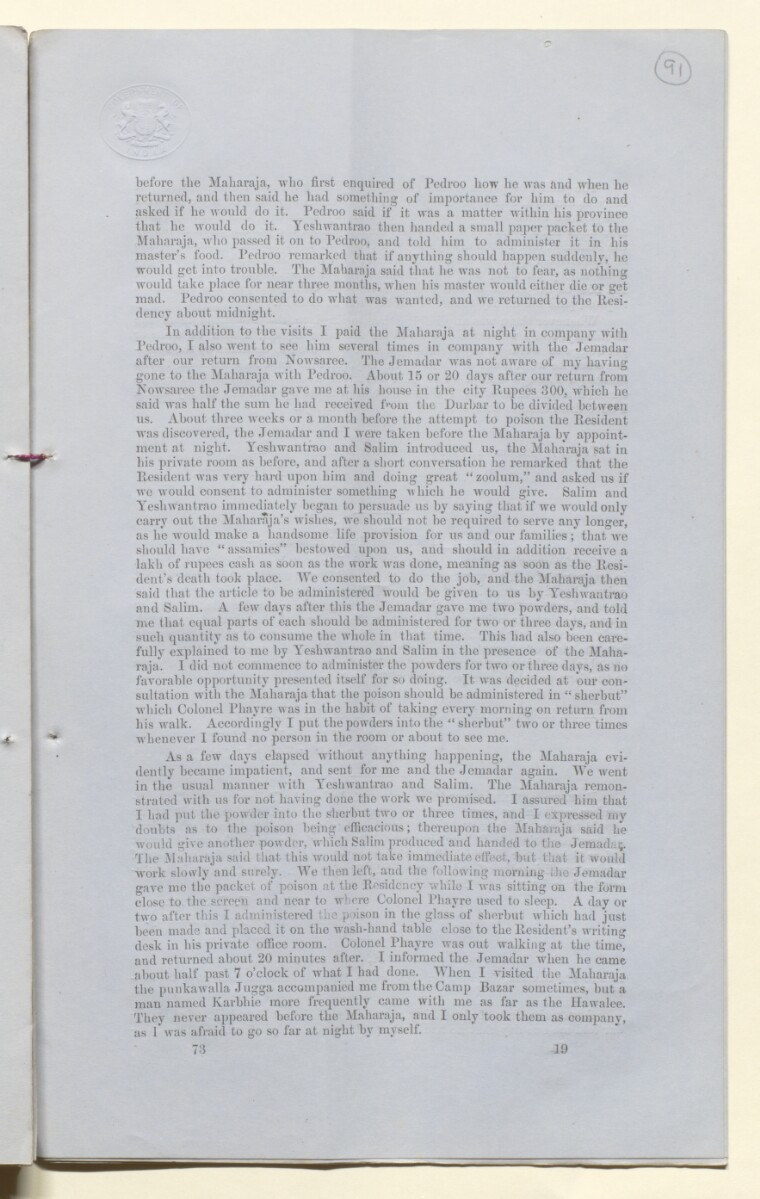
before the Maharaja, who first enquired of Pedroo how he was and when he
returned, and then said he had something of importance for him to do and
asked if he would do it. Pedroo said if it was a matter within his province
that he would do it. Yeshwantrao then handed a small paper packet to the
Maharaja, who passed it on to Pedroo, and told him to administer it in his
master's food. Pedroo remarked that if anything should happen suddenly, he
would get into trouble. The Maharaja said that he was not to fear, as nothing
would take place for near three months, when his master would either die or get
mad. Pedroo consented to do what was wanted, and we returned to the llesi-
dency about midnight.
In addition to the visits I paid the Maharaja at night in company with
Pedroo, I also went to see him several times in company with the Jemadar
after our return from Nowsaree. The Jemadar was not aware of my having
gone to the Maharaja with Pedroo. About 15 or 20 days after our return from
Kowsaree the Jemadar gave me at his house in the city
Rupees
Indian silver coin also widely used in the Persian Gulf.
300, which he
said was half the sum he had received f»'oni the
Durbar
A public or private audience held by a high-ranking British colonial representative (e.g. Viceroy, Governor-General, or member of the British royal family).
to be divided between
us. About three weeks or a month before the attempt to poison the Resident
was discovered, the Jemadar and I were taken before the Maharaja by appoint
ment at night. Yeshwantrao and Salim introduced us, the Maharaja sat in
his private room as before, and after a short conversation he remarked that the
Resident was very hard upon him and doing great " zoolum," and asked us if
we would consent to administer something which he would give. Salim and
Yeshwantrao immediately began to persuade us by saying that if we would only
carry out the Maharaja's wishes, we should not be required to serve any longer,
as he would make a handsome life provision for us and our families ; that we
should have " assamies" bestowed upon us, and should in addition receive a
lakh
One lakh is equal to one hundred thousand rupees
of
rupees
Indian silver coin also widely used in the Persian Gulf.
cash as soon as the work was done, meaning as soon as the Resi
dent's death took place. We consented to do the job, and the Maharaja then
said that the article to be administered would be given to us by Yeshwantrao
and Salini. A few days after this the Jemadar gave me two powders, and told
me that equal parts of each should be administered for two or three days, and in
such quantity as to consume the whole in that time. This had also been care
fully explained to me by Yeshwantrao and Salim in the presence of the Maha
raja
King
. I did not commence to administer the powders for two or three days, as no
favorable opportunity presented itself for so doing. It was decided at our con
sultation with the Maharaja that the poison should be administered in " sherbut"
which Colonel Phayre was in the habit of taking every morning on return from
his walk. Accordingly I put the powders into the " sherbut" two or three times
whenever I found no person in the room or about to see me.
As a few days elapsed without anything happening, the Maharaja evi
dently became impatient, and sent for me and the Jemadar again. We went
in the usual manner with Yeshwantrao and Salim. The Maharaja remon
strated with ns for not having done the work we promised. I assured him that
I had put the powder into the sherbut two or three times, and I expressed my
doubts as to the poison being efficacious; thereupon the Maharaja said he
would give another powder, which Salim produced and handed to the Jemad:
The Maharaja said that this would not take immediate effect, but that it would
work slowly and surely. We then left, and the following morning the Jemadar
gave me the packet of poisoii at the
Residency
An office of the East India Company and, later, of the British Raj, established in the provinces and regions considered part of, or under the influence of, British India.
while I was sitting on the form
close to the screen and near to where Colonel Phayre used to sleep. A day or
two after this I administered the poison in the glass of sherbut which had just
been made and placed it on the wash-hand table close to the Resident's writing
desk in his private office room. Colonel Phayre was out walking at the time,
and returned about 20 minutes after. I informed the Jemadar when he came
about half past 7 o'clock of what I had done. When I visited the Maharaja
the punkawalla Jugga accompanied me from the Camp Bazar sometimes, but a
man named Karbhie more frequently came with me as far as the Hawalee.
They never appeared before the Maharaja, and I only took them as company,
as 1 was afraid to go so far at night by myself.
73 19
About this item
- Content
The enclosures relate to the attempted poisoning of Colonel Robert Phayre, formerly Political Resident A senior ranking political representative (equivalent to a Consul General) from the diplomatic corps of the Government of India or one of its subordinate provincial governments, in charge of a Political Residency. at Baroda, including the Colonels interviews with the staff at the Residency An office of the East India Company and, later, of the British Raj, established in the provinces and regions considered part of, or under the influence of, British India. on duty the day of the poisoning, and the implication that the Gaekwar of Baroda had ordered it. Also discussed are the subsequent enquiry into the affairs of the Gaekwar, both financial and personal, and concerns that such an enquiry and any subsequent trial could lead to civil disturbances in Baroda.
The enclosed correspondence is between the Secretary to Government at Bombay (Charles Gonne); Secretary to the Government of India, Foreign Department (Charles Umpherston Aitchison and Frederick Henvey - Officiating Under-Secretary); Agent, Governor-General for Rajputana [Rājasthān] and Special Commissioner at Baroda (Lewis Pelly); the Viceroy of India (Thomas George Baring, Second Baron Northbrook); the Advocate-General at Bombay (Andrew Scoble); and the Commissioner of Police at Bombay (Frank Henry Souter).
- Extent and format
- 50 folios
- Written in
- English in Latin script View the complete information for this record
Use and share this item
- Share this item
Enclosures of letter to Her Majesty's Secretary of State for India, No.11, dated 15 January 1875: Nos. 3 to 45 of Abstract of Contents, from the Officiating Under-Secretary to the Government of India, Fort William [91r] (81/100), British Library: India Office Records and Private Papers, Mss Eur F126/81, ff 52-100, in Qatar Digital Library <https://www.qdl.qa/archive/81055/vdc_100023626960.0x0000b8> [accessed 9 July 2026]
https://www.qdl.qa/en/archive/81055/vdc_100023626960.0x0000b8
Copy and paste the code below into your web page where you would like to embed the image.
<meta charset="utf-8"><a href="https://www.qdl.qa/en/archive/81055/vdc_100023626960.0x0000b8">Enclosures of letter to Her Majesty's Secretary of State for India, No.11, dated 15 January 1875: Nos. 3 to 45 of Abstract of Contents, from the Officiating Under-Secretary to the Government of India, Fort William [‎91r] (81/100)</a> <a href="https://www.qdl.qa/en/archive/81055/vdc_100023626960.0x0000b8"> <img src="https://iiif.qdl.qa/iiif/images/81055/vdc_100000001524.0x000384/Mss Eur F126_81_0183.jp2/full/!280,240/0/default.jpg" alt="" /> </a>
This record has a IIIF manifest available as follows. If you have a compatible viewer you can drag the icon to load it.https://www.qdl.qa/en/iiif/81055/vdc_100000001524.0x000384/manifestOpen in Universal viewerOpen in Mirador viewerMore options for embedding images
Copyright: How to use this content
- Reference
- Mss Eur F126/81, ff 52-100
- Title
- Enclosures of letter to Her Majesty's Secretary of State for India, No.11, dated 15 January 1875: Nos. 3 to 45 of Abstract of Contents, from the Officiating Under-Secretary to the Government of India, Fort William
- Pages
- 52r:77v, 77ar:77av, 78r:100v
- Author
- East India Company, the Board of Control, the India Office, or other British Government Department
- Usage terms
- Open Government Licence