
![‘A collection of treaties, engagements and sanads relating to India and neighbouring countries’ [‎33] (50/578)](https://iiif.qdl.qa/iiif/images/81055/vdc_100000000884.0x0003bf/IOR_L_PS_20_G3_14_0050.jp2/full/!1200,1200/0/default.jpg "‘A collection of treaties, engagements and sanads relating to India and neighbouring countries’ [‎33] (50/578)")
‘A collection of treaties, engagements and sanads relating to India and neighbouring countries’ [33] (50/578)
The record is made up of 1 volume (289 folios). It was created in 1933. It was written in English and French. The original is part of the British Library: India Office The department of the British Government to which the Government of India reported between 1858 and 1947. The successor to the Court of Directors. Records and Private Papers Documents collected in a private capacity. .
Transcription
This transcription is created automatically. It may contain errors.
PERSIA—SISTAN.
33
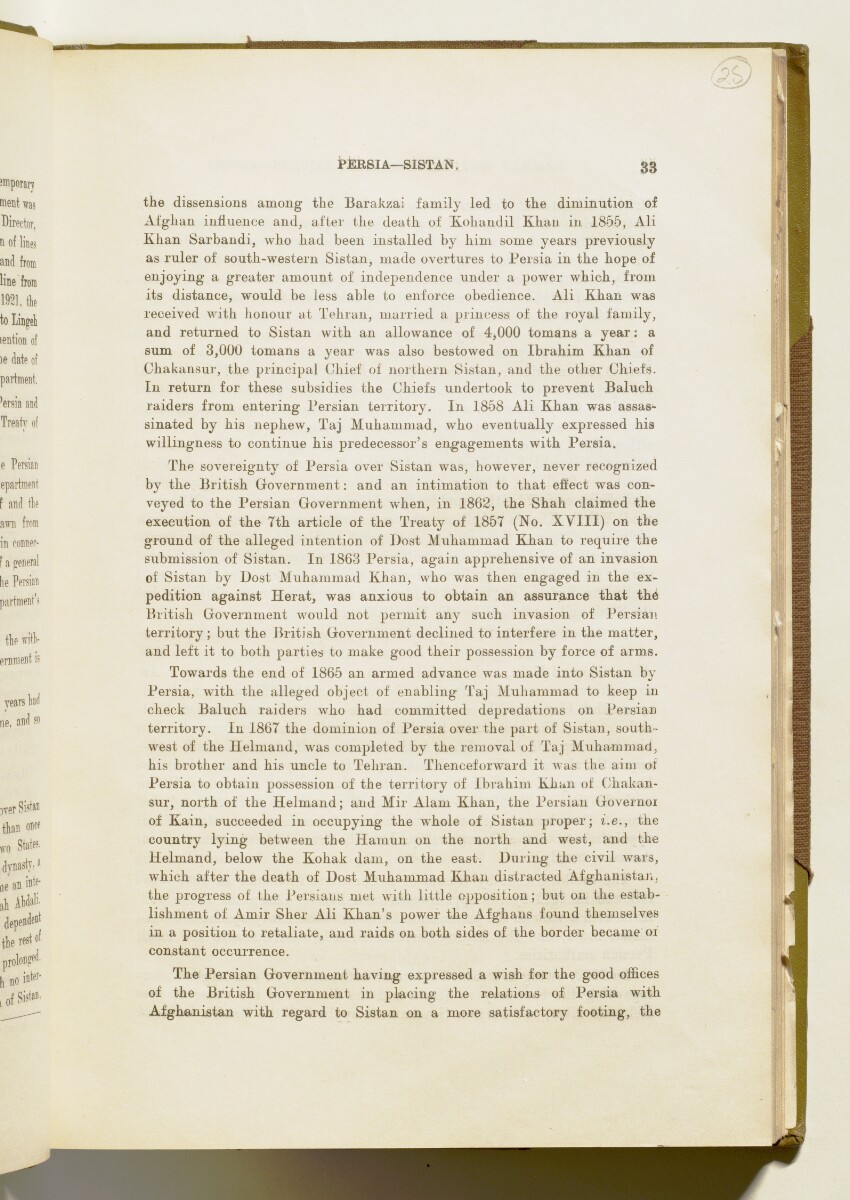
the dissensions among the Barakzai family led to the diminution of
Afghan influence and, after the death of Kohandil Khan in 1855, Ali
Khan Sarbandi, who had been installed by him some years previously
as ruler of south-western Sistan, made overtures to Persia in the hope of
enjoying a greater amount of independence under a power which, from
its distance, would be less able to enforce obedience. Ali Khan was
received with honour at Tehran, married a princess of the royal family,
and returned to Sistan with an allowance of 4,000
tomans
10,000 Persian dinars, or a gold coin of that value.
a year: a
sum of 3,000
tomans
10,000 Persian dinars, or a gold coin of that value.
a year was also bestowed on Ibrahim Khan of
Chakansur, the principal Chief of northern Sistan, and the other Chiefs.
In return for these subsidies the Chiefs undertook to prevent Baluch
raiders from entering Persian territory. In 1858 Ali Khan was assas
sinated by his nephew, Taj Muhammad, who eventually expressed his
willingness to continue his predecessor’s engagements with Persia.
The sovereignty of Persia over Sistan was, however, never recognized
by the British Government: and an intimation to that effect was con
veyed to the Persian Government when, in 1862, the Shah claimed the
execution of the Tth article of the Treaty of 1857 (No. XVIII) on the
ground of the alleged intention of Dost Muhammad Khan to require the
submission of Sistan. In 1863 Persia, again apprehensive of an invasion
of Sistan by Dost Muhammad Khan, who was then engaged in the ex
pedition against Herat, was anxious to obtain an assurance that the
British Government would not permit any such invasion of Persian
territory; but the British Government declined to interfere in the matter,
and left it to both parties to make good their possession by force of arms.
Towards the end of 1865 an armed advance was made into Sistan by
Persia, with the alleged object of enabling Taj Muhammad to keep in
check Baluch raiders who had committed depredations on Persian
territory. In 1867 the dominion of Persia over the part of Sistan, south
west of the Helmand, was completed by the removal of Taj Muhammad,
his brother and his uncle to Tehran. Thenceforward it was the aim of
Persia to obtain possession of the territory of Ibrahim Khan of Chakan
sur, north of the Helmand; and Mir Alam Khan, the Persian Governoi
of Kain, succeeded in occupying the whole of Sistan proper; i.e., the
country lying between the Hamun on the north and west, and the
Helmand, below the Kohak dam, on the east. During the civil wars,
which after the death of Dost Muhammad Khan distracted Afghanistan,
the progress of the Persians met with little opposition; but on the estab
lishment of Amir Sher Ali Khan’s power the Afghans found themselves
in a position to retaliate, and raids on both sides of the border became oi
constant occurrence.
The Persian Government having expressed a wish for the good offices
of the British Government in placing the relations of Persia with
Afghanistan with regard to Sistan on a more satisfactory footing, the
About this item
- Content
The volume is the fifth edition of volume 13 of a collection of historic treaties, engagements and sanads (charters) relating to India and its neighbouring countries, namely Persia and Afghanistan. This volume, originally compiled by Charles Umpherston Aitchison, Under Secretary to the Government of India in the Foreign Department, was revised in 1930 and published in 1933 by the Manager of Publications in Delhi, under the authority of the Government of India.
Part 1 of the volume contains treaties and engagements relating to Persia and dating from between 12 April 1763 and 10 May 1929. The treaties refer to: trade agreements; foreign relations; prohibition and suppression of the slave trade; sovereignty and status of Persian regions; frontier negotiations; foreign concessions; telegraph lines. Part 2 of the volume contains treaties and engagements relating to Afghanistan and dating from between 17 June 1809 and 6 May 1930. The treaties relate to: foreign relations; the establishment of boundaries and frontier negotiations; peace treaties; commercial relations; import of arms. A number of appendices follow part 2, which contain the text of treaties relating to both Persia and Afghanistan.
- Extent and format
- 1 volume (289 folios)
- Arrangement
The volume is arranged into two parts covering Persia and Afghanistan respectively, as are the appendices at the end of the volume. Each part is divided into a number of chapters, identified by Roman numerals, and arranged chronologically, from the earliest treaties to the most recent. At the beginning of each part is a general introduction to the treaties and engagements that follow.
There is a contents page at the front of the volume (ff 4-8) which lists the geographical regions and treaties. The contents pages refers to the volume’s pagination system. There is a subject index, arranged alphabetically, at the end of the volume (ff 277-87) which also refers to the volume’s pagination system.
- Physical characteristics
Foliation: The foliation sequence commences at the inside front cover, and terminates at the inside back cover; these numbers are written in pencil, are circled, and are located in the top right corner of the recto The front of a sheet of paper or leaf, often abbreviated to 'r'. side of each folio (except for the front cover where the folio number is on the verso The back of a sheet of paper or leaf, often abbreviated to 'v'. ).
Pagination: The volume also contains an original printed pagination sequence.
- Written in
- English and French in Latin script View the complete information for this record
Use and share this item
- Share this item
‘A collection of treaties, engagements and sanads relating to India and neighbouring countries’ [33] (50/578), British Library: India Office Records and Private Papers, IOR/L/PS/20/G3/14, in Qatar Digital Library <https://www.qdl.qa/archive/81055/vdc_100023947390.0x000033> [accessed 29 June 2026]
https://www.qdl.qa/en/archive/81055/vdc_100023947390.0x000033
Copy and paste the code below into your web page where you would like to embed the image.
<meta charset="utf-8"><a href="https://www.qdl.qa/en/archive/81055/vdc_100023947390.0x000033">‘A collection of treaties, engagements and sanads relating to India and neighbouring countries’ [‎33] (50/578)</a> <a href="https://www.qdl.qa/en/archive/81055/vdc_100023947390.0x000033"> <img src="https://iiif.qdl.qa/iiif/images/81055/vdc_100000000884.0x0003bf/IOR_L_PS_20_G3_14_0050.jp2/full/!280,240/0/default.jpg" alt="" /> </a>
This record has a IIIF manifest available as follows. If you have a compatible viewer you can drag the icon to load it.https://www.qdl.qa/en/iiif/81055/vdc_100000000884.0x0003bf/manifestOpen in Universal viewerOpen in Mirador viewerMore options for embedding images
Copyright: How to use this content
- Reference
- IOR/L/PS/20/G3/14
- Title
- ‘A collection of treaties, engagements and sanads relating to India and neighbouring countries’
- Pages
- front, back, front-i, i-r, i-v, ii-r, ii-v, 1:10, 1:306, 1:230, 1:22, iii-r, iii-v, back-i
- Author
- Unknown
- Usage terms
- The copyright status is unknown. Please contact [email protected] with any information you have regarding this item.