
![File 600/1905 Pt 3 'Aden Hinterland: Situation; Withdrawal of Political Agent from Dthala; Treaties with Haushabi, Kotaibi and Alawi chiefs' [‎179v] (354/508)](https://iiif.qdl.qa/iiif/images/81055/vdc_100000000365.0x00039f/IOR_L_PS_10_74_0363.jp2/full/!1200,1200/0/default.jpg "File 600/1905 Pt 3 'Aden Hinterland: Situation; Withdrawal of Political Agent from Dthala; Treaties with Haushabi, Kotaibi and Alawi chiefs' [‎179v] (354/508)")
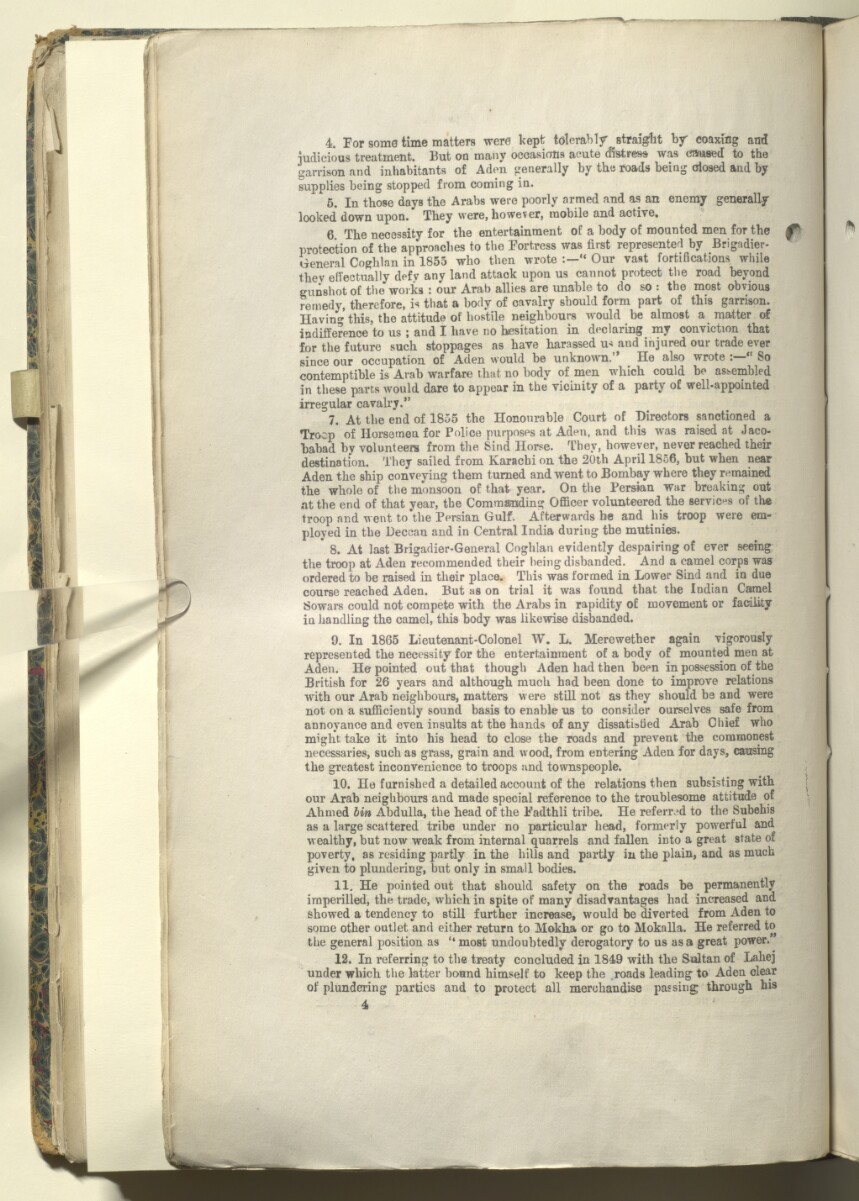
File 600/1905 Pt 3 'Aden Hinterland: Situation; Withdrawal of Political Agent from Dthala; Treaties with Haushabi, Kotaibi and Alawi chiefs' [179v] (354/508)
The record is made up of 1 item (253 folios). It was created in Oct 1906-Sep 1915. It was written in English. The original is part of the British Library: India Office The department of the British Government to which the Government of India reported between 1858 and 1947. The successor to the Court of Directors. Records and Private Papers Documents collected in a private capacity. .
Transcription
This transcription is created automatically. It may contain errors.
4. For some time matters were kept tderablf straight by coaxing and
indicious treatment. But on many occasions acute cfistress as caused to the
garrison and inhabitants of Aden generally by the roads being dosed and by
supplies being stopped from coming in.
5. In those days the Arabs were poorly armed and as an enemy generally
looked down upon. They were, however, mobile and active.
6 The necessity for the entertainment of a body of mounted men for the
protection of the approaches to the Fortress was first represented by Brigadier-
General Coghlan in 1855 who then wrote “ Our vast fortifications while
thev effectually defy any land attack upon us cannot protect the road beyond
gunshot of the works : our Arab allies are unable to do so : the most obvious
remedy, therefore, is that a body of cavalry should form part of this garrison.
Having this, the attitude of hostile neighbours w^ould be almost a matter of
indifference to us ; and I have no hesitation in declaring my conviction that
for the future such stoppages as have harassed us and injured our trade ever
since our occupation of Aden would be unknown.” He also wrote :—“ So
contemptible is Arab warfare that no body of men v\ bich could be assembled
in these parts would dare to appear in the vicinity of a party of well-appointed
irregular cavalry.”
7 . At the end of 1855 the Honourable
Court of Directors
The London-based directors of the East India Company who dealt with the daily conduct of the Company's affairs.
sanctioned a
Trocp of Horsemea for Police purposes at Aden, and this was raised at Jaco-
babad by volunteers from the Sind Horse. They, however, never reached their
destination. They sailed from Karachi on the 20 th April 1856, but when near
Aden the ship conveying them turned and went to Bombay where they remained
the whole of the monsoon of that year. On the Persian war breaking out
at the end of that year, the Commanding Officer volunteered, the services of the
troop and went to the
Persian Gulf
The historical term used to describe the body of water between the Arabian Peninsula and Iran.
. Afterwards be and his troop were em
ployed in the Deccan and in Central India during the mutinies.
8 . At last Brigadier-General Coghlan evidently despairing of ever seeing
the troop at Aden recommended their being disbanded. And a camel corps was
ordered to be raised in their place. This was formed in Lower Sind and in due
course reached Aden. But as on trial it was found that the Indian Camel
Sowars could not compete with the Arabs in rapidity of movement or facility
in handling the camel, this body was likewise disbanded.
9. In 1865 Lieutenant-Colonel W. L. Merewether again vigorously
represented the necessity for the entertainment of a body of mounted men at
Aden. He pointed out that though Aden had then been in possession of the
British for 26 years and although much had been done to improve relations
with our Arab neighbours, matters were still not as they should be and were
not on a sufficiently sound basis to enable us to consider ourselves safe from
annoyance and even insults at the hands of any dissatisfied Arab Chief who
might take it into his head to close the roads and prevent the commonest
necessaries, such as grass, grain and wood, from entering Aden for days, causing
the greatest inconvenience to troops and townspeople.
10. He furnished a detailed account of the relations then subsisting with
our Arab neighbours and made special reference to the troublesome attitude of
Ahmed bin Abdulla, the head of the Fadthli tribe. He referred to the Subebis
as a large scattered tribe under no particular head, formerly powerful and
wealthy, but now weak from internal quarrels and fallen into a great state of
poverty, as residing partly in the hills and partly in the plain, and as much
given to plundering, but only in small bodies.
11. He pointed out that should safety on the roads be permanently
imperilled, the trade, which in spite of many disadvantages had increased and
Showed a tendency to still further increase, would be diverted from Aden to
some other outlet and either return to Mokha or go to Mokalla. He referred to
the general position as “ most undoubtedly derogatory to us as a great power.
12. In referring to the treaty concluded in 1849 with the Sultan of Lahej
under which the latter bound himself to keep the roads leading to Aden clear
of plundering parties and to protect all merchandise passing through his
About this item
- Content
Part 3 of the file relates to the withdrawal of troops and the Political Agent A mid-ranking political representative (equivalent to a Consul) from the diplomatic corps of the Government of India or one of its subordinate provincial governments, in charge of a Political Agency. from Dthala [al-Ḍāli‘].
The correspondents include:
- Major-General Ernest de Brath, Political Resident A senior ranking political representative (equivalent to a Consul General) from the diplomatic corps of the Government of India or one of its subordinate provincial governments, in charge of a Political Residency. at Aden;
- Government of India, Foreign Department;
- Government of Bombay From c. 1668-1858, the East India Company’s administration in the city of Bombay [Mumbai] and western India. From 1858-1947, a subdivision of the British Raj. It was responsible for British relations with the Gulf and Red Sea regions. ;
- India Office The department of the British Government to which the Government of India reported between 1858 and 1947. The successor to the Court of Directors. , London;
- Foreign Office, London.
The correspondence reports and discusses matters related to the withdrawal from Dthala and the subsequent treaty negotiations with tribes of the Aden hinterland, including:
- an attack on a party of King's Own Borderers by members of the Dthambari tribe in October 1906;
- the scale and speed of the withdrawal;
- hostilities between tribal groups;
- the security of the Aden-Dthala road;
- changes to Aden Residency An office of the East India Company and, later, of the British Raj, established in the provinces and regions considered part of, or under the influence of, British India. administration and garrison;
- negotiations and final treaty agreements with the Kotaibi, Alawi, and Haushabi tribes, ratified in September 1915.
- Extent and format
- 1 item (253 folios)
- Written in
- English in Latin script View the complete information for this record
Use and share this item
- Share this item
File 600/1905 Pt 3 'Aden Hinterland: Situation; Withdrawal of Political Agent from Dthala; Treaties with Haushabi, Kotaibi and Alawi chiefs' [179v] (354/508), British Library: India Office Records and Private Papers, IOR/L/PS/10/74/3, in Qatar Digital Library <https://www.qdl.qa/archive/81055/vdc_100034189575.0x0000a4> [accessed 30 August 2026]
https://www.qdl.qa/en/archive/81055/vdc_100034189575.0x0000a4
Copy and paste the code below into your web page where you would like to embed the image.
<meta charset="utf-8"><a href="https://www.qdl.qa/en/archive/81055/vdc_100034189575.0x0000a4">File 600/1905 Pt 3 'Aden Hinterland: Situation; Withdrawal of Political Agent from Dthala; Treaties with Haushabi, Kotaibi and Alawi chiefs' [‎179v] (354/508)</a> <a href="https://www.qdl.qa/en/archive/81055/vdc_100034189575.0x0000a4"> <img src="https://iiif.qdl.qa/iiif/images/81055/vdc_100000000365.0x00039f/IOR_L_PS_10_74_0363.jp2/full/!280,240/0/default.jpg" alt="" /> </a>
This record has a IIIF manifest available as follows. If you have a compatible viewer you can drag the icon to load it.https://www.qdl.qa/en/iiif/81055/vdc_100000000365.0x00039f/manifestOpen in Universal viewerOpen in Mirador viewerMore options for embedding images
Copyright: How to use this content
- Reference
- IOR/L/PS/10/74/3
- Title
- File 600/1905 Pt 3 'Aden Hinterland: Situation; Withdrawal of Political Agent from Dthala; Treaties with Haushabi, Kotaibi and Alawi chiefs'
- Pages
- 3r:256v
- Author
- East India Company, the Board of Control, the India Office, or other British Government Department
- Usage terms
- Open Government Licence