
![Coll 6/8(1) 'Printed Series: 1929 to 1938.' [‎207r] (418/1062)](https://iiif.qdl.qa/iiif/images/81055/vdc_100000000555.0x000261/IOR_L_PS_12_2071_0418.jp2/full/!1200,1200/0/default.jpg "Coll 6/8(1) 'Printed Series: 1929 to 1938.' [‎207r] (418/1062)")
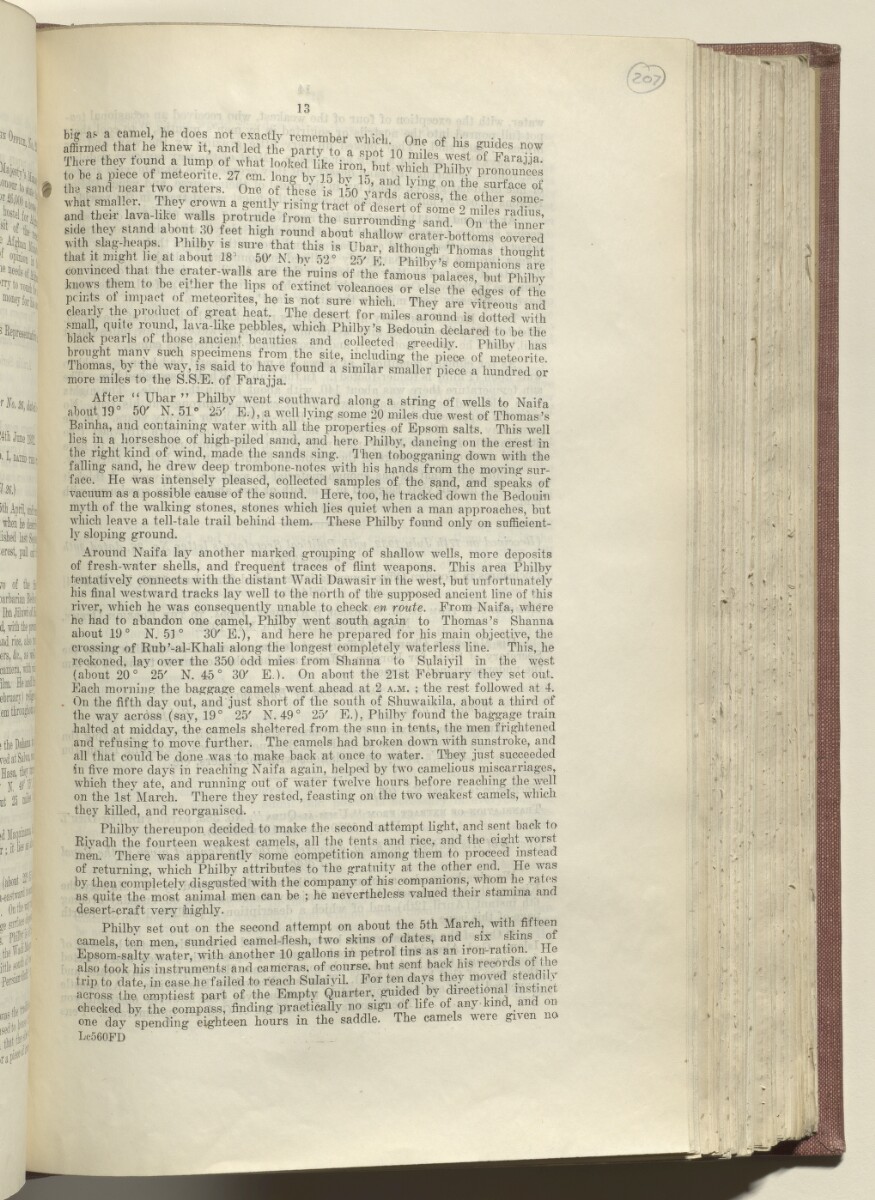
Coll 6/8(1) 'Printed Series: 1929 to 1938.' [207r] (418/1062)
The record is made up of 1 volume (527 folios). It was created in 6 Jan 1929-15 Jan 1938. It was written in English and French. The original is part of the British Library: India Office The department of the British Government to which the Government of India reported between 1858 and 1947. The successor to the Court of Directors. Records and Private Papers Documents collected in a private capacity. .
Transcription
This transcription is created automatically. It may contain errors.
auy« 4 ftitaiW 8 ;ssrtr.’»-?<! «*"" ~
H,™ they to.nd • lump ol mk.t 1»„M pp, b !„“ lit k PMbl
t h -as,iraa "cjtss g s,%g a* «. ‘‘* F“
uhat smullpr. Tb.j orom . gum], miu 8 t,«, of d.irtol ,“i,o 2 ” l.'.'r'S’.'
and their lava-like walls protrude from the surroundW n>, n ra . aius »
side they stand about 30 feet high round at^nT s ClW fra^bottonr ^“d
with slag-heaps. Philby is sure that this is Dbar, although Thomas though
that it might he at about 18’ 50' N. by 52° 25'E. Philby’s companions are
convinced that tie crater-walls are the rums of the famous palaces, but Philby
knows them to be either the lips of extinct volcanoes or else the edo-es of the
pants oi impact of meteorites, he is not sure which. They are vitreous and
clearly the product of great heat The desert for miles around is dotted with
sma 1, quite roiind, lava-like pebbles, which Philby’s Bedouin declared to be the
black pearls of those ancient beauties and collected greedily. Philbv has
brought many such specimens from the site, including the niece of meteorite
Thomas by the way is said to have found a similar smaller piece a hundred or
more miles to the S.S.E. of Farajja.
After “ Ubar ” Philby went southward along a string of wells to Naif a
about 19° 50' N. 51° 25' E.), a well lying some 20 miles due west of Thomas’s
Bainha, and containing water with all the properties of Epsom salts. This well
lies in a horseshoe of high-piled sand, and here Philby, dancing on the crest in
the right kind of wind, made the sands sing. Then tobogganing down with the
falling sand, he drew deep trombone-notes with his hands from the moving sur
face. Pie was intensely pleased, collected samples of the sand, and speaks of
vacunm as a possible cause of the sound. Here, too, he tracked down the Bedouin
myth of the walking stones, stones which lies quiet when a man approaches, but
which leave a tell-tale trail behind them. These Philby found only on sufficient
ly sloping ground.
Around Naifa lay another marked grouping of shallow wells, more deposits
of fresh-water shells, and frequent traces of flint weapons. This area Philby
tentatively connects with the distant
Wadi
A seasonal or intermittent watercourse, or the valley in which it flows.
Dawasir in the west, but unfortunately
his final westward tracks lay well to the north of the supposed ancient line of this
river, which he was consequently unable to check en route. From Naifa, where
he had to abandon one camel, Philby went south again to Thomas’s Shanna
about 19° N. 51 ° 30' E.), and here he prepared for his main objective, the
crossing of Rub’-al-Khali along the longest completely waterless line. This, he
reckoned, lay over the 350 odd mies from Shanna to Sulaiyil in the west
(about 20° 25' N. 45 ° SO 7 E.). On about the 21st February they set out.
Each morning the baggage camels went ahead at 2 a.m. ; the rest followed at 4.
On the fifth day out, and just short of the south of Shuwaikila, about a third of
the way across (say, 19° * 25' N. 49° 25' E.), Philby found the baggage train
halted at midday, the camels sheltered from the sun in tents, the men frightened
and refusing to "move further. The camels had broken down with sunstroke, and
all that could be done was to make back at once to water. They just succeeded
in five more days in reaching Naifa again, helped by two camelions miscarriages,
which they ate, and running out of water twelve hours before reaching the well
on the 1st" March. There they rested, feasting on the two weakest camels, which
they killed, and reorganised.
Philby thereupon decided to make the second attempt light, and sent back to
Riyadh the fourteen weakest camels, all the tents and rice, and the eight worst
men. There was apparently some competition among them to proceed instead
of returning, which Philby attributes to the gratuity at the other end. He was
by then completely disgusted with the company of his companions, whom he fates
as quite the most animal men can be ; he nevertheless valued their stamina and
desert-craft very highly.
Philby set out on the second attempt on about the 5th March, with fifteen
camels, ten men, sundried camel-flesh, two skins of dates, and. six s uns o
Epsom-salty water, with another 10 gallons in petrol tins as an iron-ration. e
also took his instruments and cameras, of course, but sent back his recor s o n
trip to date, in case he failed to reach Sulaiyil. For ten days they moved stent i y
across the emptiest part of the Empty Quarter,, guided by directional in.
checked by the compass, finding practically no sign of life of any •km
one day spending eighteen hours in the saddle. The camels weie
Lc560FD _
About this item
- Content
This volume compiles printed copies of letters, telegrams, memoranda and newspaper extracts relating to Britain's involvement across the Arabian Peninsula during the period 1929-1938. Whilst the correspondence encompasses all matters concerning British interests in the region, much of it relates to Ibn Saud [‘Abd al-‘Azīz bin ‘Abd al-Raḥmān bin Fayṣal Āl Sa‘ūd] and the Kingdom of the Hejaz and Nejd (later Saudi Arabia). Matters discussed in the correspondence include the following:
- Reports of unrest in the Hejaz.
- Relations between Imam Yeha Hamid-Ud-Din [Yaḥyá Muḥammad Ḥamīd al-Dīn, Imam of Yemen] and Ibn Saud.
- Reports of raids and arms trafficking on the Transjordan Used in three contexts: the geographical region to the east of the River Jordan (literally ‘across the River Jordan’); a British protectorate (1921-46); an independent political entity (1946-49) now known as Jordan -Nejd frontier.
- Reports of the proceedings of British naval ships in the Red Sea.
- Details of the Akhwan [Ikhwan] revolt against Ibn Saud, including the movements of one of the revolt's leaders, Faisal Dawish [Fayṣal bin Sulṭān al-Dawīsh], and his surrender to the British in Kuwait.
- Relations between Kuwait and Nejd.
- Relations between Iraq and Nejd, including a proposed meeting between Ibn Saud and King Faisal [Fayṣal] of Iraq, and reports of a treaty of alliance between Iraq and Saudi Arabia.
- Objections from the Hejaz Government to Royal Air Force aircraft flying over Nejd territory.
- The purchase of arms by the Hejaz Government from Poland.
- Ibn Saud's annexation of Asir.
- The death of King Hussein [Ḥusayn bin ‘Alī al-Hāshimī].
- Harry St John Bridger Philby's conversion to Islam, his mapping of Rub-al-Khali, and his reported spreading of Saudi propaganda in the Aden Protectorate.
- The currency exchange crisis in the Hejaz-Nejd and the financial situation in the kingdom generally.
- Reports on a survey of the water and mineral content of the Hejaz coastal area.
- Relations between Soviet Russia and Saudi Arabia.
- The emigration of Jews from Yemen to Palestine, via Aden.
- British fears that Italy might harbour ambitions to annex Yemen.
- Saudi oil concessions.
- Italian-Saudi relations.
Prominent correspondents include the following: the British Agent (later His Majesty's Chargé d’Affaires) at Jeddah; His Majesty's Minister at Jeddah; the High Commissioner for Egypt; the High Commissioner for Iraq; the High Commissioner for Transjordan Used in three contexts: the geographical region to the east of the River Jordan (literally ‘across the River Jordan’); a British protectorate (1921-46); an independent political entity (1946-49) now known as Jordan ; the Political Agent A mid-ranking political representative (equivalent to a Consul) from the diplomatic corps of the Government of India or one of its subordinate provincial governments, in charge of a Political Agency. , Kuwait; the Political Resident A senior ranking political representative (equivalent to a Consul General) from the diplomatic corps of the Government of India or one of its subordinate provincial governments, in charge of a Political Residency. (later Chief Commissioner, and later still, Governor), Aden; the Political Resident A senior ranking political representative (equivalent to a Consul General) from the diplomatic corps of the Government of India or one of its subordinate provincial governments, in charge of a Political Residency. in the Persian Gulf The historical term used to describe the body of water between the Arabian Peninsula and Iran. ; His Majesty's Ambassador to Iraq; His Majesty's Ambassador to Italy; the Secretary of State for the Colonies; the Minister (and Acting Minister) for Foreign Affairs for the Kingdom of the Hejaz and Nejd (later Saudi Arabia); Ibn Saud; King Feisal of Iraq; the Prime Minister of Iraq; various officials of the Colonial Office, the Foreign Office, the Air Ministry, and the Admiralty.
The French material in the volume consists of several items of correspondence and a copy of a treaty between France and Yemen, which was signed in April 1936.
The volume includes a divider which gives a list of correspondence references contained in the volume by year. This is placed at the back of the correspondence.
- Extent and format
- 1 volume (527 folios)
- Arrangement
The papers are arranged in approximate chronological order from the rear to the front of the volume.
The items of correspondence are divided (roughly) into various sections. Each extract or item of correspondence within these sections has its own number, which is enclosed in brackets. These numbers proceed in ascending (and approximate chronological) order from left to right; however, the sections themselves proceed in reverse, from the rear to the front of the volume, in distinct groups (e.g. for 1929 numbers 1-23, which are located at folios 517-526, are followed by numbers 24-49 at folios 509-516, which are then followed by numbers 50-89 at folios 494-508, and so on).
- Physical characteristics
Foliation: the foliation sequence commences at the inside front cover with 1, and terminates at the inside back cover with 529; these numbers are written in pencil, are circled, and are located in the top right corner of the recto The front of a sheet of paper or leaf, often abbreviated to 'r'. side of each folio.
Pagination: each section of correspondence within the volume (as described in the arrangement field) has its own pagination sequence.
- Written in
- English and French in Latin script View the complete information for this record
Use and share this item
- Share this item
Coll 6/8(1) 'Printed Series: 1929 to 1938.' [207r] (418/1062), British Library: India Office Records and Private Papers, IOR/L/PS/12/2071, in Qatar Digital Library <https://www.qdl.qa/archive/81055/vdc_100061765165.0x000013> [accessed 16 June 2026]
https://www.qdl.qa/en/archive/81055/vdc_100061765165.0x000013
Copy and paste the code below into your web page where you would like to embed the image.
<meta charset="utf-8"><a href="https://www.qdl.qa/en/archive/81055/vdc_100061765165.0x000013">Coll 6/8(1) 'Printed Series: 1929 to 1938.' [‎207r] (418/1062)</a> <a href="https://www.qdl.qa/en/archive/81055/vdc_100061765165.0x000013"> <img src="https://iiif.qdl.qa/iiif/images/81055/vdc_100000000555.0x000261/IOR_L_PS_12_2071_0418.jp2/full/!280,240/0/default.jpg" alt="" /> </a>
This record has a IIIF manifest available as follows. If you have a compatible viewer you can drag the icon to load it.https://www.qdl.qa/en/iiif/81055/vdc_100000000555.0x000261/manifestOpen in Universal viewerOpen in Mirador viewerMore options for embedding images
Copyright: How to use this content
- Reference
- IOR/L/PS/12/2071
- Title
- Coll 6/8(1) 'Printed Series: 1929 to 1938.'
- Pages
- front, back, spine, edge, head, tail, front-i, 2r:5v, 6v, 8v:10r, 11r:14r, 15r:20r, 21r:21v, 22v, 24v:26v, 27v:30r, 32r:41v, 43r:46v, 48r:48v, 49v:52v, 53v, 55v:58r, 59r:60r, 61r:70r, 71v:77v, 78v:79r, 80v:81v, 82v:93v, 95r:101v, 102v:104v, 106r:108r, 109v:110v, 111v:113v, 115r:120v, 122r:123r, 124r:126v, 127v, 128v:130v, 132r, 133v:137r, 139r:154r, 155r, 156r:157v, 159r:166r, 167r, 168r:171r, 172r:174r, 175r:175v, 176v:177v, 180v:181r, 182v, 183v:184v, 187v:188r, 191r:198r, 199r:199v, 200v:201r, 202r, 203r:203v, 206r:207r, 210r:211v, 213r:220r, 223v:224v, 226r:226v, 228r, 230v:234v, 236r, 237r:252r, 253v:257v, 259r:260v, 262r:262v, 264r:268v, 269v:276r, 277v:278v, 279v:281r, 282v:285r, 287r:288r, 289r:292v, 295r:296v, 297v:307r, 308r, 309r:316v, 318r:320v, 322r, 324r:325r, 327r, 329r:331r, 332r:335r, 336r:337v, 338v:345r, 347r:348r, 350v, 353v:358v, 360r:363r, 364v:365v, 366v:371r, 372v:375r, 376v, 377v:379v, 383r:383v, 384v:385r, 387v:389r, 390r:391v, 395v:400v, 401v:412v, 414v:420r, 422r:433v, 435v:437v, 440r:447v, 449r:449v, 451v:459r, 460r:463v, 465r:468v, 469v:471r, 474r:477r, 480r:485r, 486v:492v, 494r:507r, 508v:511r, 512r:513v, 514v, 516r:518v, 520r:522r, 523r:528v, back-i
- Author
- East India Company, the Board of Control, the India Office, or other British Government Department
- Usage terms
- Open Government Licence