
!['Seistan' [‎80v] (160/782)](https://iiif.qdl.qa/iiif/images/81055/vdc_100000001452.0x0003bc/Mss Eur F111_352_0176.jp2/full/!1200,1200/0/default.jpg "'Seistan' [‎80v] (160/782)")
The record is made up of 1 file (388 folios). It was created in 17 Jan 1899-4 Apr 1904. It was written in English. The original is part of the British Library: India Office The department of the British Government to which the Government of India reported between 1858 and 1947. The successor to the Court of Directors. Records and Private Papers Documents collected in a private capacity. .
Transcription
This transcription is created automatically. It may contain errors.
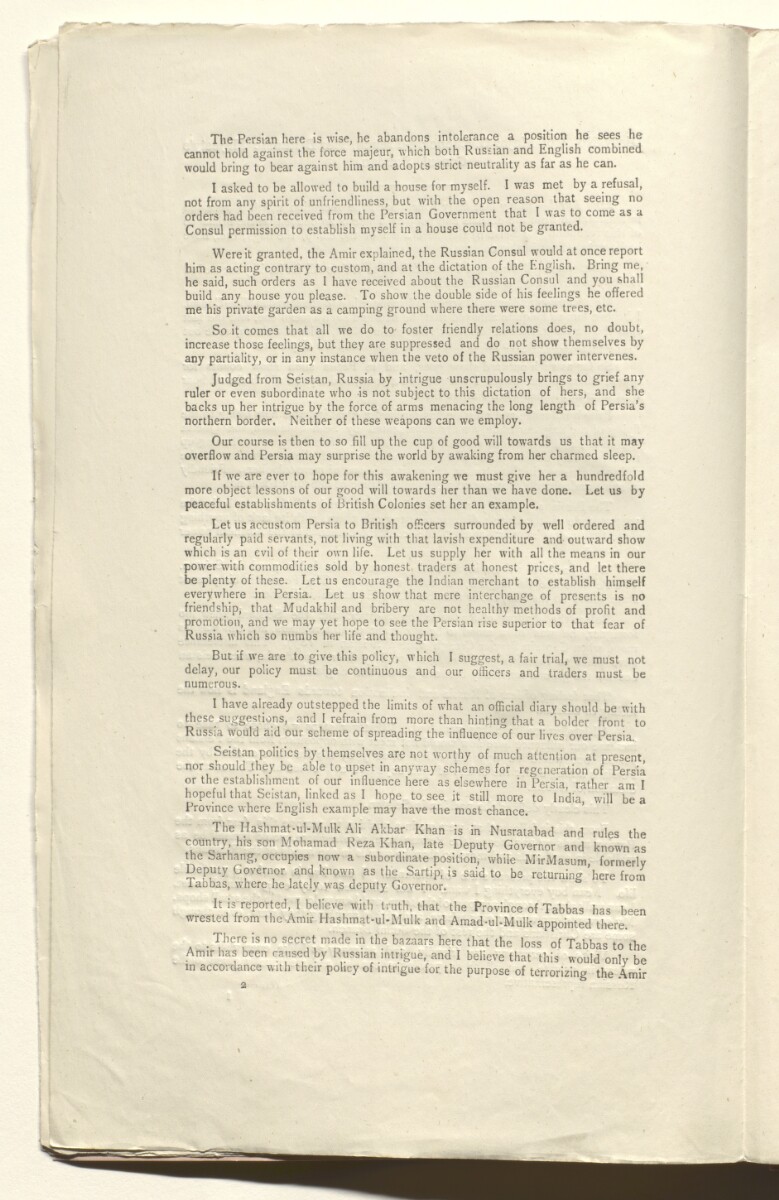
The Persian here is wise, he abandons intolerance a position he sees he
cannot hold against the force majeur, which both Russian and English combined
would bring to bear against him and adopts strict neutrality as far as he can.
I asked to be allowed to build a house for myself. I was met by a refusal,
not from any spirit of unfriendliness, but with the open reason that seeing no
orders had been received from the Persian Government that I was to come as a
Consul permission to establish myself in a house could not be granted.
Were it granted, the Amir explained, the Russian Consul would at once report
him as acting contrary to custom, and at the dictation of the English. Bring me,
he said, such orders as I have received about the Russian Consul and you shall
build any house you please. To show the double side of his feelings he offered
me his private garden as a camping ground where there were some trees, etc.
So it comes that all we do to foster friendly relations does, no doubt,
increase those feelings, but they are suppressed and do not show themselves by
any partiality, or in any instance when the veto of the Russian power intervenes.
Judged from Seistan, Russia by intrigue unscrupulously brings to grief any
ruler or even subordinate who is not subject to this dictation of hers, and she
backs up her intrigue by the force of arms menacing the long length of Persia’s
northern border. Neither of these weapons can we employ.
Our course is then to so fill up the cup of good will towards us that it may
overflow and Persia may surprise the world by awaking from her charmed sleep.
If we are ever to hope for this awakening we must give her a hundredfold
more object lessons of our good will towards her than we have done. Let us by
peaceful establishments of British Colonies set her an example.
Let us accustom Persia to British officers surrounded by well ordered and
regularly paid servants, not living with that lavish expenditure and outward show
which is an evil of their own life. Let us supply her with all the means in our
power with commodities sold by honest traders at honest prices, and let there
be plenty of these. Let us encourage the Indian merchant to establish himself
everywhere in Persia. Let us show that mere interchange of presents is no
friendship, that Mudakhil and bribery are not healthy methods of profit and
promotion, and we may yet hope to see the Persian rise superior to that fear of
Russia which so numbs her life and thought.
But if we are to give this policy, which I suggest, a fair trial, we must not
delay, our policy must be continuous and our officers and traders must be
numerous.
I have already outstepped the limits of what an official diary should be with
these suggestions, and I refrain from more than hinting that a bolder front to
Russia would aid our scheme of spreading the influence of our lives over Persia.
Seistan politics by themselves are not worthy of much attention at present,
nor should they be able to upset in anyway schemes for regeneration of Persia
or the establishment of our influence here as elsewhere in Persia, rather ami
hopeful that Seistan, linked as I hope to see it still more to India, will be a
Province where English example may have the most chance.
The Hashmat-ul-Mulk Mi Akbar Khan is in Nusratabad and rules the
country, his son Mohamad Reza Khan, late Deputy Governor and known as
the Sarhang, occupies now a subordinate position, while MirMasum formerly
Deputy Governor and known as the Sartip, is said to be returning herefrom
iabbas, where he lately was deputy Governor.
It is reported, I believe with truth, that the Province of Tabbas has been
wrested from the Amir Hashmat-ul-Mulk and Amad-ul-Mulk appointed there.
. There is no secret made in the bazaars here that the loss of Tabbas to the
Amir has been caused by Russian intrigue, and I believe that this would only be
in accordance with their policy of intrigue for the purpose of terrorizing the Amir
2
About this item
- Content
The file contains papers relating to Seistan [Sistan] and Persia [Iran].
The file includes printed copies of despatches from the Agent to the Governor-General of India and HM Consul-General for Khorasan and Seistan (Lieutenant-Colonel Henry Martindale Temple), to the Secretary to the Government of India Foreign Department, with enclosed despatches from Captain Percy Molesworth Sykes to the Secretary of State for Foreign Affairs (the Marquis of Salisbury). Skyes’s despatches regard matters including: Seistan; trade routes into South-East Persia; the boundary between Persia and Afghanistan, in relation to the River Helmund [Helmand] changing its course (in despatch No. 5, which includes four sketch maps, folios 12, 13, 14 and 15); Sykes’s journey to Birjand (in despatch No. 7, which includes a sketch map on folio 20); the ruling family of Kain, which also governed Seistan, Tabbas and Tun; Sykes’s journey from Seistan to Kerman [Kirman] (in despatch No. 11, which includes a sketch map); and the direct Kerman-Quetta caravan trade that Sykes was trying to establish.
The file also includes copies of the following papers:
- A despatch from Temple to the Secretary to the Government of India Foreign Department, enclosing a letter from Temple to Sir Henry Mortimer Durand (HM Minister, Tehran), with copies of enclosures, regarding the establishment of a Seistan and Kain consulate
- A letter from Charles Edward Pitman, Director General of Telegraphs, to the Secretary to the Government of India Public Works Department, enclosing a copy of a ‘Report on the Preliminary Survey of the Route for a Telegraph Line from Quetta to the Persian Frontier’ by H A Armstrong, Assistant Superintendent, Indian Telegraph Department, which includes six photographs of views along the route [Mss Eur F111/352, f 52; Mss Eur F111/352, f 53; Mss Eur F111/352, f 54; Mss Eur F111/352, f 55; Mss Eur F111/352, f 56; and Mss Eur F111/352, f 57], and a map showing the proposed route of the telegraph line [Mss Eur F111/352, f 59]
- Letters from Hugh Shakespear Barnes, Agent to the Governor-General in Baluchistan, to the Secretary to the Government of India Foreign Department, enclosing copies of the diary of the Political Assistant, Chagai, for the weeks ending 16 February, 28 February, and 8 March 1900
- Diary No. 3, 4, 6, 7, 8, 9, 11 and 12 of Major-General George Frederick Chenevix-Trench, HM Consul for Seistan (Diary No. 6 includes a sketch map, folio 86)
- A copy of a ‘Report on Reconnaissances Made while Attached to the Seistan Arbitration Commission’ by W A Johns, Deputy Consulting Engineer for Railways, Bombay
- A copy of the report ‘Notes on Persian Seistan’, compiled by Captain Edward Abadie Plunkett, and issued by the Government of India Intelligence Branch, Quarter-Master General’s Department
- Two copies of map signed by Plunkett titled ‘Persian Seistan-Cultivated Area’ [Mss Eur F111/352, f 270]
- A booklet entitled ‘Notes on the Leading Notables, Officials, Merchants, and Clergy of Khorasan, Seistan, Kain, and Kerman.’
- Printed copies of letters from the Government of India Foreign Department to the Secretary of State for India (Lord George Francis Hamilton), relating to the maintenance of British interests in Persia, dated 4 September 1899 and 7 November 1901 (the former with an enclosure of a minute by the Viceroy on Seistan).
- Extent and format
- 1 file (388 folios)
- Arrangement
The papers are arranged in approximate chronological order from the front to the rear of the file.
- Physical characteristics
Foliation: the foliation sequence (used for referencing) commences at the front cover with 1, and terminates at the inside back cover with 390; these numbers are written in pencil, are circled, and are located in the top right corner of the recto The front of a sheet of paper or leaf, often abbreviated to 'r'. side of each folio. The file contains one foliation anomaly, f 301A
- Written in
- English in Latin script View the complete information for this record
Use and share this item
- Share this item
'Seistan' [80v] (160/782), British Library: India Office Records and Private Papers, Mss Eur F111/352, in Qatar Digital Library <https://www.qdl.qa/archive/81055/vdc_100069721602.0x0000a3> [accessed 25 June 2026]
https://www.qdl.qa/en/archive/81055/vdc_100069721602.0x0000a3
Copy and paste the code below into your web page where you would like to embed the image.
<meta charset="utf-8"><a href="https://www.qdl.qa/en/archive/81055/vdc_100069721602.0x0000a3">'Seistan' [‎80v] (160/782)</a> <a href="https://www.qdl.qa/en/archive/81055/vdc_100069721602.0x0000a3"> <img src="https://iiif.qdl.qa/iiif/images/81055/vdc_100000001452.0x0003bc/Mss Eur F111_352_0176.jp2/full/!280,240/0/default.jpg" alt="" /> </a>
This record has a IIIF manifest available as follows. If you have a compatible viewer you can drag the icon to load it.https://www.qdl.qa/en/iiif/81055/vdc_100000001452.0x0003bc/manifestOpen in Universal viewerOpen in Mirador viewerMore options for embedding images
Copyright: How to use this content
- Reference
- Mss Eur F111/352
- Title
- 'Seistan'
- Pages
- front, front-i, 2r:51v, 58r:58v, 60r:112r, 113r:125v, 147r:218r, 218r, 219r:269v, 271r:301v, 301Ar, 301Av, 302r:388v, 389v:390r, 389r, back
- Author
- East India Company, the Board of Control, the India Office, or other British Government Department
- Usage terms
- Open Government Licence