
!['Seistan' [‎81r] (161/782)](https://iiif.qdl.qa/iiif/images/81055/vdc_100000001452.0x0003bc/Mss Eur F111_352_0177.jp2/full/!1200,1200/0/default.jpg "'Seistan' [‎81r] (161/782)")
The record is made up of 1 file (388 folios). It was created in 17 Jan 1899-4 Apr 1904. It was written in English. The original is part of the British Library: India Office The department of the British Government to which the Government of India reported between 1858 and 1947. The successor to the Court of Directors. Records and Private Papers Documents collected in a private capacity. .
Transcription
This transcription is created automatically. It may contain errors.
i
3
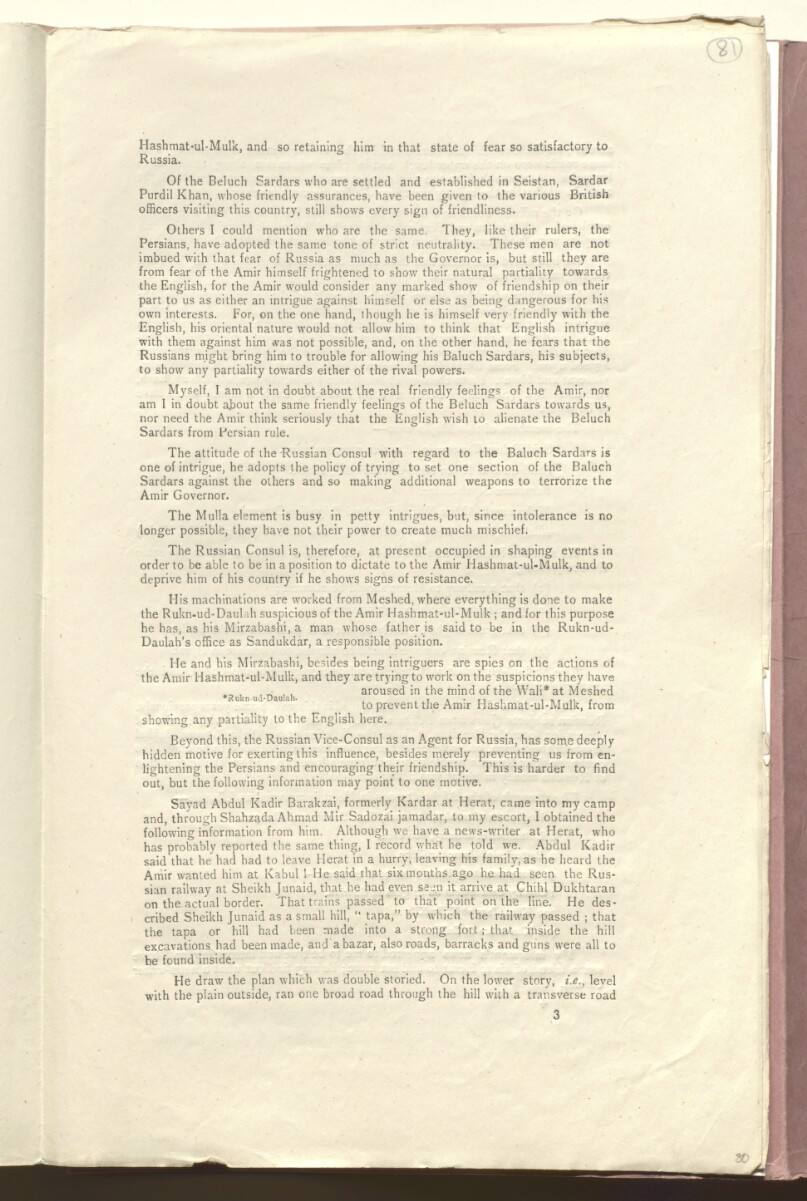
Hashmat-ul-Mulk, and so retaining him in that state of fear so satisfactory to
Russia.
Of the Beluch Sardars who are settled and established in Seistan,
Sardar
Leader of a tribe or a polity; also refers to a military rank or title given to a commander of an army or division.
Purdil Khan, whose friendly assurances, have been given to the various British
officers visiting this country, still shows every sign of friendliness.
Others I could mention who are the same. They, like their rulers, the
Persians, have adopted the same tone of strict neutrality. These men are not
imbued with that fear of Russia as much as the Governor is, but still they are
from fear of the Amir himself frightened to show their natural partiality towards
the English, for the Amir would consider any marked show of friendship on their
part to us as either an intrigue against himself or else as being dangerous for his
own interests. For, on the one hand, though he is himself very friendly with the
English, his oriental nature would not allow him to think that English intrigue
with them against him was not possible, and, on the other hand, he fears that the
Russians m.ight bring him to trouble for allowing his Baluch Sardars, his subjects,
to show any partiality towards either of the rival powers.
Myself, I am not in doubt about the real friendly feelings of the Amir, nor
am I in doubt about the same friendly feelings of the Beluch Sardars towards us,
nor need the Amir think seriously that the English wish to alienate the Beluch
Sardars from Persian rule.
The attitude of the Russian Consul with regard to the Baluch Sardars is
one of intrigue, he adopts the policy of trying to set one section of the Baluch
Sardars against the others and so making additional weapons to terrorize the
Amir Governor.
The Mulla element is busy in petty intrigues, but, since intolerance is no
longer possible, they have not their power to create much mischief.
The Russian Consul is, therefore, at present occupied in shaping events in
order to be able to be in a position to dictate to the Amir Hashmat-ul-Mulk, and to
deprive him of his country if he shows signs of resistance.
His machinations are worked from Meshed, where everything is done to make
the Rukn-ud-Daulah suspicious of the Amir Hashmat-ul-Mulk ; and for this purpose
he has, as his Mirzabashi, a man whose father is said to be in the Rukn-ud-
Daulah’s office as Sandukdar, a responsible position.
He and his Mirzabashi, besides being intriguers are spies on the actions of
the Amir Hashmat-ul-Mulk, and they are trying to work on the suspicions they have
aroused in the mind of the Wall* at Meshed
to prevent the Amir Hashmat-ul-Mulk, from
showing any partiality to the English here.
Beyond this, the Russian Vice-Consul as an Agent for Russia, has som.e deeply
hidden motive for exerting this influence, besides merely preventing us from en
lightening the Persians and encouraging their friendship. This is harder to find
out, but the following information may point to one motive.
Sayad Abdul Kadir Barakzai, formerly Kardar at Herat, came into my camp
and, through Shahzada Ahmad Mir Sadozai jamadar, to my escort, I obtained the
following information from him. Although we have a news-
writer
The lowest of the four classes into which East India Company civil servants were divided. A Writer’s duties originally consisted mostly of copying documents and book-keeping.
at Herat, who
has probably reported the same thing, I record what he told we. Abdul Kadir
said that he had had to leave Herat in a hurry, leaving his family, as he heard the
Amir wanted him at Kabul 1 He said that six months ago he had seen the Rus
sian railway at Sheikh Junaid, that he had even seen it arrive at Chihl Dukhtaran
on the actual border. That trains passed to that point on the line. He des
cribed Sheikh Junaid as a small hill, “ tapa,” by which the railway passed ; that
the tapa or hill had been made into a strong fort; that inside the hill
excavations had been made, and a bazar, also roads, barracks and guns were all to
be found inside.
He draw the plan which was double storied. On the lower story, i.e., level
with the plain outside, ran one broad road through the hill with a transverse road
About this item
- Content
The file contains papers relating to Seistan [Sistan] and Persia [Iran].
The file includes printed copies of despatches from the Agent to the Governor-General of India and HM Consul-General for Khorasan and Seistan (Lieutenant-Colonel Henry Martindale Temple), to the Secretary to the Government of India Foreign Department, with enclosed despatches from Captain Percy Molesworth Sykes to the Secretary of State for Foreign Affairs (the Marquis of Salisbury). Skyes’s despatches regard matters including: Seistan; trade routes into South-East Persia; the boundary between Persia and Afghanistan, in relation to the River Helmund [Helmand] changing its course (in despatch No. 5, which includes four sketch maps, folios 12, 13, 14 and 15); Sykes’s journey to Birjand (in despatch No. 7, which includes a sketch map on folio 20); the ruling family of Kain, which also governed Seistan, Tabbas and Tun; Sykes’s journey from Seistan to Kerman [Kirman] (in despatch No. 11, which includes a sketch map); and the direct Kerman-Quetta caravan trade that Sykes was trying to establish.
The file also includes copies of the following papers:
- A despatch from Temple to the Secretary to the Government of India Foreign Department, enclosing a letter from Temple to Sir Henry Mortimer Durand (HM Minister, Tehran), with copies of enclosures, regarding the establishment of a Seistan and Kain consulate
- A letter from Charles Edward Pitman, Director General of Telegraphs, to the Secretary to the Government of India Public Works Department, enclosing a copy of a ‘Report on the Preliminary Survey of the Route for a Telegraph Line from Quetta to the Persian Frontier’ by H A Armstrong, Assistant Superintendent, Indian Telegraph Department, which includes six photographs of views along the route [Mss Eur F111/352, f 52; Mss Eur F111/352, f 53; Mss Eur F111/352, f 54; Mss Eur F111/352, f 55; Mss Eur F111/352, f 56; and Mss Eur F111/352, f 57], and a map showing the proposed route of the telegraph line [Mss Eur F111/352, f 59]
- Letters from Hugh Shakespear Barnes, Agent to the Governor-General in Baluchistan, to the Secretary to the Government of India Foreign Department, enclosing copies of the diary of the Political Assistant, Chagai, for the weeks ending 16 February, 28 February, and 8 March 1900
- Diary No. 3, 4, 6, 7, 8, 9, 11 and 12 of Major-General George Frederick Chenevix-Trench, HM Consul for Seistan (Diary No. 6 includes a sketch map, folio 86)
- A copy of a ‘Report on Reconnaissances Made while Attached to the Seistan Arbitration Commission’ by W A Johns, Deputy Consulting Engineer for Railways, Bombay
- A copy of the report ‘Notes on Persian Seistan’, compiled by Captain Edward Abadie Plunkett, and issued by the Government of India Intelligence Branch, Quarter-Master General’s Department
- Two copies of map signed by Plunkett titled ‘Persian Seistan-Cultivated Area’ [Mss Eur F111/352, f 270]
- A booklet entitled ‘Notes on the Leading Notables, Officials, Merchants, and Clergy of Khorasan, Seistan, Kain, and Kerman.’
- Printed copies of letters from the Government of India Foreign Department to the Secretary of State for India (Lord George Francis Hamilton), relating to the maintenance of British interests in Persia, dated 4 September 1899 and 7 November 1901 (the former with an enclosure of a minute by the Viceroy on Seistan).
- Extent and format
- 1 file (388 folios)
- Arrangement
The papers are arranged in approximate chronological order from the front to the rear of the file.
- Physical characteristics
Foliation: the foliation sequence (used for referencing) commences at the front cover with 1, and terminates at the inside back cover with 390; these numbers are written in pencil, are circled, and are located in the top right corner of the recto The front of a sheet of paper or leaf, often abbreviated to 'r'. side of each folio. The file contains one foliation anomaly, f 301A
- Written in
- English in Latin script View the complete information for this record
Use and share this item
- Share this item
'Seistan' [81r] (161/782), British Library: India Office Records and Private Papers, Mss Eur F111/352, in Qatar Digital Library <https://www.qdl.qa/archive/81055/vdc_100069721602.0x0000a4> [accessed 27 June 2026]
https://www.qdl.qa/en/archive/81055/vdc_100069721602.0x0000a4
Copy and paste the code below into your web page where you would like to embed the image.
<meta charset="utf-8"><a href="https://www.qdl.qa/en/archive/81055/vdc_100069721602.0x0000a4">'Seistan' [‎81r] (161/782)</a> <a href="https://www.qdl.qa/en/archive/81055/vdc_100069721602.0x0000a4"> <img src="https://iiif.qdl.qa/iiif/images/81055/vdc_100000001452.0x0003bc/Mss Eur F111_352_0177.jp2/full/!280,240/0/default.jpg" alt="" /> </a>
This record has a IIIF manifest available as follows. If you have a compatible viewer you can drag the icon to load it.https://www.qdl.qa/en/iiif/81055/vdc_100000001452.0x0003bc/manifestOpen in Universal viewerOpen in Mirador viewerMore options for embedding images
Copyright: How to use this content
- Reference
- Mss Eur F111/352
- Title
- 'Seistan'
- Pages
- front, front-i, 2r:51v, 58r:58v, 60r:112r, 113r:125v, 147r:218r, 218r, 219r:269v, 271r:301v, 301Ar, 301Av, 302r:388v, 389v:390r, 389r, back
- Author
- East India Company, the Board of Control, the India Office, or other British Government Department
- Usage terms
- Open Government Licence