
!['Seistan' [‎330v] (662/782)](https://iiif.qdl.qa/iiif/images/81055/vdc_100000001452.0x0003bc/Mss Eur F111_352_0686.jp2/full/!1200,1200/0/default.jpg "'Seistan' [‎330v] (662/782)")
The record is made up of 1 file (388 folios). It was created in 17 Jan 1899-4 Apr 1904. It was written in English. The original is part of the British Library: India Office The department of the British Government to which the Government of India reported between 1858 and 1947. The successor to the Court of Directors. Records and Private Papers Documents collected in a private capacity. .
Transcription
This transcription is created automatically. It may contain errors.
1
J
[ 16
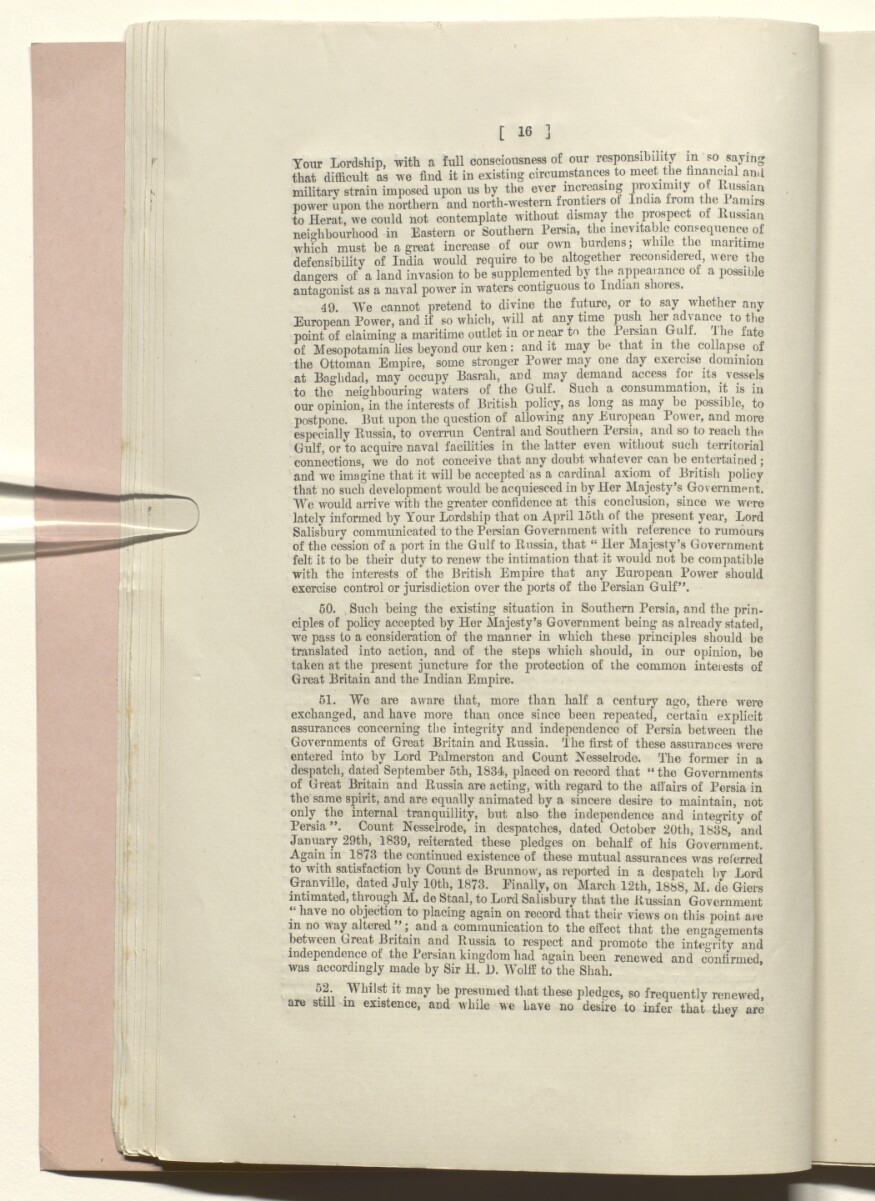
Your Lordship, with a full consciousness of our responsibility in so saying
that difficult as we find it in existing circumstances to meet the financial and
military strain imposed upon us by the ever increasing pioximity o tussian
power upon the northern and north-western frontiers of India from the 1 amirs
to Herat, we could not contemplate without dismay the prospect of Russian
neighbourhood in Eastern or Southern Persia, the inevitable consequence of
winch must be a great increase of our own burdens; while the maritime
defensibility of India would require to be altogether reconsidered, were the
dangers of a land invasion to be supplemented by the appearance of a possible
antagonist as a naval power in waters contiguous to Indian shores.
49 . We cannot pretend to divine the future, or to say whether any
European Power, and if so which, will at any time push her ad\ance to the
point of claiming a maritime outlet in or near to the I ersian Criilf. 1 lie late
of Mesopotamia lies beyond our ken: and it may be that in the collapse of
the Ottoman Empire, some stronger Power may one day exercise ^ dominion
at Baghdad, may occupy Basrah, and may demand access for its vessels
to the neighbouring waters of the Gulf. Such a consummation, it is in
our opinion,°in the interests of British policy, as long as may be possible, to
postpone. But upon the question of allowing any European Power, and more
especially Russia, to overrun Central and Southern Persia, and so to reach the
Gulf, or to acquire naval facilities in the latter even without such territorial
connections, we do not conceive that any doubt whatever can be entertained;
and we imagine that it will be accepted as a cardinal axiom of British policy
that no such development would be acquiesced in by Her Majesty’s Government.
We would arrive with the greater confidence at this conclusion, since we were
lately informed by Your Lordship that on April 15th of the present year, Lord
Salisbury communicated to the Persian Government with reference to rumours
of the cession of a port in the Gulf to Russia, that “ Her Majesty’s Government
felt it to be their duty to renew the intimation that it would not be compatible
with the interests of the British Empire that any European Power should
exercise control or jurisdiction over the ports of the Persian Gulf”.
50. Such being the existing situation in Southern Persia, and the prin
ciples of policy accepted by Her Majesty’s Government being as already stated,
we pass to a consideration of the manner in which these principles should be
translated into action, and of the steps which should, in our opinion, be
taken at the present juncture for the protection of the common interests of
Great Britain and the Indian Empire.
51. We are aware that, more than half a century ago, there were
exchanged, and have more than once since been repeated, certain explicit
assurances concerning the integrity and independence of Persia between the
Governments of Great Britain and Russia. The first of these assurances were
entered into by Lord Palmerston and Count Nesselrode. The former in a
despatch, dated September 5th, 1834, placed on record that “ the Governments
of Great Britain and Russia are acting, with regard to the affairs of Persia in
the same spirit, and are equally animated by a sincere desire to maintain, not
only the internal tranquillity, but also the independence and integrity of
Persia ”. Count Nesselrode, in despatches, dated October 20 th, 1838, and
January 29th, 1839, reiterated these pledges on behalf of his Government.
Again in 1873 the continued existence of these mutual assurances was referred
to with satisfaction by Count de Brunnow, as reported in a despatch by Lord
Granville, dated July 10 th, 1873. Finally, on March 12 th, 1888, M. de Giers
intimated, through M. de Staal, to Lord Salisbury that the Russian Government
‘‘ have no objection to placing again on record that their views on this point are
in no v ay^ altered , and a communication to the effect that the engagements
between Great Britain and Russia to respect and promote the integrity and
independence of the Persian kingdom had again been renewed and confirmed
was accordingly made by Sir H. D. Wolff to the Shah.
hilst it may be presumed that these pledges, so frequently renewed,
are still in existence, and while we Lave no desire to infer that they are
About this item
- Content
The file contains papers relating to Seistan [Sistan] and Persia [Iran].
The file includes printed copies of despatches from the Agent to the Governor-General of India and HM Consul-General for Khorasan and Seistan (Lieutenant-Colonel Henry Martindale Temple), to the Secretary to the Government of India Foreign Department, with enclosed despatches from Captain Percy Molesworth Sykes to the Secretary of State for Foreign Affairs (the Marquis of Salisbury). Skyes’s despatches regard matters including: Seistan; trade routes into South-East Persia; the boundary between Persia and Afghanistan, in relation to the River Helmund [Helmand] changing its course (in despatch No. 5, which includes four sketch maps, folios 12, 13, 14 and 15); Sykes’s journey to Birjand (in despatch No. 7, which includes a sketch map on folio 20); the ruling family of Kain, which also governed Seistan, Tabbas and Tun; Sykes’s journey from Seistan to Kerman [Kirman] (in despatch No. 11, which includes a sketch map); and the direct Kerman-Quetta caravan trade that Sykes was trying to establish.
The file also includes copies of the following papers:
- A despatch from Temple to the Secretary to the Government of India Foreign Department, enclosing a letter from Temple to Sir Henry Mortimer Durand (HM Minister, Tehran), with copies of enclosures, regarding the establishment of a Seistan and Kain consulate
- A letter from Charles Edward Pitman, Director General of Telegraphs, to the Secretary to the Government of India Public Works Department, enclosing a copy of a ‘Report on the Preliminary Survey of the Route for a Telegraph Line from Quetta to the Persian Frontier’ by H A Armstrong, Assistant Superintendent, Indian Telegraph Department, which includes six photographs of views along the route [Mss Eur F111/352, f 52; Mss Eur F111/352, f 53; Mss Eur F111/352, f 54; Mss Eur F111/352, f 55; Mss Eur F111/352, f 56; and Mss Eur F111/352, f 57], and a map showing the proposed route of the telegraph line [Mss Eur F111/352, f 59]
- Letters from Hugh Shakespear Barnes, Agent to the Governor-General in Baluchistan, to the Secretary to the Government of India Foreign Department, enclosing copies of the diary of the Political Assistant, Chagai, for the weeks ending 16 February, 28 February, and 8 March 1900
- Diary No. 3, 4, 6, 7, 8, 9, 11 and 12 of Major-General George Frederick Chenevix-Trench, HM Consul for Seistan (Diary No. 6 includes a sketch map, folio 86)
- A copy of a ‘Report on Reconnaissances Made while Attached to the Seistan Arbitration Commission’ by W A Johns, Deputy Consulting Engineer for Railways, Bombay
- A copy of the report ‘Notes on Persian Seistan’, compiled by Captain Edward Abadie Plunkett, and issued by the Government of India Intelligence Branch, Quarter-Master General’s Department
- Two copies of map signed by Plunkett titled ‘Persian Seistan-Cultivated Area’ [Mss Eur F111/352, f 270]
- A booklet entitled ‘Notes on the Leading Notables, Officials, Merchants, and Clergy of Khorasan, Seistan, Kain, and Kerman.’
- Printed copies of letters from the Government of India Foreign Department to the Secretary of State for India (Lord George Francis Hamilton), relating to the maintenance of British interests in Persia, dated 4 September 1899 and 7 November 1901 (the former with an enclosure of a minute by the Viceroy on Seistan).
- Extent and format
- 1 file (388 folios)
- Arrangement
The papers are arranged in approximate chronological order from the front to the rear of the file.
- Physical characteristics
Foliation: the foliation sequence (used for referencing) commences at the front cover with 1, and terminates at the inside back cover with 390; these numbers are written in pencil, are circled, and are located in the top right corner of the recto The front of a sheet of paper or leaf, often abbreviated to 'r'. side of each folio. The file contains one foliation anomaly, f 301A
- Written in
- English in Latin script View the complete information for this record
Use and share this item
- Share this item
'Seistan' [330v] (662/782), British Library: India Office Records and Private Papers, Mss Eur F111/352, in Qatar Digital Library <https://www.qdl.qa/archive/81055/vdc_100069721606.0x000041> [accessed 30 June 2026]
https://www.qdl.qa/en/archive/81055/vdc_100069721606.0x000041
Copy and paste the code below into your web page where you would like to embed the image.
<meta charset="utf-8"><a href="https://www.qdl.qa/en/archive/81055/vdc_100069721606.0x000041">'Seistan' [‎330v] (662/782)</a> <a href="https://www.qdl.qa/en/archive/81055/vdc_100069721606.0x000041"> <img src="https://iiif.qdl.qa/iiif/images/81055/vdc_100000001452.0x0003bc/Mss Eur F111_352_0686.jp2/full/!280,240/0/default.jpg" alt="" /> </a>
This record has a IIIF manifest available as follows. If you have a compatible viewer you can drag the icon to load it.https://www.qdl.qa/en/iiif/81055/vdc_100000001452.0x0003bc/manifestOpen in Universal viewerOpen in Mirador viewerMore options for embedding images
Copyright: How to use this content
- Reference
- Mss Eur F111/352
- Title
- 'Seistan'
- Pages
- front, front-i, 2r:51v, 58r:58v, 60r:112r, 113r:125v, 147r:218r, 218r, 219r:269v, 271r:301v, 301Ar, 301Av, 302r:388v, 389v:390r, 389r, back
- Author
- East India Company, the Board of Control, the India Office, or other British Government Department
- Usage terms
- Open Government Licence