Overview
Origins of Formal Anglo-Qatari Relations
Following an 1867 attack by Bahrain and Abu Dhabi on Qatar, the Political Resident A senior ranking political representative (equivalent to a Consul General) from the diplomatic corps of the Government of India or one of its subordinate provincial governments, in charge of a Political Residency. in the Persian Gulf The historical term used to describe the body of water between the Arabian Peninsula and Iran. , Lewis Pelly, insisted that Bahrain and Abu Dhabi re-sign and re-affirm their trucial declarations in 1868. Alongside other senior Qatari tribal leaders, Shaikh Muhammad bin Thani also signed a treaty with Britain at this time establishing formal political relations between the two parties. This pivotal moment could be viewed as Britain’s formal recognition of Qatar as a sovereign entity. In reality, however, Britain largely continued to regard Qatar as a place of Ottoman interest until the First World War, when Ottoman alignment with Germany shifted Qatar’s strategic significance. In the following decades, the rulers of Qatar navigated Ottoman and British interests effectively.
‘Avoid Haste and Defer Action’
Though Britain held friendly relations with the Ottoman Empire, it was careful not to tread on the latter’s toes in the case of Qatar, particularly since there were no pressing strategic or economic reasons to do so. The British Government was accordingly circumspect in its dealings with the Al Thani rulers.
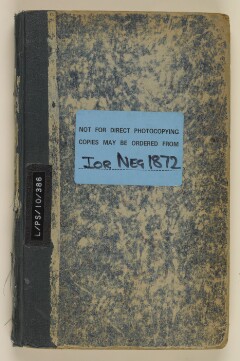
In 1913, an Anglo-Ottoman convention was signed. As part of the agreement on delimiting boundaries, it contained provisions for the withdrawal of an Ottoman garrison from Doha. While the Secretary of State for India wished to negotiate a treaty with Qatar as soon this convention came into force, Charles Hardinge, the Viceroy of India, advised patience. Following the recent death of Shaikh Jasim bin Muhammad Al Thani, he suggested delaying negotiations ‘until such time as it is known whether new Shaikh [‘Abdullah] can establish his position as successor’ (IOR/L/PS/10/386, f. 109r). He further elaborated that: ‘[i]n the circumstances it is clearly desirable to avoid haste and to defer action as regards treaties for the present […] When Sheikh’s position is assured, our relations with Bin Saud defined, and El Katr affairs have had time to settle, we are of opinion that suitable opportunity might be taken to conclude treaty’ (IOR/L/PS/10/386, f. 116r). The Secretary of State was persuaded.
Archive items in this article


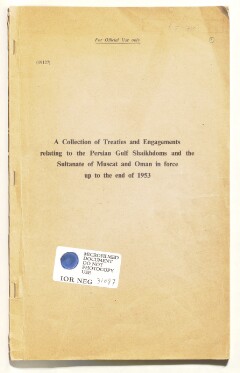
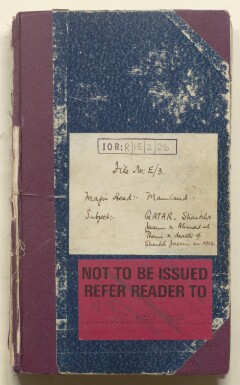
![Minute paper confirming the Secretary of State’s ‘concurrence […] that nothing should be done for the present in the matter of the proposed treaty with El Katr.’ IOR/L/PS/10/386, f. 108r](https://www.qdl.qa/sites/default/files/styles/standard_content_image/public/ior_l_ps_10_386_crop_web.jpg?itok=SSmoB-aj)
Ottoman Withdrawal and Sa‘udi Negotiations
Following the Ottoman decision to sign a secret deal with the Central Powers (Germany and Austria-Hungary) at the outbreak of the First World War, the 1913 Convention was never ratified. The Ottoman garrison at Doha only withdrew in 1915 for their own strategic reasons. This seemed to clear the way for Political Resident A senior ranking political representative (equivalent to a Consul General) from the diplomatic corps of the Government of India or one of its subordinate provincial governments, in charge of a Political Residency. Sir Percy Cox to agree a second treaty with Qatar.
At the same time, British officials were also concerned with the perceived attitude of ‘Abd al-‘Aziz bin ‘Abd al-Rahman Al Sa‘id [often referred to in British sources as Ibn Sa‘ud], following his recent settlement with the Ottoman Government. British authorities were vexed by the question of concluding negotiations with Ibn Sa‘ud before completing a treaty with Qatar.

Obligations of the Anglo-Qatar Treaty
The British Government signed a treaty with Ibn Sa‘ud in December 1915, which was ratified in July 1916. A treaty with Shaikh ‘Abdullah of Qatar followed in November 1916 and was ratified in March 1918. The Anglo-Qatar treaty committed Britain to guaranteeing Qatar’s security. In exchange, Qatar ceded control of its foreign affairs to the British Government. Shaikh ‘Abdullah agreed in particular ‘not [to] have relations nor correspond with, nor receive the agent of, any other Power without the consent of the High British Government’, and not to grant ‘pearl-fishery concessions, or any other monopolies [or] concessions’ without British Government approval.

Keeping the Lion at Bay
Mindful of the implications of accepting Britain’s imperialist embrace, Shaikh ‘Abdullah ensured that articles seven, eight, and nine of the treaty remained in abeyance. These included the article permitting Britain to appoint a Political Agent in Qatar. Cox confirmed the suspension of these three articles in a side letter to Shaikh ‘Abdullah, which accompanied the treaty. Furthermore, the treaty was not binding on Shaikh ‘Abdullah’s heirs and successors, something which the British Government would later recognise as an ‘oversight’ (IOR/L/PS/12/3816, f. 7r).
Related Articles





Britain’s 1916 treaty with Qatar helped further consolidate its dominance in the Gulf. However, through their skilful diplomacy, the Al Thani rulers still managed to keep British influence at bay, at least for the time being.