‘1900. THE LORD CURZON OF KEDLESTON. TELEGRAPHIC CORRESPONDENCE WITH THE SECRETARY OF STATE FOR INDIA.’
Mss Eur F111/170


340 items in this record
Search within this record
The record is made up of 1 volume (168 folios). It was created in 1901?. It was written in English. The original is part of the British Library: India Office The department of the British Government to which the Government of India reported between 1858 and 1947. The successor to the Court of Directors. Records and Private Papers Documents collected in a private capacity. .
About this record
- Content
This volume consists of printed copies of telegraphic correspondence, dated 1 January to 31 December 1900, of Lord Curzon of Kedleston, Viceroy and Governor-General of India, with Lord George Hamilton, Secretary of State for India.
The start of the volume contains a detailed index of names, places and subjects (ff 2-8). This is followed by telegrams from the Secretary of State for India to Lord Curzon, numbered 1-489 (ff 9-75) and telegrams from Lord Curzon to the Secretary of State for India, numbered 1-502 (ff 77-162).
A wide variety of subjects are covered, including matters relating to the following:
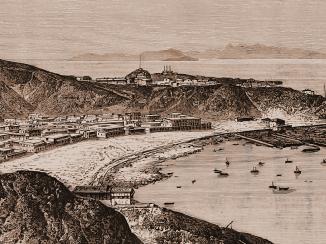
- The Aden Protectorate, notably Turkish [Ottoman] ‘encroachments’ on Haushabi [al-Ḥawshabī] territory
- The war in South Africa [the South African War or Second Boer War in Southern Africa, 1899-1902]
- Army matters, such as the recall of officers of the Indian Army from furlough
- Boer prisoners of war, including the proposal to send them to Ceylon [Sri Lanka]
- Russian ‘designs’ upon Bunder Abbas [Bandar Abbas]
- The Burma [or Myanmar]-China boundary
- The China Expeditionary Force [Gaselee Expedition], notably arms and ammunition, estimated cost, hospital and medical arrangements, and the rank and position of General Sir Alfred Gaselee within the Force
- The replacement of the Garrison at Hong Kong
- Currency, including proposed measures to address the serious scarcity of rupees Indian silver coin also widely used in the Persian Gulf. , the Paper Currency Act Amendment Bill, the purchase and shipment of silver from England, the release of gold, and the shipment of gold to England
- Famine [the Indian famine of 1899-1900], notably famine and cholera in the Bombay Presidency The name given to each of the three divisions of the territory of the East India Company, and later the British Raj, on the Indian subcontinent. , crop prospects and relief works, and composition of the Famine Commission
- Honours, including the Queen’s Birthday Honours
- Koweit [Kuwait], in particular a dispute with Nejd [Najd]
- Loans, including applications from Native States [Princely States] for loans for famine relief purposes, and a loan to the Nizam of Hyderabad
- Maskat [Muscat], notably a site for a French coal-shed, and the actions of the Sultan of Muskat regarding the use of French flags by his subjects
- Railways in British India and the Uganda Railway
- Russia, in particular Russian ‘designs’ on the Persian Gulf The historical term used to describe the body of water between the Arabian Peninsula and Iran. .
- Extent and format
- 1 volume (168 folios)
- Arrangement
The telegrams are arranged in chronological order from the front to the rear of each of the two sections of the volume, which are divided by a folio of blue card. Each telegram is numbered, and the index on folios 2-8 gives the numbers of the telegrams which correspond to each name, place or subject listed in the index.
- Physical characteristics
Foliation: the foliation sequence (used for referencing) commences at the first folio with 1, and terminates at the last folio with 162; these numbers are written in pencil, are circled, and are located in the top right corner of the recto The front of a sheet of paper or leaf, often abbreviated to 'r'. side of each folio. The foliation sequence does not include the front and back covers, nor does it include the leading and ending flyleaves.
Pagination: the volume also contains two original printed pagination sequences.
- Written in
- English in Latin script
- Type
- Archival file
Archive information for this record
- Original held at
- British Library: India Office The department of the British Government to which the Government of India reported between 1858 and 1947. The successor to the Court of Directors. Records and Private Papers Documents collected in a private capacity.
- Access conditions
Unrestricted
- Archive reference
- Mss Eur F111/170
- Date(s)
- 1901? (CE, Gregorian)
Access & Reference
History of this record
Related search terms
- Subjects
- Boer War (1899-1902)Prisoners of WarHonoursFaminesMilitary operationsInternational relationsForeign policyRailwaysLoansBoundariesCurrenciesArmy
- Places
- AdenIndiaChinaKoweitMaskatPersian GulfBunder Abbas Burma
- People & organisations
- China Expeditionary ForceViceroy and Governor-General of India in CouncilSecretary of State for India, United Kingdom
Use and share this record
- Share this record
- Cite this record in your research
‘1900. THE LORD CURZON OF KEDLESTON. TELEGRAPHIC CORRESPONDENCE WITH THE SECRETARY OF STATE FOR INDIA.’, British Library: India Office Records and Private Papers, Mss Eur F111/170, in Qatar Digital Library <https://www.qdl.qa/archive/81055/vdc_100000001452.0x000329> [accessed 22 July 2026]
- Link to this record
https://www.qdl.qa/en/archive/81055/vdc_100000001452.0x000329
- IIIF details
This record has a IIIF manifest available as follows. If you have a compatible viewer you can drag the icon to load it.https://www.qdl.qa/en/iiif/81055/vdc_100000001452.0x000329/manifestOpen in Universal viewerOpen in Mirador viewerMore options for embedding images
Copyright: How to use this content
- Reference
- Mss Eur F111/170
- Title
- ‘1900. THE LORD CURZON OF KEDLESTON. TELEGRAPHIC CORRESPONDENCE WITH THE SECRETARY OF STATE FOR INDIA.’
- Pages
- front, back, spine, edge, head, tail, front-i, i-r:ii-v, 1r:162v, iii-r:iv-v, back-i
- Author
- East India Company, the Board of Control, the India Office, or other British Government Department
- Usage terms
- Open Government Licence