
![Coll 6/8(1) 'Printed Series: 1929 to 1938.' [‎482v] (969/1062)](https://iiif.qdl.qa/iiif/images/81055/vdc_100000000555.0x000261/IOR_L_PS_12_2071_0969.jp2/full/!1200,1200/0/default.jpg "Coll 6/8(1) 'Printed Series: 1929 to 1938.' [‎482v] (969/1062)")
Coll 6/8(1) 'Printed Series: 1929 to 1938.' [482v] (969/1062)
The record is made up of 1 volume (527 folios). It was created in 6 Jan 1929-15 Jan 1938. It was written in English and French. The original is part of the British Library: India Office The department of the British Government to which the Government of India reported between 1858 and 1947. The successor to the Court of Directors. Records and Private Papers Documents collected in a private capacity. .
Transcription
This transcription is created automatically. It may contain errors.
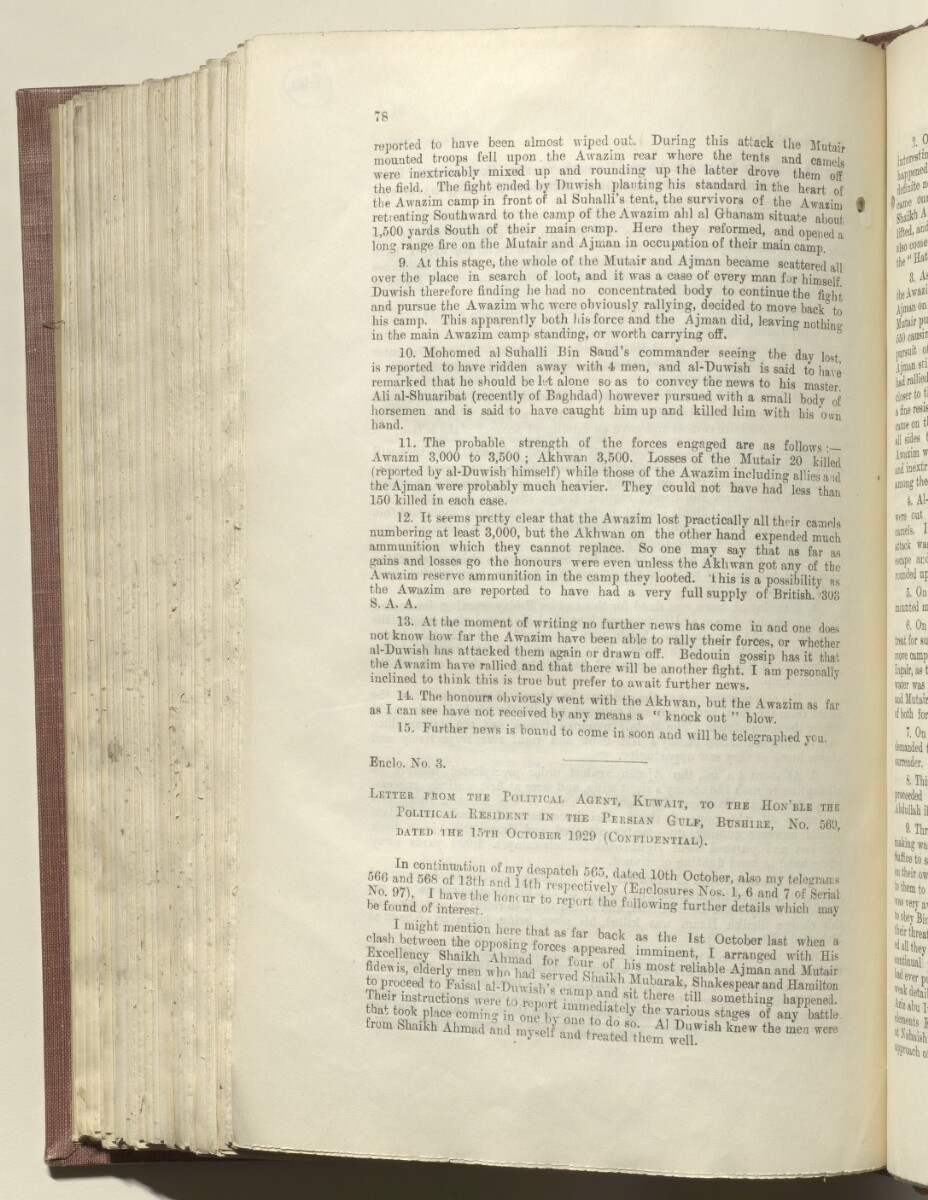
78
reported to have been almost wiped out. During this attack the Mutair
mounted troops fell upon the Awazim rear where the tents and camels
were inextricably mixed up and rounding up the latter drove them off
the field. The fight ended by Duwish planting his standard in the heart of
the Awazim camp in front of al Suhalli’s tent, the survivors of the Awazim
retreating Southward to the camp of the Awazim ahl al Ghanam situate about
1,500 yards South of their main camp. Here they reformed, and opened a
long range fire on the Mutair and Ajman in occupation of their main camp.
9. At this stage, the whole of the Mutair and Ajman became scattered all
over the place in search of loot, and it wuis a case of every man for himself
Duwish therefore finding he had no concentrated body to continue the fiaU
and pursue the Awazim whc were obviously rallying, decided to move back°to
his camp. This apparently both liis force and the Ajman did, leaving nothino-
in the main Awazim camp standing, or worth carrying off.
10. Mohomed al Suhalli Bin Sand’s commander seeing the day lost
is reported to have ridden away with 4 men, and al-Duwish is said to have
remarked that he should be let alone so as to convey the news to his master
Ali al-Shuarihat (recently of Baghdad) however pursued with a small bod? 0 f
horsemen and is said to have caught him up and killed him with his own
hand.
11. The probable
strength
of
the forces engaged are as follows
Awazim 3,000 to 3,500 ; Akhwan 3,500. Losses of the Mutair 20 killed
(reported by al-Duwish himself) while those of the Awazim including allies and
the Ajman -were probably much heavier. They could not have had” less that,
150 killed in each case.
12. It seems pretty clear that the Aw azim lost practically all their camels
numbering at least 3,000, but the Akliwum on the other hand expended much
ammunition which they cannot replace. So one may say that as far as
gains and losses go the honours w^ere even unless the Akhwan got any of the
Awazim reserve ammunition in the camp they looted. This is a"possibility as
the Awazim are reported to have had a very full supply of British ‘303
S. A. A.
13. At the moment of writing no further news has come in and one does
not know how far the Awazim have been able to rally their forces, or whether
al-Duwish has attacked them again or drawn off. Bedouin gossip has it that
the Atozhu have rallied and that there will be another fight, I am personally
inclined to think this is true hut prefer to await further news.
14. The honours obviously went with the Akhwan, but the Awazim as far
as I can see have not received by any means a “ knock out ” blow.
lo. Further news is hound to come in soon and will be telegraphed you.
Enclo. No. 3. —
No. 56 ( J,
Le tt er from the
Political Agent
A mid-ranking political representative (equivalent to a Consul) from the diplomatic corps of the Government of India or one of its subordinate provincial governments, in charge of a Political Agency.
, Kuwait, to the Hobble the
Political Lesident in the
Persian Gulf
The historical term used to describe the body of water between the Arabian Peninsula and Iran.
, Bttshiee
DATED THE 15TH OCTOBER 1929 (CONFIDENTIAL).
566 and 568 of 13th aLa^thT^peeth^ly ^ 0c ^° ber ’ also m - v telegrams
No. 97), I have the honour to rer nrt H } ? SUr f ]S os - 1 ’ 6 arid ? of Serial
he found of interest. ^ 1 tbe fullowi Dg further details which may
clash between the opposing forces f ann ^ tbe lst 0ct ober last when a
Excellency ShaikhThmad for four 1 arranged with His
fidewis, elderly men who had served qn at I ? 0s t reliable Ajman and Mutair
to proceed to Faisal al-Duwish ’s eamnT ^ ^ rabarak ’. Sha kespear and Hamilton
Their instructions were to report immedbif ^ iere ^11 something happened,
tia., took place coming in one bv one tn i C " tim various stages of any battle
Shaikh Ahmad "" “
About this item
- Content
This volume compiles printed copies of letters, telegrams, memoranda and newspaper extracts relating to Britain's involvement across the Arabian Peninsula during the period 1929-1938. Whilst the correspondence encompasses all matters concerning British interests in the region, much of it relates to Ibn Saud [‘Abd al-‘Azīz bin ‘Abd al-Raḥmān bin Fayṣal Āl Sa‘ūd] and the Kingdom of the Hejaz and Nejd (later Saudi Arabia). Matters discussed in the correspondence include the following:
- Reports of unrest in the Hejaz.
- Relations between Imam Yeha Hamid-Ud-Din [Yaḥyá Muḥammad Ḥamīd al-Dīn, Imam of Yemen] and Ibn Saud.
- Reports of raids and arms trafficking on the Transjordan Used in three contexts: the geographical region to the east of the River Jordan (literally ‘across the River Jordan’); a British protectorate (1921-46); an independent political entity (1946-49) now known as Jordan -Nejd frontier.
- Reports of the proceedings of British naval ships in the Red Sea.
- Details of the Akhwan [Ikhwan] revolt against Ibn Saud, including the movements of one of the revolt's leaders, Faisal Dawish [Fayṣal bin Sulṭān al-Dawīsh], and his surrender to the British in Kuwait.
- Relations between Kuwait and Nejd.
- Relations between Iraq and Nejd, including a proposed meeting between Ibn Saud and King Faisal [Fayṣal] of Iraq, and reports of a treaty of alliance between Iraq and Saudi Arabia.
- Objections from the Hejaz Government to Royal Air Force aircraft flying over Nejd territory.
- The purchase of arms by the Hejaz Government from Poland.
- Ibn Saud's annexation of Asir.
- The death of King Hussein [Ḥusayn bin ‘Alī al-Hāshimī].
- Harry St John Bridger Philby's conversion to Islam, his mapping of Rub-al-Khali, and his reported spreading of Saudi propaganda in the Aden Protectorate.
- The currency exchange crisis in the Hejaz-Nejd and the financial situation in the kingdom generally.
- Reports on a survey of the water and mineral content of the Hejaz coastal area.
- Relations between Soviet Russia and Saudi Arabia.
- The emigration of Jews from Yemen to Palestine, via Aden.
- British fears that Italy might harbour ambitions to annex Yemen.
- Saudi oil concessions.
- Italian-Saudi relations.
Prominent correspondents include the following: the British Agent (later His Majesty's Chargé d’Affaires) at Jeddah; His Majesty's Minister at Jeddah; the High Commissioner for Egypt; the High Commissioner for Iraq; the High Commissioner for Transjordan Used in three contexts: the geographical region to the east of the River Jordan (literally ‘across the River Jordan’); a British protectorate (1921-46); an independent political entity (1946-49) now known as Jordan ; the Political Agent A mid-ranking political representative (equivalent to a Consul) from the diplomatic corps of the Government of India or one of its subordinate provincial governments, in charge of a Political Agency. , Kuwait; the Political Resident A senior ranking political representative (equivalent to a Consul General) from the diplomatic corps of the Government of India or one of its subordinate provincial governments, in charge of a Political Residency. (later Chief Commissioner, and later still, Governor), Aden; the Political Resident A senior ranking political representative (equivalent to a Consul General) from the diplomatic corps of the Government of India or one of its subordinate provincial governments, in charge of a Political Residency. in the Persian Gulf The historical term used to describe the body of water between the Arabian Peninsula and Iran. ; His Majesty's Ambassador to Iraq; His Majesty's Ambassador to Italy; the Secretary of State for the Colonies; the Minister (and Acting Minister) for Foreign Affairs for the Kingdom of the Hejaz and Nejd (later Saudi Arabia); Ibn Saud; King Feisal of Iraq; the Prime Minister of Iraq; various officials of the Colonial Office, the Foreign Office, the Air Ministry, and the Admiralty.
The French material in the volume consists of several items of correspondence and a copy of a treaty between France and Yemen, which was signed in April 1936.
The volume includes a divider which gives a list of correspondence references contained in the volume by year. This is placed at the back of the correspondence.
- Extent and format
- 1 volume (527 folios)
- Arrangement
The papers are arranged in approximate chronological order from the rear to the front of the volume.
The items of correspondence are divided (roughly) into various sections. Each extract or item of correspondence within these sections has its own number, which is enclosed in brackets. These numbers proceed in ascending (and approximate chronological) order from left to right; however, the sections themselves proceed in reverse, from the rear to the front of the volume, in distinct groups (e.g. for 1929 numbers 1-23, which are located at folios 517-526, are followed by numbers 24-49 at folios 509-516, which are then followed by numbers 50-89 at folios 494-508, and so on).
- Physical characteristics
Foliation: the foliation sequence commences at the inside front cover with 1, and terminates at the inside back cover with 529; these numbers are written in pencil, are circled, and are located in the top right corner of the recto The front of a sheet of paper or leaf, often abbreviated to 'r'. side of each folio.
Pagination: each section of correspondence within the volume (as described in the arrangement field) has its own pagination sequence.
- Written in
- English and French in Latin script View the complete information for this record
Use and share this item
- Share this item
Coll 6/8(1) 'Printed Series: 1929 to 1938.' [482v] (969/1062), British Library: India Office Records and Private Papers, IOR/L/PS/12/2071, in Qatar Digital Library <https://www.qdl.qa/archive/81055/vdc_100061765167.0x0000aa> [accessed 20 June 2026]
https://www.qdl.qa/en/archive/81055/vdc_100061765167.0x0000aa
Copy and paste the code below into your web page where you would like to embed the image.
<meta charset="utf-8"><a href="https://www.qdl.qa/en/archive/81055/vdc_100061765167.0x0000aa">Coll 6/8(1) 'Printed Series: 1929 to 1938.' [‎482v] (969/1062)</a> <a href="https://www.qdl.qa/en/archive/81055/vdc_100061765167.0x0000aa"> <img src="https://iiif.qdl.qa/iiif/images/81055/vdc_100000000555.0x000261/IOR_L_PS_12_2071_0969.jp2/full/!280,240/0/default.jpg" alt="" /> </a>
This record has a IIIF manifest available as follows. If you have a compatible viewer you can drag the icon to load it.https://www.qdl.qa/en/iiif/81055/vdc_100000000555.0x000261/manifestOpen in Universal viewerOpen in Mirador viewerMore options for embedding images
Copyright: How to use this content
- Reference
- IOR/L/PS/12/2071
- Title
- Coll 6/8(1) 'Printed Series: 1929 to 1938.'
- Pages
- front, back, spine, edge, head, tail, front-i, 2r:5v, 6v, 8v:10r, 11r:14r, 15r:20r, 21r:21v, 22v, 24v:26v, 27v:30r, 32r:41v, 43r:46v, 48r:48v, 49v:52v, 53v, 55v:58r, 59r:60r, 61r:70r, 71v:77v, 78v:79r, 80v:81v, 82v:93v, 95r:101v, 102v:104v, 106r:108r, 109v:110v, 111v:113v, 115r:120v, 122r:123r, 124r:126v, 127v, 128v:130v, 132r, 133v:137r, 139r:154r, 155r, 156r:157v, 159r:166r, 167r, 168r:171r, 172r:174r, 175r:175v, 176v:177v, 180v:181r, 182v, 183v:184v, 187v:188r, 191r:198r, 199r:199v, 200v:201r, 202r, 203r:203v, 206r:207r, 210r:211v, 213r:220r, 223v:224v, 226r:226v, 228r, 230v:234v, 236r, 237r:252r, 253v:257v, 259r:260v, 262r:262v, 264r:268v, 269v:276r, 277v:278v, 279v:281r, 282v:285r, 287r:288r, 289r:292v, 295r:296v, 297v:307r, 308r, 309r:316v, 318r:320v, 322r, 324r:325r, 327r, 329r:331r, 332r:335r, 336r:337v, 338v:345r, 347r:348r, 350v, 353v:358v, 360r:363r, 364v:365v, 366v:371r, 372v:375r, 376v, 377v:379v, 383r:383v, 384v:385r, 387v:389r, 390r:391v, 395v:400v, 401v:412v, 414v:420r, 422r:433v, 435v:437v, 440r:447v, 449r:449v, 451v:459r, 460r:463v, 465r:468v, 469v:471r, 474r:477r, 480r:485r, 486v:492v, 494r:507r, 508v:511r, 512r:513v, 514v, 516r:518v, 520r:522r, 523r:528v, back-i
- Author
- East India Company, the Board of Control, the India Office, or other British Government Department
- Usage terms
- Open Government Licence