Overview
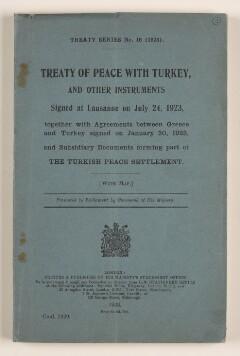
On 24 July 1923, delegates of the Allies and Associated Powers convened at the Palais de Rumine in Lausanne, Switzerland, to sign the Treaty of Peace with Turkey. Commonly referred to as the Treaty of Lausanne, it officially ended the conflict between the Allies of the First World War and the Ottoman Empire. The signatories included Britain and France, but not the United States or Soviet Union.
The conference that preceded the treaty started in November 1922 and was attended by representatives of Turkey, Britain, France, Italy, Greece, Yugoslavia, Romania, and Japan. The United States participated as an observer, and the Soviet delegation – including the Soviet Republics of Russia, Ukraine, and Georgia – took part in the discussions relating to passage through the Black Sea. There were, however, notable absences: Syrian and Palestinian delegations attempted to attend, but were excluded. No Armenian, Persian [Iranian], or Kurdish delegations were invited. Amid shifting post-war allegiances, the head of the British delegation, Secretary of State for Foreign Affairs Lord Curzon, had sought to exclude Britain’s former ally, Sharif Husayn of Mecca, from the conference. When Husayn sent his delegate anyway, Curzon refused to meet him.
Archive items in this article



Redrawing Borders and Boundaries
The Treaty of Lausanne was the last of the peace settlements that followed the end of the First World War, and is the only one still in force today. For Turkey, it marked a shift from the dictated peace of the 1920 Treaty of Sèvres, which would have reduced it to a rump of territory in Anatolia Peninsula that forms most of modern-day Turkey. . Under the leadership of Mustapha Kemal Atatürk, Turkey had contested that treaty via a series of military campaigns, forcing the Allies into fresh negotiations. Turkey emerged from the resulting Treaty of Lausanne as a sovereign state equal to the other signatories, no longer bound by earlier capitulations or legal stipulations on the treatment of foreigners. Recognition of the Republic of Turkey [officially known today as Türkiye] followed several months later.
The Treaty of Lausanne delimited new boundaries for several countries, including Bulgaria, Greece, and Turkey. In addition, under the terms of a separate convention also signed at Lausanne in January 1923, massive compulsory population exchanges took place between Greece and Turkey, based on religion and ethnicity.

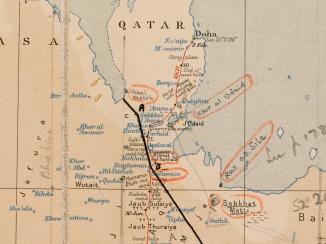
The treaty also defined Turkey’s southern border ‘from the Mediterranean to the frontier of Persia’ (Mss Eur F112/280/2, f. 11r). It thereby confirmed the cession of those territories in the southern part of the Arabian Peninsula that had previously been under Ottoman rule, including Asir, parts of Hejaz, and Yemen. Turkey’s cession meant that, in the most part, Britain led the efforts to delimit the boundaries of these territories. However, the treaty itself left many boundary issues unresolved.
The Ongoing Mosul Question
Central to the Lausanne negotiations was the question of whether Mosul should be part of Turkey or British-occupied Iraq. In November 1918, less than a month after the Armistice of Mudros, which had ostensibly brought about a ceasefire between the British and Ottoman armies, British forces raced forward to occupy Mosul. This brought the city and province (and its purportedly vast oil wealth) into British hands. The so-called Mosul question became a sticking point at Lausanne. Lord Curzon was adamant that Mosul should remain under British influence and resisted Turkish attempts to settle the matter in any other way.

This question remained unsettled until 1925, when the League of Nations ruled that Mosul should be part of British-controlled Iraq. In 1926, the League’s proposed boundary, known as the Brussels Line, was recognised by both Turkey and Britain. Nevertheless, while still a mandated territory under Britain, Iraq agreed to pay Turkey ten percent royalties on Mosul’s oil resources for the next twenty-five years.
Related Articles




Left Behind at Lausanne
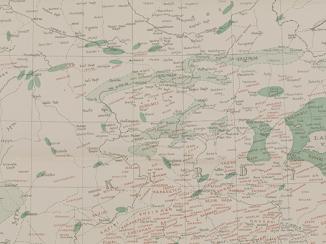
As with any treaty, there were losers as well as winners. For British imperial strategists, their job was done; as they saw it, they had achieved the best they could in difficult circumstances. For the Greeks, however, the treaty ended their irredentist dream of retaking Constantinople and created more than a million refugees. Lausanne also dashed the hopes of the Kurds. The difference is marked between the defunct Treaty of Sèvres, which explicitly envisaged areas of Kurdish autonomy and an independent state, and the Treaty of Lausanne, where any mention of a Kurdish homeland is completely absent. In addition, the Lausanne Treaty declared that ‘[f]ull and complete amnesty shall be respectively granted by the Turkish Government and by the Greek Government for all crimes or offences committed during the same period [1914-22] which were evidently connected with the political events which have taken place during that period’ (Mss Eur F112/280/2, f. 100r). This left many peoples including the Armenians, Assyrians, and Kurds feeling that their grievances and aspirations resulting from the First World War and culminating in the Treaty of Lausanne had been ignored.
Lausanne has conventionally been lauded by the founders of modern Turkey as the culmination of a victorious revival instigated by Atatürk. However, from other Turkish viewpoints it has been regarded as disastrous, and for many of the peoples of the post-Ottoman space, the consequences of the treaty still resonate painfully a century later.